Socially connected older adults had more physical and mental reserve, across five regions
Social life and healthPart of a story we are following · 4 articles · See every update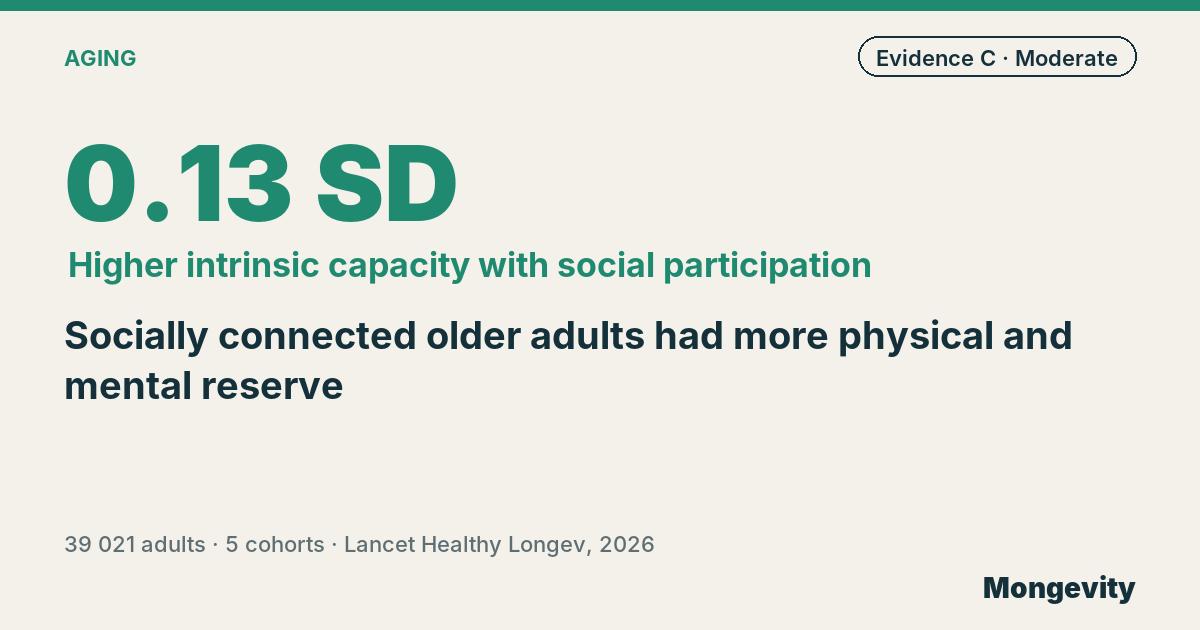
Stronger social connection was linked to higher intrinsic capacity, especially in mood and thinking, but not to slower decline, in 39 021 adults aged 50 or older in the USA, England, Europe, China and Japan, in a study published in October 2026 in The Lancet Healthy Longevity. Social life and health go together in later life.
Intrinsic capacity is the World Health Organization’s term for a person’s combined physical and mental abilities: moving, thinking, mood, hearing and vision, and overall vitality. It’s a way to measure healthy aging beyond the absence of disease.
What did the study do?
Researchers combined data from five aging studies in the USA, England, Europe and Israel, China and Japan, with 39 021 participants aged 50 or older. They scored social connection from 0 to 5, one point each for having a partner, living with others, family contact, contact with friends or relatives and taking part in social activities. They tracked intrinsic capacity for two to 12 years, depending on the study.
What did the study find about social life and health?
- Each extra point of social connection was linked to slightly higher intrinsic capacity at the start, 0.04 standard deviations.
- The links were strongest for psychological well-being (0.05) and cognition (0.03), smaller for movement (0.02) and weak for senses and vitality.
- Of the five components, taking part in social activities (0.13) and having a partner (0.06) showed the most consistent links.
- Social connection was not linked to a slower decline in intrinsic capacity over time.
Why does this matter?
The pattern held across the USA, Europe, China and Japan, suggesting it isn’t tied to one culture. Social participation, joining groups and activities, stood out more than simply living with others.
How solid is this evidence?
It’s moderate. Mongevity rates it C on our A-to-E scale: a large, carefully harmonized multinational study, but observational. The links were small, and people with better health may simply find it easier to stay socially active. The lack of a link with decline over time is an important limit.
What are the open questions?
Researchers need to test whether programs that strengthen social connection actually improve intrinsic capacity, or slow its decline.
What does this mean for you?
Look for ways to take part, not just to be around people: a club, a choir, a class, a volunteer role or a regular game night. For older relatives, helping them get to activities they enjoy can matter as much as visiting.
How do I explain this at dinner?
Across five regions of the world, older adults with more social ties, especially those who joined in activities, had better mood, thinking and mobility. But social ties didn’t seem to slow decline over the years. A good question for the table: what group or activity makes you feel most alive?
In one sentence: stronger social connection, especially social participation, was linked to higher intrinsic capacity in older adults across five regions, but not to slower decline.
Questions and answers
- What is intrinsic capacity?
- A person's combined physical and mental abilities, including movement, cognition, mood, senses and vitality.
- Is social connection linked to it?
- Yes: each extra point of social connection was linked to slightly higher intrinsic capacity (0.04 SD).
- Which kind of connection mattered most?
- Taking part in social activities (0.13 SD) and having a partner (0.06 SD).