Exercise, nutrition and a medicine check eased frailty in older heart patients
FrailtyPart of a story we are following · 3 articles · See every update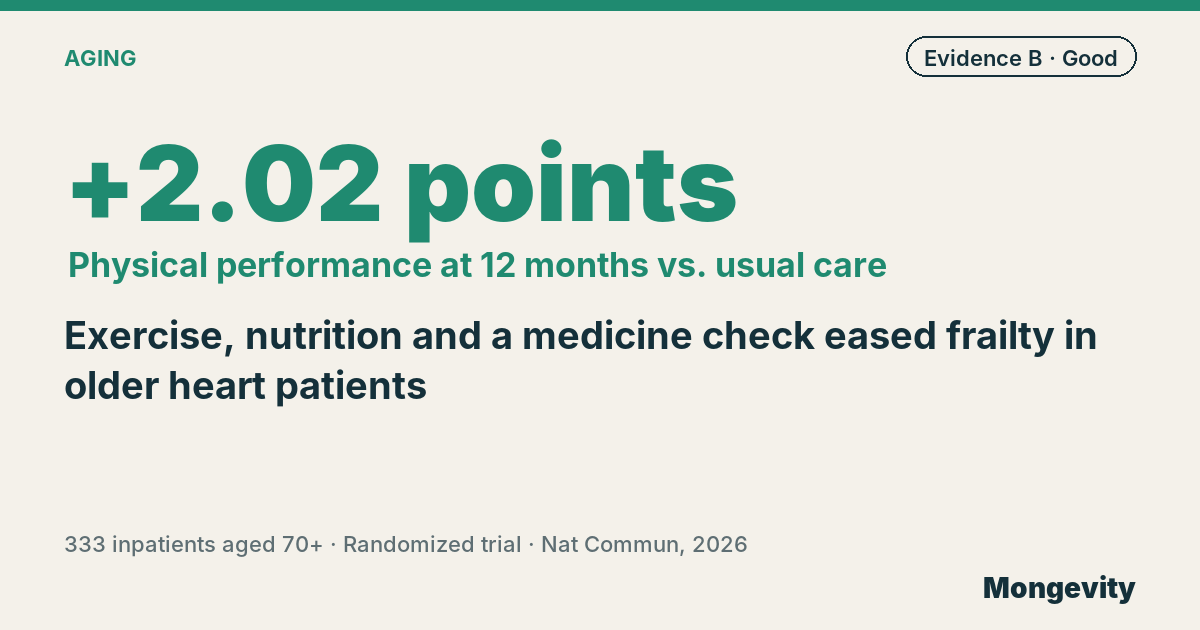
A program of rehabilitation exercise, education, nutrition advice, acupoint massage and medicine review improved frailty and physical performance at 12 months in 333 frail inpatients aged 70 or older with heart disease in Beijing, in a randomized trial published in August 2026 in Nature Communications. Frailty can be partly reversed, even starting in hospital.
Frailty is a state of reduced strength and reserve that makes older adults more vulnerable to falls, hospital stays and loss of independence. It is common in people with heart disease.
What did the trial test?
333 frail inpatients aged 70 or older with cardiovascular disease were assigned by chance to the RENAP program (166) or usual care (167). RENAP stands for rehabilitation exercises, patient education, nutritional guidance, acupoint massage and polypharmacy management, meaning a review of the many medicines older patients often take. The main outcomes were changes at 12 months in the Fried frailty score, where lower is better, and the Short Physical Performance Battery, a test of balance, walking speed and standing from a chair, where higher is better.
What did the study find about frailty?
- RENAP lowered the frailty score by 0.79 points more than usual care.
- It raised the physical performance score by 2.02 points more than usual care.
- No serious adverse events related to the program were observed.
Why does this matter?
Frailty was once seen as an inevitable part of aging. This trial adds to evidence that it can be partly reversed, even in older adults with heart disease, when several approaches are combined. A hospital stay can be a good moment to start, because patients are already in contact with the care team.
How solid is this evidence?
It’s good. Mongevity rates it B on our A-to-E scale: a randomized trial across several hospitals, with a year of follow-up and assessors who did not know the group assignment. Limits: it took place in a single city, some participants were lost to follow-up, patients knew which program they received, and it is hard to know which component helped most.
What are the open questions?
Studies in other countries and health systems still need to show whether the results hold, whether the benefit lasts beyond a year, and whether it reduces hospital readmissions or deaths.
What does this mean for you?
If an older relative with heart disease seems weaker, slower or more tired, ask the care team about frailty. Regular exercise adapted to their condition, enough protein and a review of medicines with the doctor are steps that tend to help, alone or together.
How do I explain this at dinner?
Frail older people hospitalized for heart problems got a program with exercise, education, food advice, massage and a check of their medicines. A year later they were less frail and moved better than those who got usual care. A good question for the table: when was the last time someone checked all of grandma’s pills together?
In one sentence: a multidisciplinary program started in hospital improved frailty and physical function at 12 months in frail adults aged 70 or older with cardiovascular disease.
Questions and answers
- What is frailty?
- A state of reduced strength and reserve that makes older adults more vulnerable to falls, hospital stays and loss of independence.
- What did RENAP include?
- Rehabilitation exercise, patient education, nutrition advice, acupoint massage and a review of medicines.
- How much did it help?
- It lowered the frailty score by 0.79 points and raised physical performance by 2.02 points at 12 months vs. usual care.
- Was it safe?
- No serious adverse events related to the program were observed.