Social isolation and loneliness leave different marks on the brain, a review finds
Social life and healthPart of a story we are following · 4 articles · See every update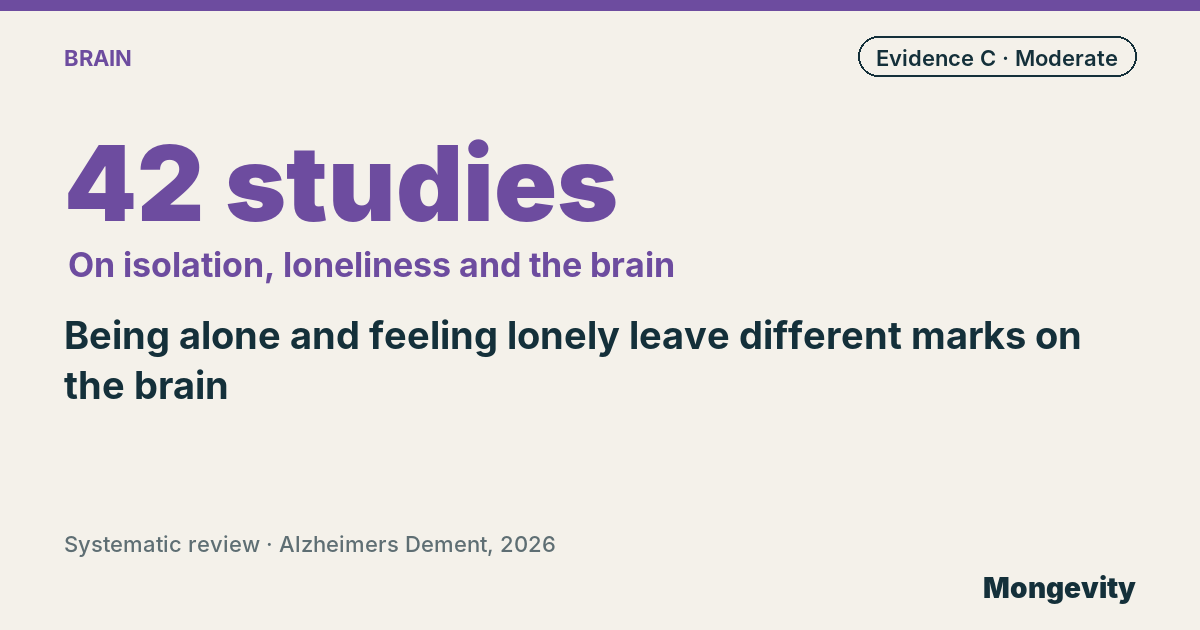
Social isolation and loneliness were linked to partly different brain regions, and both to more white matter damage and inflammation, according to a systematic review of 42 studies published in October 2026 in Alzheimer’s & Dementia. Social life and health connect through the brain.
Social isolation, having few contacts, and loneliness, feeling alone, are different things: you can be surrounded by people and feel lonely, or live alone and feel fine. Both are linked to a higher risk of dementia.
What did the study do?
Researchers identified 42 studies in middle-aged and older adults that measured social isolation or loneliness together with brain scans, markers of inflammation or markers of brain degeneration.
What did the study find about social life and health?
| Linked brain areas | |
|---|---|
| Social isolation | Mainly temporal regions, involved in memory and language |
| Loneliness | Mainly deep structures, the putamen and globus pallidus, involved in movement and reward |
| Both | Limbic regions: hippocampus, amygdala, thalamus and fusiform gyrus |
Both were also linked to more white matter damage seen on MRI, a sign of small vessel disease, and to higher C-reactive protein, a marker of inflammation. Several of these regions are vulnerable in dementia.
Why does this matter?
It suggests isolation and loneliness may affect the brain in partly different ways, which could explain why both raise dementia risk. It also supports treating them as separate targets: more contact doesn’t always cure loneliness, and the reverse.
How solid is this evidence?
It’s moderate. Mongevity rates it C on our A-to-E scale: a systematic review, but of studies that used very different methods and measures, most of them observational. The authors stress that heterogeneity limits conclusions, and links don’t prove that isolation or loneliness cause brain changes.
What are the open questions?
Researchers need consistent ways to measure isolation and loneliness, and long-term studies that show whether improving social health changes these brain markers.
What does this mean for you?
Think about both sides: how many people you see, and how connected you feel. Small steps help with each, such as a weekly call, a class or volunteering. If loneliness feels heavy or lasting, talk to a professional.
How do I explain this at dinner?
Being alone and feeling lonely aren’t the same, and studies of the brain suggest they leave partly different marks, with some overlap in memory and emotion areas. A good question for the table: when do you feel most connected?
In one sentence: a review of 42 studies found that social isolation and loneliness are linked to partly different brain regions, and both to signs of brain damage and inflammation.
Questions and answers
- Are social isolation and loneliness the same?
- No: isolation is having few contacts, loneliness is feeling alone; you can have one without the other.
- What did the brain studies show?
- Isolation was linked mainly to temporal regions, loneliness to deep structures, and both to limbic regions.
- Do they cause dementia?
- Both are linked to higher risk, but these studies can't prove cause.