Probiotics and prebiotics gave a small boost to thinking scores in older adults
The gut-brain connectionPart of a story we are following · 3 articles · See every update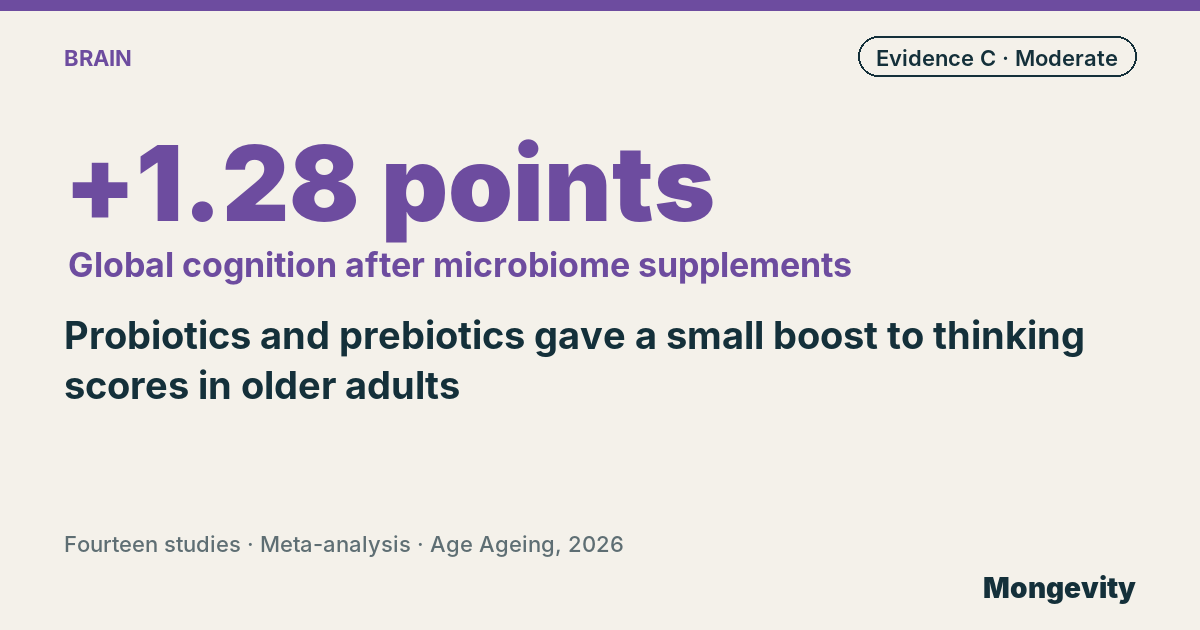
Probiotics, prebiotics and synbiotics improved global cognition scores by 1.28 points in a pooled subgroup of studies in adults aged 60 or older, according to a review of fourteen studies published in September 2026 in Age and Ageing. The gut-brain connection may offer a modest lever on thinking.
The gut and the brain talk to each other through nerves, hormones and immune signals, and the microbes living in our intestines take part in that conversation. Could changing those microbes help memory and thinking in later life?
What did the study look at?
Researchers searched four databases for studies in adults aged 60 or older that tested products designed to change the gut microbiome against placebo. These were probiotics (live beneficial bacteria), prebiotics (fibers that feed them) and synbiotics (both together). Fecal transplants were excluded. Fourteen studies qualified: 13 randomized trials and 1 other interventional study. There were 10 probiotic, 2 prebiotic and 2 synbiotic trials, in both healthy older adults and people with cognitive impairment.
What did the study find about the gut-brain connection?
- Nine studies reported significant improvement in at least one area of thinking, mainly global cognition, memory, attention and executive function.
- Pooling a subgroup of studies, global cognition scores improved by 1.28 points after supplementation.
- The products studied are generally low-risk.
Why does this matter?
Cognitive decline and dementia are among the biggest health challenges of aging. Simple, safe interventions that support the brain are valuable. This review adds to evidence that the gut may be one route, but the size of the effect is small, and it’s not yet known whether it changes daily life or the risk of dementia.
How solid is this evidence?
It’s limited. Mongevity rates it C on our A-to-E scale: a systematic review mostly of randomized trials, but few were of high quality, products and doses differed a lot, and the pooled result came from a subgroup. The authors themselves note the heterogeneity and the lack of high-quality studies.
What are the open questions?
Larger, longer trials are needed to know which strains or fibers work, at what dose, for whom, and whether the gains last and translate into a lower risk of dementia.
What does this mean for you?
Rather than relying on a supplement, feed your gut microbes with food: vegetables, fruit, legumes, whole grains, nuts and fermented foods such as yogurt or kefir. Combined with physical activity, good sleep and social contact, that is a solid strategy for brain health. If you consider a probiotic, discuss it with your doctor.
How do I explain this at dinner?
Researchers pooled studies giving older adults good bacteria or the fibers that feed them. Thinking test scores rose a little, but the studies were small and different from each other. A good question for the table: what fermented foods do we eat at home?
In one sentence: in fourteen studies of adults aged 60 or older, gut microbiome modulation with probiotics, prebiotics or synbiotics was linked to a small improvement in global cognition, with limited evidence quality.
Questions and answers
- What are probiotics, prebiotics and synbiotics?
- Live beneficial bacteria, fibers that feed them, and products combining both.
- Did they improve thinking?
- In a pooled subgroup, global cognition scores rose by 1.28 points.
- Do they prevent dementia?
- Not shown. The studies measured test scores over short periods.
- Should I take a probiotic?
- Food-based fiber and fermented foods are a good start; discuss supplements with your doctor.