Clot removal 24 to 72 hours after stroke improved recovery but raised bleeding and deaths
StrokePart of a story we are following · 3 articles · See every update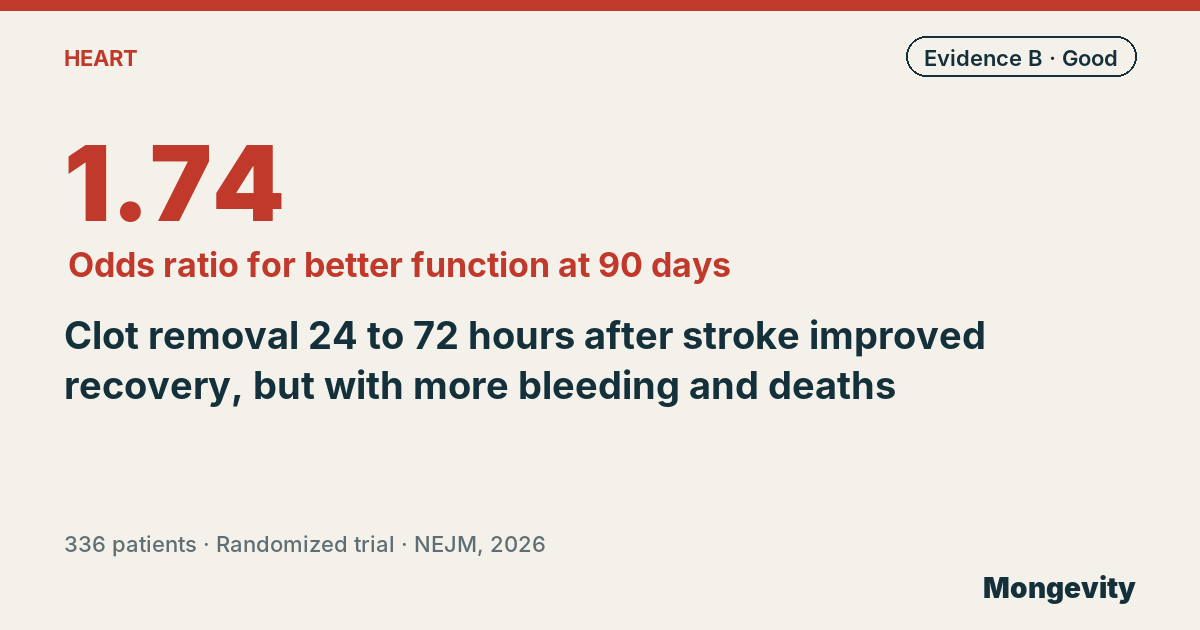
Removing the clot 24 to 72 hours after a large-artery stroke improved function at 90 days, but brain bleeding (4.8% vs. none) and deaths (6.0% vs. 1.8%) were higher, in the LATE-MT trial in China published Oct. 23, 2026, in New England Journal of Medicine. The window for stroke treatment may be wider than thought, at a cost.
For a stroke caused by a blocked large brain artery, removing the clot works best when done quickly. Over the years, the time window has been stretched to 24 hours for people whose scans show brain tissue that can still be saved.
What did the trial test?
At comprehensive stroke centers in China, 336 patients with a stroke from a large blocked artery in the front of the brain, and scans showing tissue that could still be saved, were assigned by chance, 168 to each group: clot removal plus standard care, or standard care alone. The median time from the start of symptoms, or from when the person was last seen well, to randomization was 38.5 hours. Doctors who judged the results didn’t know the treatment.
What did the study find about stroke?
Clot removal led to better scores on the modified Rankin scale, which measures disability, at 90 days. The common odds ratio for a better outcome was 1.74.
| Clot removal + standard care | Standard care | |
|---|---|---|
| Symptomatic brain bleeding | 4.8% | None |
| Death within 90 days | 6.0% | 1.8% |
How do I weigh benefit vs. risk?
That’s the core of this trial. More patients ended up with less disability, but more also had a brain bleed or died. For each person, doctors and families will have to weigh how much brain is still at risk against these dangers. Specialists will also be looking at which patients gained the most.
How solid is this evidence?
It’s good. Mongevity rates it B on our A-to-E scale: a randomized trial with blinded assessment of results. Limits: treatment was open-label, it was done only in China in specialized centers, and the risks were clearly higher with the procedure.
What does this mean for you?
Stroke treatment is still about speed: the earlier, the better. Learn the signs, a drooping face, arm weakness and slurred speech, and call emergency services at once. Don’t wait to see whether symptoms pass. Even if time has passed, going to the hospital is still worth it.
How do I explain this at dinner?
Doctors usually pull out stroke clots within the first day. A trial in China tried doing it up to three days later, in patients whose scans showed brain that could still be saved. More people recovered better, but more also bled or died. A good question for the table: how would you weigh that trade-off?
In one sentence: clot removal 24 to 72 hours after a large-artery stroke improved recovery, but with more brain bleeding and deaths.
Questions and answers
- Can a stroke clot be removed after 24 hours?
- In this trial, removal at 24 to 72 hours improved function at 90 days in patients with salvageable tissue.
- What were the risks?
- Symptomatic brain bleeding was 4.8% vs. none, and deaths at 90 days were 6.0% vs. 1.8%.
- Should I wait if symptoms are mild?
- No: call emergency services at once; the earlier treatment starts, the better.