A wearable diuretic pump let heart failure patients go home days earlier
Heart failurePart of a story we are following · 4 articles · See every update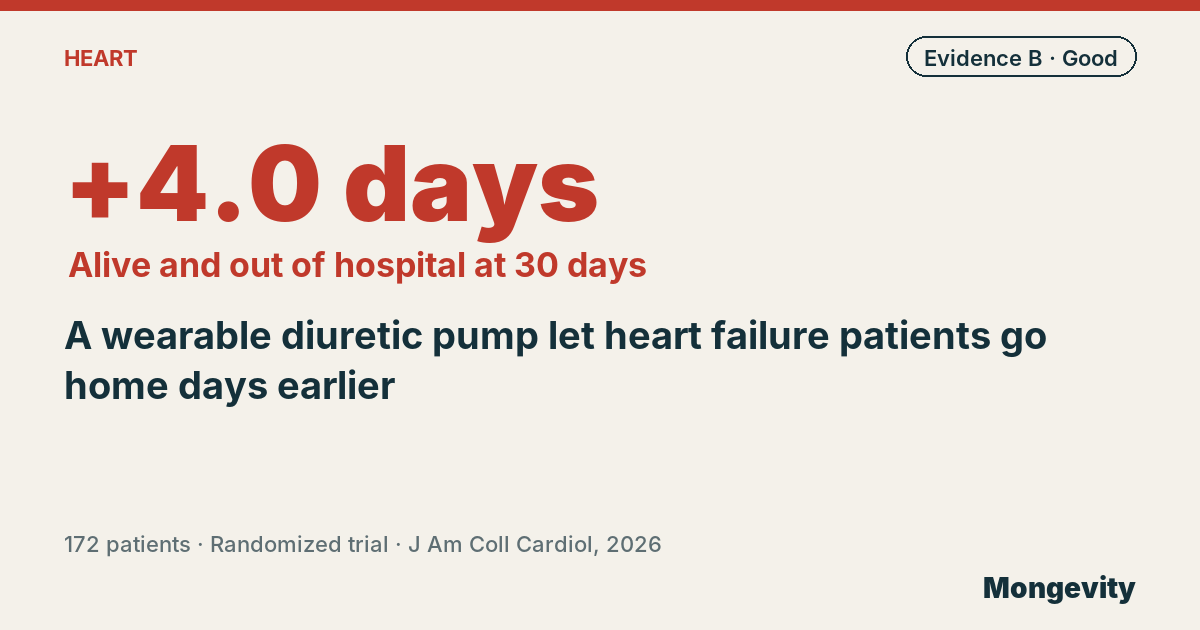
Sending heart failure patients home early with a wearable furosemide pump added 4.0 days alive and out of hospital at 30 days, in the SUBCUT-HF II trial in the UK published Oct. 13, 2026, in Journal of the American College of Cardiology. Heart failure readmissions were more common, 14% vs. 6%.
When heart failure gets worse, fluid builds up in the lungs and legs. Patients are usually admitted to the hospital for days of intravenous diuretics, drugs that help the body get rid of extra fluid.
What did the trial test?
At several hospitals in the United Kingdom, 172 patients hospitalized for heart failure who still needed injected diuretics were assigned by chance to an early discharge strategy (92) or usual care (80). The early discharge group went home with a wearable minipump that delivers furosemide under the skin, with a check-up every 3 days while on it. Both groups had a clinic review at 2 weeks. The main goal was days alive and out of hospital over 30 days.
What did the study find about heart failure?
- Early discharge added 4.0 days alive and out of hospital at 30 days.
- The first hospital stay was shorter by an average of 5.5 days.
- The benefit held at 60 days, with 4.2 more days alive and out of hospital.
- Heart failure readmissions were more common with early discharge: 14% vs. 6%.
- Serious adverse events were similar: 25% vs. 23%.
- Problems with the device occurred in 3% of pump placements, none serious.
- 4.2 more days alive and out of hospital at 60 days
- Serious adverse events similar: 25% vs. 23%
- Heart failure readmissions 14% vs. 6%
- Device problems in 3% of pump placements
Why does this matter?
Hospital stays are costly, tiring and carry risks such as infections and loss of strength, especially for older patients. Getting treatment at home can be more comfortable and free up hospital beds, as long as patients are closely followed.
How solid is this evidence?
It’s good. Mongevity rates it B on our A-to-E scale: a multicenter randomized trial with a clear main result. Limits: it was open-label, relatively small, done in one country’s health system, and the higher readmission rate needs watching in larger trials.
What are the open questions?
Larger trials are needed to confirm the benefit, understand the extra readmissions and see whether this approach works in other health systems.
What does this mean for you?
If you or an older relative has heart failure, weigh yourself every morning, watch for swelling or breathlessness, and know whom to call if symptoms worsen. If hospitalized, ask whether home-based treatment options exist and what follow-up they involve.
How do I explain this at dinner?
People with heart failure often spend days in hospital getting fluid pills through a drip. In a UK trial, some went home early wearing a small pump that delivers the medicine under the skin, and they spent more days at home overall. A good question for the table: where would you rather recover, at home or in hospital?
In one sentence: an early discharge strategy with a wearable under-the-skin furosemide pump gave heart failure patients more days alive and out of hospital, with more readmissions to watch.
Questions and answers
- What is subcutaneous furosemide?
- A diuretic given under the skin, here by a small wearable pump, instead of through a vein.
- Did early discharge help?
- Yes: it added 4.0 days alive and out of hospital at 30 days.
- Were there downsides?
- Heart failure readmissions were more frequent: 14% vs. 6%.