Fat around the heart may drive one form of heart failure, and a drug may block it
Heart failurePart of a story we are following · 4 articles · See every update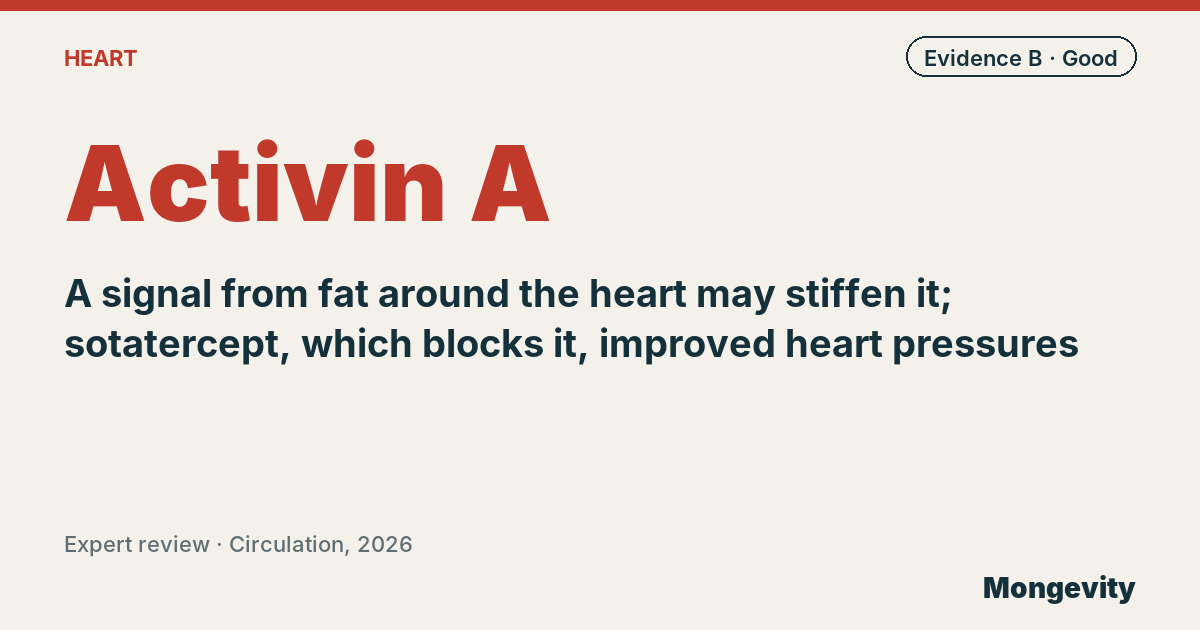
Activin A released by fat around the heart may drive stiffness and fibrosis in one form of heart failure, and sotatercept, which blocks this signal, improved heart pressures in the CADENCE trial, according to a review published Oct. 26, 2026, in Circulation. It points to a new way to treat heart failure with pulmonary hypertension.
Heart failure with preserved ejection fraction (HFpEF) is common in older adults, especially those with obesity. The heart pumps normally but is stiff and fills poorly. Some patients also develop high pressure in the lung vessels, a combination that’s hard to treat.
What does the review propose?
- Fat around the heart matters. Epicardial fat sits right next to the left atrium and the lung veins. When it expands, it releases inflammatory substances.
- Activin A is a key signal. The best known of these, activin A, causes fibrosis, stiffness and aging of heart cells through activin type II receptors.
- Patients show the pattern. Circulating activin A is higher in people with HFpEF who have enlarged left atria, high lung vein pressure and stiffer lung vessels.
- Blocking it helps in models. In experimental models of obesity-related disease, drugs that trap activin ligands eased HFpEF and its lung and heart abnormalities.
What about sotatercept?
Sotatercept is a drug that traps activin signals and is already used for pulmonary arterial hypertension. In the CADENCE trial, it lowered pulmonary artery wedge pressure, a measure of left heart filling pressure, and reduced left atrial size in patients with this combined condition. According to the authors, those effects couldn’t be explained just by lower resistance in the lung vessels. A phase 3 outcomes trial is now testing whether it slows the disease.
Why does this matter for heart failure?
HFpEF has few effective treatments. If fat around the heart drives part of the problem through a specific signal, it opens a new target, and connects HFpEF with obesity in a concrete way.
How solid is this evidence?
It’s good as a synthesis. Mongevity rates it B on our A-to-E scale. The argument combines laboratory, animal and human data and a positive mid-stage trial, but it’s a review written to support a hypothesis. Whether sotatercept improves symptoms, hospitalizations or survival in this condition isn’t known yet.
What does this mean for you?
If you have HFpEF, especially with obesity, weight loss, blood pressure control and approved heart failure medicines remain the foundation. Ask your cardiologist whether you have pulmonary hypertension and whether clinical trials, such as those of sotatercept, could apply to you.
How do I explain this at dinner?
Some fat sits right on the heart, like a coat. Scientists think it sends out a signal that makes the heart stiff, and a medicine that blocks that signal helped in early tests. A good question for the table: why might where fat sits matter as much as how much there is?
In one sentence: a review suggests that a signal from fat around the heart drives a hard-to-treat form of heart failure, and that blocking it with sotatercept could help.
Questions and answers
- What is HFpEF?
- Heart failure with preserved ejection fraction: the heart pumps normally but is stiff and fills poorly.
- What is activin A?
- An inflammatory signal released by expanded fat around the heart that can cause stiffness and fibrosis.
- Does sotatercept work for this?
- In the CADENCE trial it lowered left heart filling pressure and left atrial size; a phase 3 outcomes trial is ongoing.