With heart failure and kidney disease, open valve surgery was linked to better survival
Heart valvesPart of a story we are following · 3 articles · See every update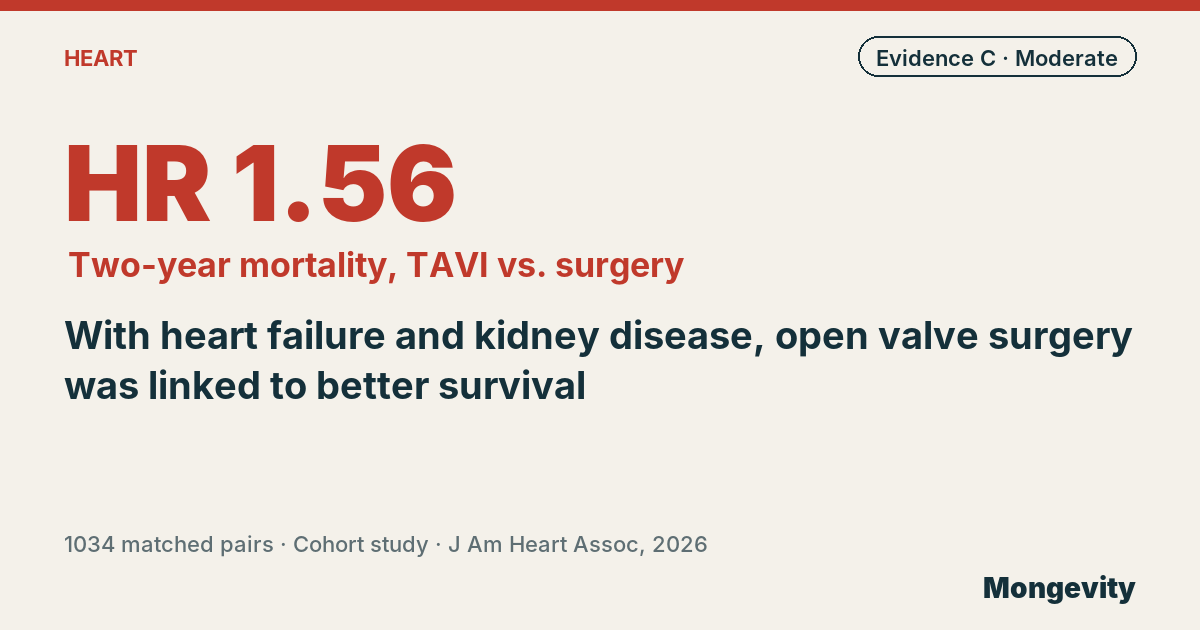
Catheter valve replacement (TAVI) was linked to higher two-year mortality than open surgery (hazard ratio 1.56) but to less acute kidney injury (0.69) in 1034 matched pairs of adults with heart failure and chronic kidney disease, in a study published Sept. 18, 2026, in Journal of the American Heart Association. Choosing how to replace heart valves involves real trade-offs.
A narrowed aortic valve can be replaced in two ways: open-heart surgery (surgical aortic valve replacement, SAVR) or a catheter procedure through a blood vessel (transcatheter aortic valve implantation, TAVI). TAVI is less invasive and has become very common. But for patients who have both heart failure and chronic kidney disease, it’s unclear which is better.
What did the study look at?
Researchers used a global network of health records to find adults with heart failure and chronic kidney disease who had TAVI or SAVR between 2020 and 2025. Before matching, 9575 had TAVI and 1233 had surgery. To make the groups comparable, they matched patients on 21 characteristics, ending with 1034 patients in each group, and followed them for 2 years.
What did the study find about heart valves?
- TAVI was linked to higher mortality than surgery (hazard ratio 1.56).
- TAVI was linked to less acute kidney injury (hazard ratio 0.69).
- Risks of heart attack, ischemic stroke and hospitalization were similar.
- Results were consistent across different analysis methods.
Why does this matter?
The choice between TAVI and surgery depends on age, frailty and other conditions. This study suggests a real trade-off in patients with failing hearts and kidneys: surgery may offer better survival, while TAVI spares the kidneys. It highlights the value of a heart team weighing each patient’s situation.
How solid is this evidence?
It’s moderate. Mongevity rates it C on our A-to-E scale: a large observational study with careful matching. Limits: patients weren’t assigned at random, and doctors often choose TAVI for frailer people, a difference that matching on recorded data may not fully remove. That could make TAVI look worse than it is.
What are the open questions?
Randomized trials in patients with both heart failure and kidney disease would help settle which procedure is best for whom.
What does this mean for you?
If you or a relative need an aortic valve replacement and have heart failure or kidney disease, ask the heart team to explain the pros and cons of each option for your case, including kidney protection, recovery time and long-term survival.
How do I explain this at dinner?
There are two ways to replace a stiff heart valve: open surgery or a catheter through an artery. In people with weak hearts and kidneys, those who had surgery lived longer on average, but the catheter was gentler on the kidneys. A good question for the table: would you rather a faster recovery or a longer-term edge?
In one sentence: in patients with heart failure and chronic kidney disease, surgical aortic valve replacement was linked to lower mortality, while TAVI was linked to less acute kidney injury.
Questions and answers
- What are TAVI and SAVR?
- Catheter-based and open-surgery ways of replacing the aortic valve.
- Which had better survival?
- Surgery; TAVI was linked to higher mortality (hazard ratio 1.56).
- Did TAVI have any advantage?
- Less acute kidney injury (hazard ratio 0.69).
- Does this mean surgery is better for everyone?
- No. The choice depends on each patient; frailer people often get TAVI.