Repairing a leaky heart valve early, before symptoms, was linked to longer survival
Heart valvesPart of a story we are following · 3 articles · See every update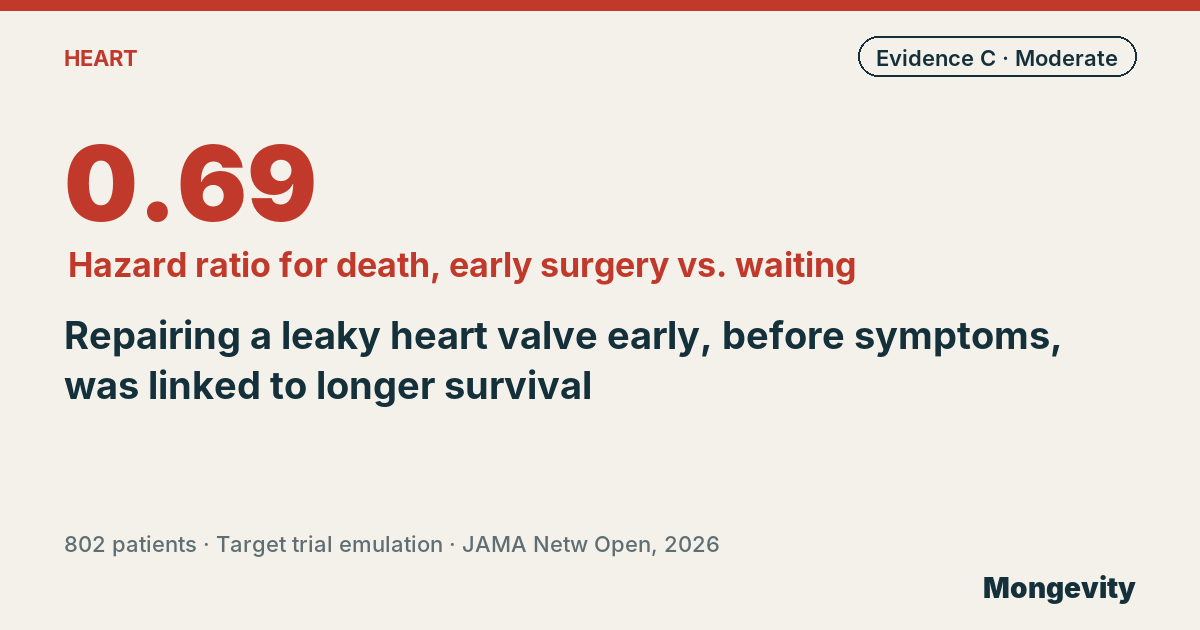
Surgery within 6 months of diagnosis was linked to lower mortality than watchful waiting (hazard ratio 0.69) in 802 people with severe but symptom-free mitral valve leakage in Korea, in a study published Oct. 1, 2026, in JAMA Network Open. For leaky heart valves, acting early may pay off.
The mitral valve sits between the left chambers of the heart. When it doesn’t close properly, blood leaks backward, a condition called mitral regurgitation. When the leak is severe, surgery to repair or replace the valve is recommended once symptoms appear. But for people with a severe leak and no symptoms, doctors debate whether to operate early or watch and wait.
What did the study do?
Researchers used a valve registry from 3 tertiary hospitals in South Korea between 2000 and 2022, with 802 people who had severe primary mitral regurgitation without symptoms. Using a method that mimics a randomized trial with registry data, they compared early surgery, within 6 months of diagnosis (344 people), with watchful waiting (458 people). The median follow-up was 7.4 years.
What did the study find about heart valves?
- There were 27 deaths in the early surgery group and 103 in the watchful waiting group.
- Early surgery was linked to lower mortality, with a hazard ratio of 0.69.
- At 5 years, early surgery was linked to an average gain of 66 days of life, and the benefit persisted up to 15 years.
- Similar results were seen in people whose heart muscle was still working well and in those with degenerative valve disease.
Why does this matter?
Waiting for symptoms can mean the heart has already been strained. These results support considering earlier surgery in suitable patients, particularly where valve repair can be done with very good results.
How solid is this evidence?
It’s moderate. Mongevity rates it C on our A-to-E scale: a careful analysis with long follow-up that emulates a trial, but still observational and from expert centers in one country. People chosen for early surgery may have been healthier, and results depend on surgical expertise.
What are the open questions?
Randomized trials are still lacking. They would show whether early surgery truly saves lives and which patients benefit most.
What does this mean for you?
If you’ve been told you have a heart murmur or a leaky mitral valve, ask how severe it is and how often it should be checked with an echocardiogram. If it’s severe, ask whether early repair is an option and where it can be done by an experienced team.
How do I explain this at dinner?
Some people have a badly leaking heart valve but feel fine. In a Korean study, those who had it fixed within six months of diagnosis lived longer than those who waited for symptoms. A good question for the table: when is it better not to wait?
In one sentence: early surgery for severe, symptom-free mitral regurgitation was linked to longer survival than watchful waiting, supporting earlier repair in suitable patients.
Questions and answers
- What is mitral regurgitation?
- A leak in the mitral valve that lets blood flow backward in the heart.
- Was early surgery linked to longer survival?
- Yes: the hazard ratio for death was 0.69 vs. watchful waiting.
- Is this proven?
- No: it's observational; randomized trials are still lacking.