Before a catheter valve, skipping stents was safe except when artery disease was complex
Heart valvesPart of a story we are following · 3 articles · See every update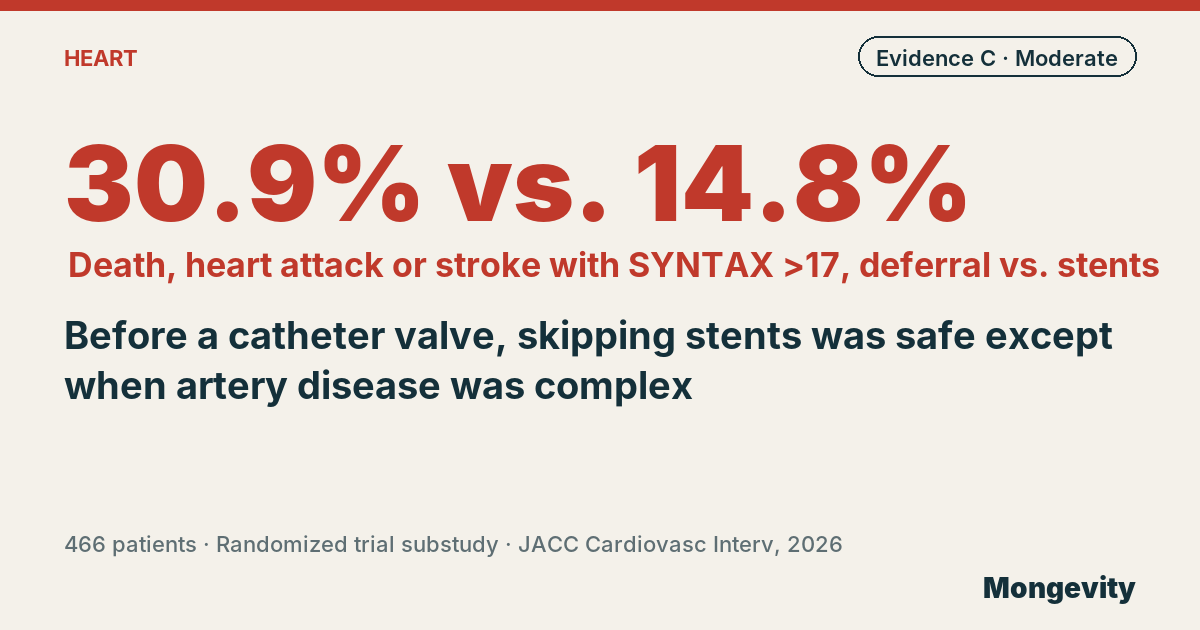
Delaying stents before a catheter valve replacement reduced bleeding at every level of coronary disease in 466 patients, but with complex disease it was linked to more deaths, heart attacks and strokes, 30.9% vs. 14.8%, in a PRO-TAVI substudy published Oct. 12, 2026, in JACC: Cardiovascular Interventions. The extent of artery disease should guide care around heart valves.
About one-half of people who need a transcatheter aortic valve replacement (TAVR) also have narrowed heart arteries. Should those arteries be opened with stents first? The PRO-TAVI trial recently showed that skipping stents before TAVR was safe at one year overall.
What did the study look at?
The analysis included 466 patients from PRO-TAVI, who had been assigned by chance to stents before TAVR or to deferring stents. Researchers calculated the SYNTAX score, a measure of how complex and widespread the artery disease is, from each patient’s angiogram, and compared outcomes across score levels. The main outcome was a combination of death, heart attack, stroke and major bleeding at one year.
What did the study find about heart valves?
- The main combined outcome did not differ between strategies at any SYNTAX level.
- Bleeding was less frequent with deferral across all levels.
- In patients with a SYNTAX score above 17, the combination of death, heart attack and stroke occurred more often with deferral: 30.9% vs. 14.8% (hazard ratio 2.43).
- That difference was mainly driven by deaths and strokes.
Why does this matter?
Placing stents adds a procedure and requires extra blood thinners, which increase bleeding in older patients. This study supports skipping stents for most, while suggesting that people with complex artery disease may benefit from treating the arteries first.
How solid is this evidence?
It’s moderate. Mongevity rates it C on our A-to-E scale: it comes from a randomized trial, but this is a post hoc subgroup analysis. Limits: the trial wasn’t designed to test differences by SYNTAX score, subgroups were small, and the authors say the findings need confirmation in dedicated trials.
What are the open questions?
Randomized trials focused on patients with complex coronary disease are needed to confirm whether stents before TAVR improve their outcomes.
What does this mean for you?
If you need TAVR and also have narrowed heart arteries, ask your heart team how extensive your artery disease is and whether treating it first makes sense for you. The decision balances bleeding risk against the risk of heart events.
How do I explain this at dinner?
Many people getting a new heart valve through a catheter also have clogged heart arteries. Skipping the stents caused less bleeding and was fine for most, but people with the most complex blockages had more serious problems without them. A good question for the table: when is doing less the better option in medicine?
In one sentence: before TAVR, deferring PCI reduced bleeding and appeared safe overall, but in complex coronary disease (SYNTAX score above 17) it was linked to more ischemic events.
Questions and answers
- What is the SYNTAX score?
- A measure of how complex and widespread coronary artery disease is, calculated from an angiogram.
- Was skipping stents safe?
- For the main outcome, yes at every level, with less bleeding.
- What about complex disease?
- With a SYNTAX score above 17, death, heart attack and stroke were more frequent with deferral: 30.9% vs. 14.8%.
- Is this definitive?
- No. It's a post hoc analysis that needs confirmation.