Cold days, not hot ones, were linked to more heart failure hospital stays in older adults
Heart failurePart of a story we are following · 4 articles · See every update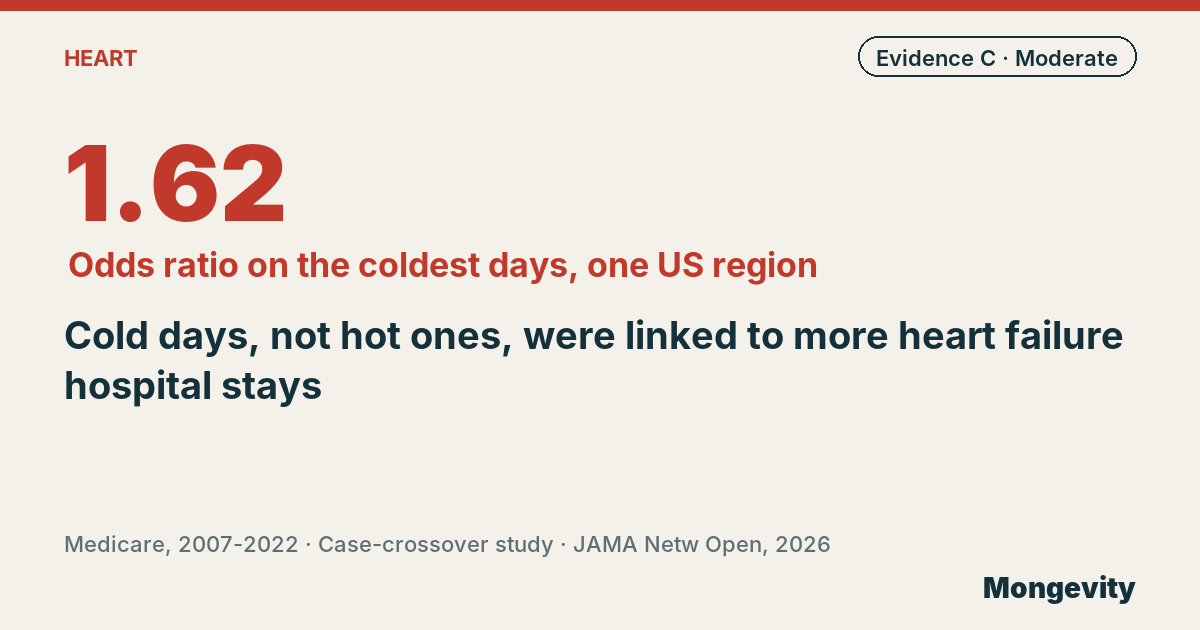
Colder days were linked to more heart failure hospitalizations in US adults 65 and older, while hot days were not, in a nationwide Medicare study covering 2007 to 2022, published Oct. 1, 2026, in JAMA Network Open. Keeping warm may matter for people with heart failure.
Heart failure means the heart can’t pump as well as it should, and it’s one of the most common reasons older adults are hospitalized. Extreme temperatures are known to raise deaths from heart disease, both in heat and in cold. But what about hospital stays for heart failure in particular?
What did the study do?
Researchers used Medicare records of adults 65 and older who were hospitalized for heart failure through the emergency department between 2007 and 2022. Each person’s hospitalization day was compared with other days for the same person, matched by day of the week and month, so each patient served as their own comparison. Daily temperature was linked to each person’s zip code. The average age was 78.0 years, and 60.3% were women. Days at 75 °F (≈24 °C) served as the reference.
What did the study find about heart failure?
Colder temperatures were linked to more heart failure hospitalizations nationwide. The strongest links, on the coldest days for each region, were:
Temperatures above 75 °F were not linked to more heart failure hospitalizations. For cold, the effect built up over about two weeks after exposure.
Why does this matter?
Heat waves get most of the attention in climate and health planning. This study suggests that, for heart failure in older adults, cold is the bigger concern, and that the risk differs by region. Interestingly, some of the strongest links were in milder regions, where homes and habits may be less prepared for cold snaps.
How solid is this evidence?
It’s moderate. Mongevity rates it C on our A-to-E scale: a very large study with a design that compares each person with themselves, which removes many differences between people. But it’s observational, it relied on billing codes and it can’t say exactly why cold raises risk.
What does this mean for you?
If you or an older relative has heart failure, take cold spells seriously: keep the home warm, dress in layers, watch for faster weight gain, swelling or shortness of breath, and keep taking medicines as prescribed. Don’t wait to call the doctor if symptoms get worse.
How do I explain this at dinner?
We worry about heat waves, but for older adults with weak hearts, cold days were linked to more hospital stays, not hot ones. The risk built up over the following two weeks. A good question for the table: how warm do you keep the home of the oldest person you know?
In one sentence: in US adults 65 and older, cold temperatures, not hot ones, were linked to more heart failure hospitalizations, with differences by region.
Questions and answers
- Does cold weather affect heart failure?
- In this study, colder days were linked to more heart failure hospitalizations in adults 65 and older.
- What about heat?
- Temperatures above 75 °F were not linked to more heart failure hospitalizations.
- Does it differ by region?
- Yes: the strongest link was in the West North Central region, with an odds ratio of 1.62.