Levodopa didn’t help movement recover after stroke, a Cochrane review finds
StrokePart of a story we are following · 3 articles · See every update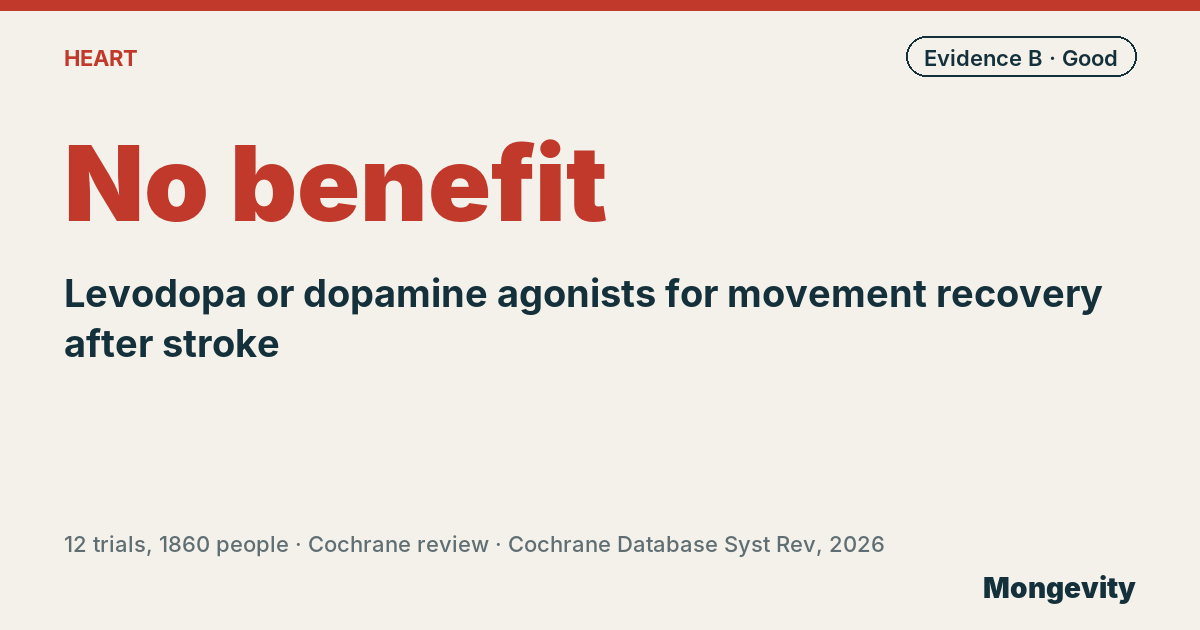
Levodopa and dopamine agonists didn’t improve motor function after stroke, according to a Cochrane review of 12 randomized trials with 1860 people from Europe, the USA and Asia, published Oct. 29, 2026, in Cochrane Database of Systematic Reviews. Serious side effects were similar with or without the drugs.
After a stroke, many people lose strength or control in an arm or leg, and rehabilitation is the main way to recover. For years, researchers have wondered whether levodopa, a drug used for Parkinson’s disease, could boost that recovery by helping the brain rewire.
Based on the available data, levodopa and similar drugs didn’t improve movement after stroke.
What did the review include?
12 randomized trials with 1860 participants, run in Europe, the USA and Asia and published between 2001 and 2025. Eleven tested levodopa and one tested ropinirole, a dopamine agonist. In each trial, both groups received the same rehabilitation, so the drug was the only difference.
What did the study find about stroke?
| Outcome | Result | Certainty |
|---|---|---|
| Motor function (scores) | no difference | very low |
| Favorable motor outcome | no difference | low |
| Serious adverse events | no notable difference | low |
When the authors looked only at the two trials with the lowest risk of bias, which included most of the participants, the result was clearly no difference between groups. None of the other outcomes, such as disability or quality of life, showed notable differences.
Why does this matter?
Recovering movement is one of the biggest concerns after a stroke. A pill that speeds it up would be very valuable, but adding a drug that doesn’t work exposes people to cost and side effects without benefit. This review helps doctors and families focus on what does help: early, intensive rehabilitation.
How solid is this evidence?
It’s good for a negative answer. Mongevity rates it B on our A-to-E scale. The two best-quality trials, which included most patients, agreed on no effect. But overall certainty was low, the trials differed a lot, and some were small, so future research in specific groups could still change the picture.
What does this mean for you?
If you or someone close to you is recovering from a stroke, ask about rehabilitation: physical, occupational and speech therapy, how often, and for how long. Levodopa isn’t recommended for this purpose based on current evidence.
How do I explain this at dinner?
After a stroke, the brain has to relearn how to move the body. Doctors hoped a medicine could speed that up, but when they checked all the studies, it didn’t. Practice and therapy are still the main way. A good question for the table: what’s something you got better at just by practicing?
In one sentence: a Cochrane review found no evidence that levodopa or dopamine agonists improve movement recovery after stroke.
Questions and answers
- Does levodopa help recovery after stroke?
- According to this Cochrane review of 12 trials, there's no evidence that it improves motor function.
- Is it harmful?
- Serious adverse events were similar with and without the drug, with low-certainty evidence.
- What does help after a stroke?
- Rehabilitation remains the main way to recover movement; ask the care team about therapy intensity and duration.