New heart-stent centers saved lives where none existed, but not where they already did
Stents and blocked heart arteriesPart of a story we are following · 3 articles · See every update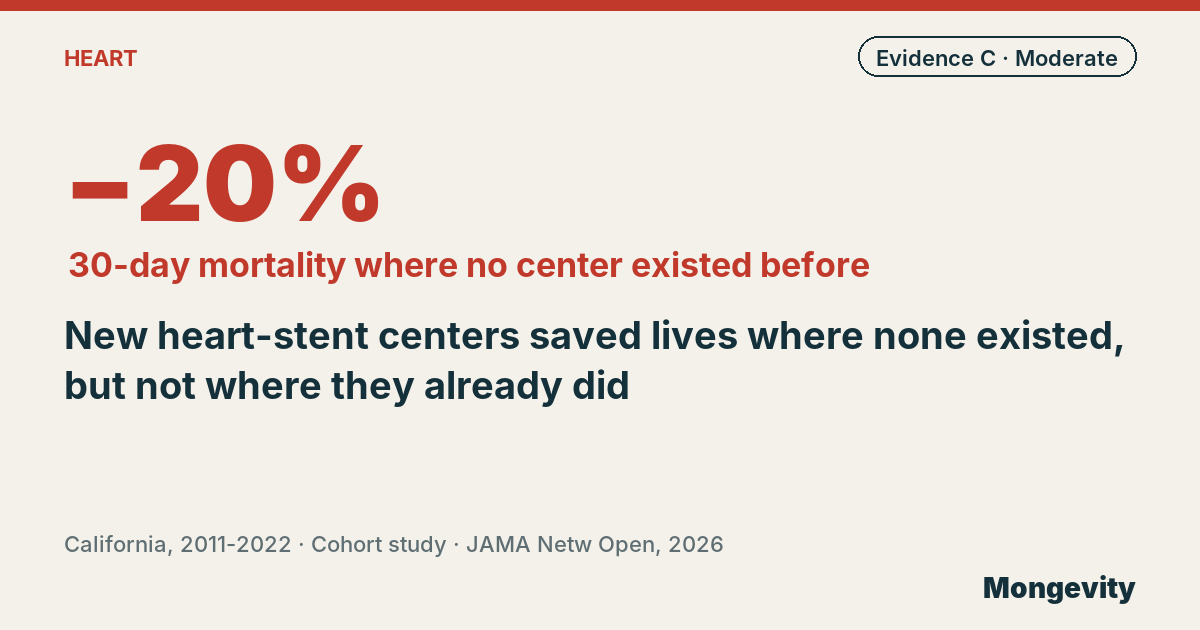
Opening a hospital able to unblock heart arteries with stents within 30 minutes of a California community without one was linked to 20% lower 30-day mortality after a heart attack, in a study published Oct. 1, 2026, in JAMA Network Open. In areas already served, new heart stent centers didn’t change mortality.
During a heart attack, quickly reopening the blocked artery, usually with a balloon and a stent in a procedure called percutaneous coronary intervention (PCI), saves heart muscle and lives. Not every hospital can do it.
What did the study look at?
Researchers used California hospital data from 2011 to 2022 on adults hospitalized for a heart attack. Communities were grouped by whether, in 2011, they had a PCI-capable hospital within a 30-minute drive. They then looked at what happened when a new one opened nearby. 85% of patients lived in communities that already had access, and 15% in communities that didn’t.
What did the study find about heart stents?
- In communities without prior access, a new center was linked to a 30.0 percentage point increase in admission to PCI-capable hospitals and a 5.1 point increase in receiving PCI.
- Mortality fell by 1.8 points at 30 days and 2.8 points at one year.
- In relative terms, that meant 53% more access to these hospitals, 16% more PCI and 20% and 15% fewer deaths at 30 days and one year.
- In communities that already had access, gains were small (1.5 points more admissions, 1.0 point more PCI) and mortality did not change.
Why does this matter?
New heart centers are expensive, and they tend to open where others already exist. This study suggests that the benefit for patients is concentrated in places without access. Health planners can use this to put new centers where they will save the most lives.
How solid is this evidence?
It’s moderate. Mongevity rates it C on our A-to-E scale: a very large observational study with methods that compare communities over time. Limits: openings were not random, other changes may have happened at the same time, and the data come from one US state.
What are the open questions?
It would help to know whether the same pattern holds in rural areas of other states and countries, and how ambulance systems that bypass smaller hospitals compare with building new centers.
What does this mean for you?
Know the signs of a heart attack: chest pain or pressure, pain spreading to the arm, jaw or back, shortness of breath, cold sweat or nausea. Call emergency services right away rather than driving yourself: ambulances can alert the hospital and take you to a center that can open the artery.
How do I explain this at dinner?
When a hospital that can unblock heart arteries opened near towns that didn’t have one, fewer people died after a heart attack. When one opened where there already was another, nothing changed for survival. A good question for the table: do you know the nearest hospital that treats heart attacks?
In one sentence: in California, new PCI-capable hospitals were linked to large gains in treatment and lower mortality after a heart attack in communities without prior access, but not in already served areas.
Questions and answers
- What is PCI?
- A procedure that reopens a blocked heart artery with a balloon and usually a stent.
- Did new centers save lives?
- In communities without prior access, 30-day mortality fell by 1.8 points, a 20% relative reduction.
- What about areas already served?
- Gains were small and mortality did not change.
- What should I do during a heart attack?
- Call emergency services right away instead of driving yourself.