Measuring blood flow before placing stents was linked to fewer heart problems at 3 years
Stents and blocked heart arteriesPart of a story we are following · 3 articles · See every update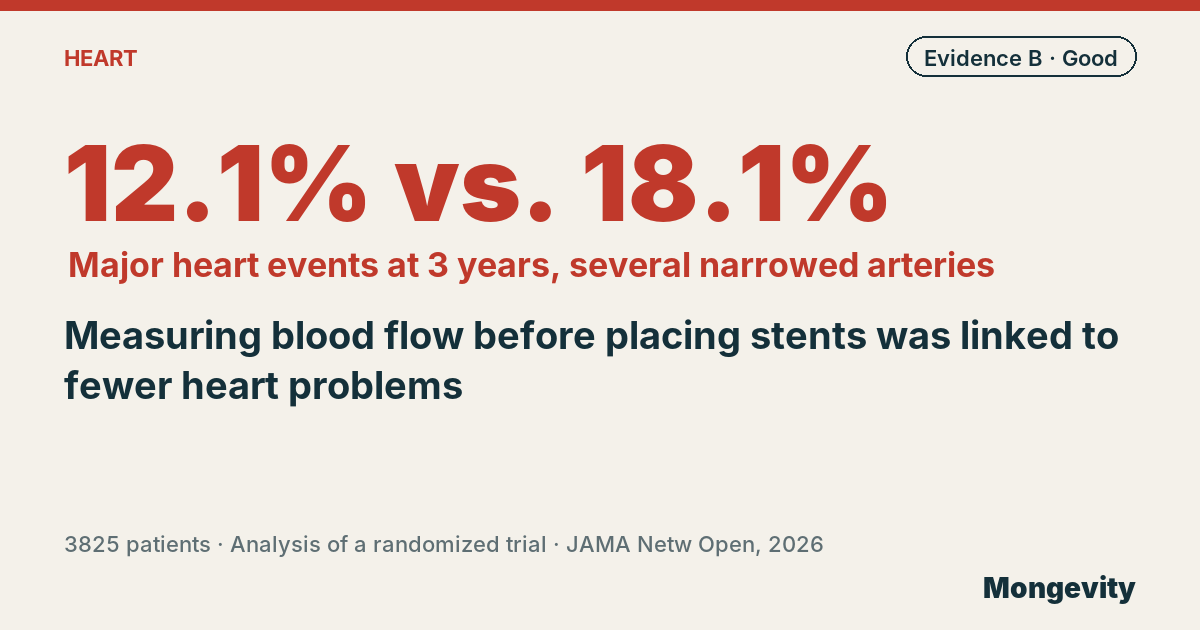
Stents guided by a flow measurement called QFR were linked to fewer major heart events at 3 years in people with several narrowed arteries, 12.1% vs. 18.1%, in an analysis of the FAVOR III China trial published Oct. 1, 2026, in JAMA Network Open. Measuring flow helps decide where heart stents are needed.
When a heart artery is narrowed, doctors can open it with a balloon and a stent, a procedure called PCI. The hard part is deciding which narrowings actually limit blood flow. Looking at an X-ray movie of the arteries, called angiography, can mislead. QFR, or quantitative flow ratio, uses software on those same images to estimate how much blood gets through, without an extra wire.
What did the trial test?
At 26 centers in China, 3825 adults having PCI for chest pain or a heart attack at least 72 hours earlier were assigned by chance to QFR-guided or angiography-guided PCI. All had at least 1 narrowing of 50% to 90% in a vessel of 2.5 mm or larger. This prespecified analysis split them by whether they had disease in several arteries.
What did the study find about heart stents?
Major adverse cardiac events combined death, heart attack and the need for another procedure.
| Major heart events at 3 years | QFR-guided | Angiography-guided |
|---|---|---|
| Disease in several arteries | 12.1% | 18.1% |
| Disease in one artery | 8.6% | 11.0% |
In people with several affected arteries, the hazard ratio was 0.65, driven by fewer heart attacks and repeat procedures. In those with one affected artery the hazard ratio was 0.77, which was not statistically significant. The difference between the two groups wasn’t significant either, which suggests QFR may help across the board.
Why does this matter?
QFR doesn’t need extra wires or drugs, so it could make physiology-guided stenting, already backed by evidence, easier and more widely used. Three years of follow-up show that the benefit seen at 1 year didn’t vanish.
How solid is this evidence?
It’s good. Mongevity rates it B on our A-to-E scale: it comes from a large randomized trial, but this is a secondary analysis of subgroups, done only in China. The authors say the findings need further confirmation.
What does this mean for you?
If a cardiologist recommends a stent, it’s reasonable to ask how they decide which narrowings to treat, and whether a flow measurement such as FFR or QFR is used. Keep taking the medicines prescribed after the procedure and work on blood pressure, cholesterol and smoking.
How do I explain this at dinner?
Before putting in a stent, doctors can now use software to estimate how much blood actually gets through a narrowed heart artery. In a large trial, people treated this way had fewer heart problems three years later, especially when several arteries were affected. A good question for the table: would you ask your doctor how they choose?
In one sentence: stents guided by a software flow measurement were linked to fewer major heart events at 3 years, especially in people with several narrowed arteries.
Questions and answers
- What is QFR?
- Quantitative flow ratio: software that estimates blood flow through a narrowed heart artery from angiography images.
- Did it help?
- In people with several narrowed arteries, major heart events at 3 years were 12.1% vs. 18.1% with angiography alone.
- Does it require extra procedures?
- No: it uses the same images taken during angiography, without an extra pressure wire.