After weight-loss surgery, fitness improved even though some lean mass was lost
Diet and weightPart of a story we are following · 4 articles · See every update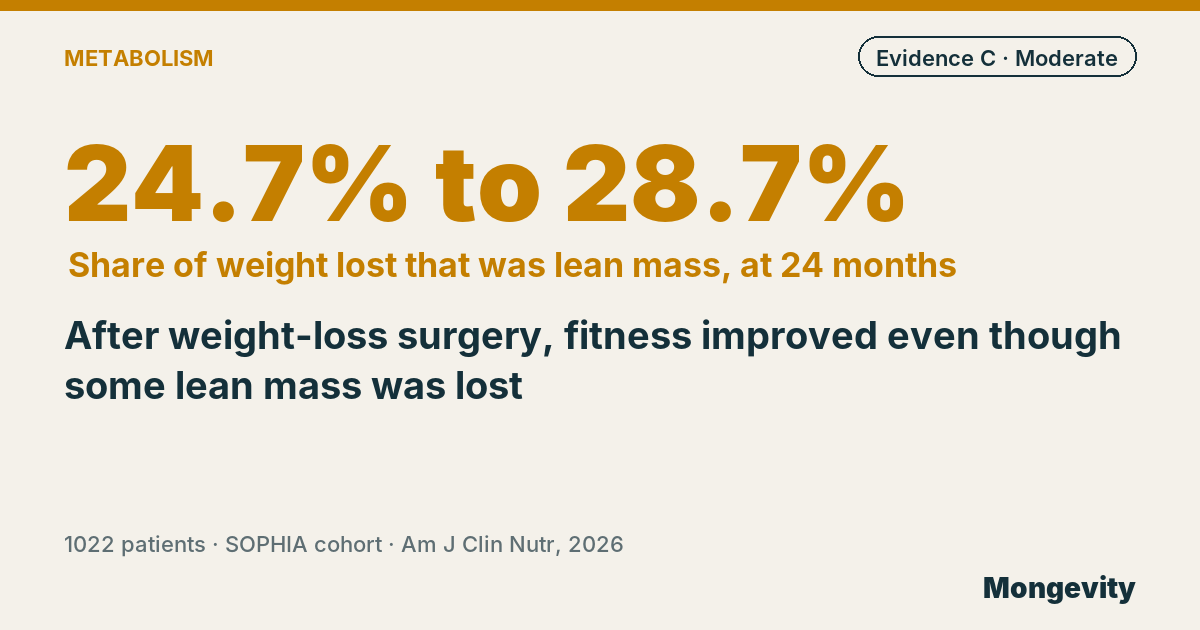
Men and postmenopausal women lost a larger share of lean mass than premenopausal women after weight-loss surgery, yet fitness improved in all groups, in a study of 1022 people published in October 2026 in The American Journal of Clinical Nutrition. It adds nuance to how diet and weight loss affect muscle.
Weight-loss surgery, also called metabolic bariatric surgery, leads to large weight loss. But part of the weight lost is fat-free mass, which includes muscle, and there’s concern this could weaken people.
What did the study do?
Researchers followed 1022 people after a first bariatric surgery for at least 18 months: 221 men, 614 premenopausal women and 187 postmenopausal women. They measured weight and fat-free mass before surgery and repeatedly afterward, up to 72 months, and assessed cardiorespiratory fitness with a bicycle test.
What did the study find about diet and weight?
| Share of weight lost that was fat-free mass, at 24 months | |
|---|---|
| Premenopausal women | 24.7% |
| Men | 27.1% |
| Postmenopausal women | 28.7% |
Men lost the most fat-free mass in absolute terms. Despite this, maximal oxygen consumption, a key fitness measure, improved significantly in all groups. Changes in fat-free mass after surgery weren’t independently linked to changes in fitness.
Why does this matter?
Losing some lean mass with large weight loss is expected. This study is reassuring: fitness still improved. It also shows that men and women after menopause lose a larger share of lean mass, so they may benefit most from strategies to protect muscle.
How solid is this evidence?
It’s moderate. Mongevity rates it C on our A-to-E scale: a large cohort with repeated measurements over years, but observational, with no comparison group, and fitness was estimated with a submaximal test. Individual results varied a lot and weren’t fully explained by sex or menopause.
What are the open questions?
Trials are needed to test which strategies, such as strength training or higher protein intake, best preserve muscle after surgery, and whether new weight-loss drugs show similar patterns.
What does this mean for you?
If you’re having or have had weight-loss surgery, ask your team about a plan to protect muscle: enough protein, strength exercises two or three times a week and regular physical activity. This matters especially for men and for women after menopause.
How do I explain this at dinner?
After weight-loss surgery, people lose fat but also some muscle. In a large study, men and older women lost a bit more muscle, yet everyone got fitter. A good question for the table: what helps keep muscle while losing weight?
In one sentence: after bariatric surgery, men and postmenopausal women lost a larger share of lean mass than premenopausal women, but fitness improved in all groups.
Questions and answers
- What is fat-free mass?
- Body mass that isn't fat, including muscle, bone, organs and water.
- Who lost the most lean mass relative to weight?
- Postmenopausal women (28.7%) and men (27.1%), more than premenopausal women (24.7%).
- Did fitness suffer?
- No: fitness improved in all groups despite the lean mass loss.