Mindfulness therapy may ease fear of moving in older adults with knee arthritis
Knee osteoarthritisPart of a story we are following · 3 articles · See every update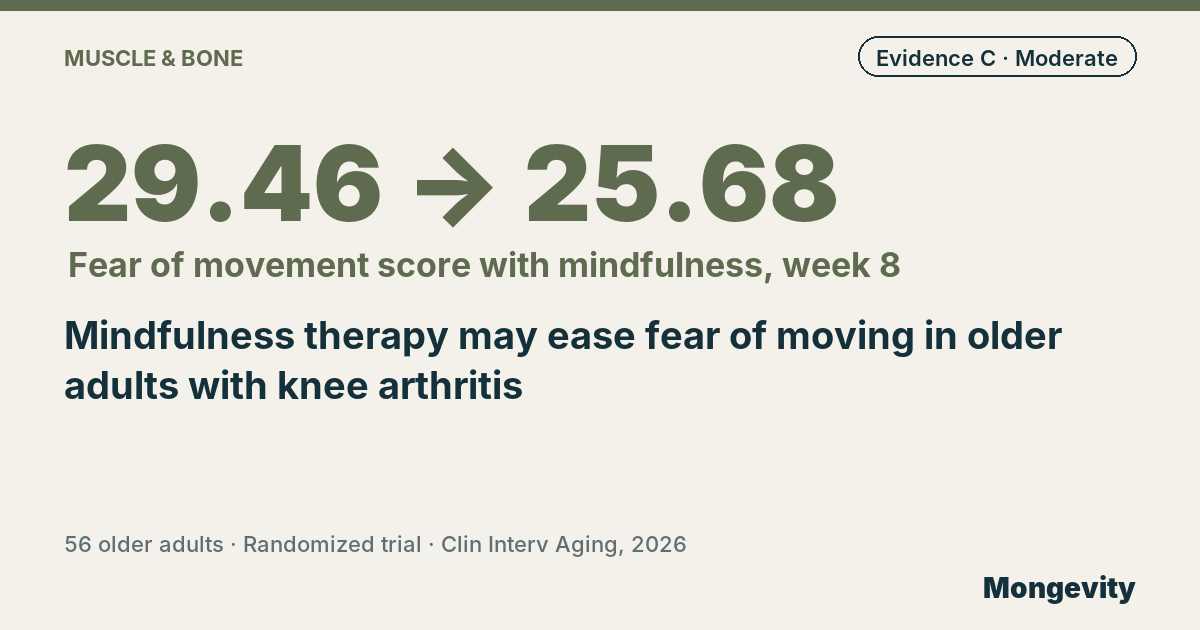
Mindfulness-based cognitive therapy shifted the course of fear of movement in older adults with knee osteoarthritis in Iran, but differences between groups at each time point weren’t significant, in a small randomized trial published Oct. 20, 2026, in Clinical Interventions in Aging. Fear of moving can hold back rehab for knee osteoarthritis.
Knee osteoarthritis causes pain and stiffness, and many people start avoiding movement because they fear it will hurt or cause damage. This fear, called kinesiophobia, can lead to less activity, weaker muscles and more pain. Mindfulness-based cognitive therapy teaches people to notice thoughts and sensations without reacting automatically.
What did the trial test?
At health centers in Kashan, Iran, in 2024, 56 older adults with chronic knee osteoarthritis were assigned by chance to eight 90-minute sessions of mindfulness-based cognitive therapy (28) or routine care (28). Fear of movement was measured with a standard questionnaire, the Tampa Scale for Kinesiophobia, at the start, at week 4, right after the program, and at week 8. All participants completed follow-up.
What did the study find about knee osteoarthritis?
| Fear of movement score | Mindfulness | Routine care |
|---|---|---|
| At the start | 29.46 | 28.64 |
| At week 8 | 25.68 | 26.68 |
The analysis showed that the two groups changed differently over time. But when compared at each time point, the differences weren’t statistically significant. The adjusted difference in change by week 8 was 1.60 points, right at the edge of significance. Both groups improved, the mindfulness group more steadily.
Why does this matter?
Fear of movement is an important, treatable barrier in arthritis care. Approaches that address it can help people stay active, which is one of the best treatments for knee osteoarthritis.
How solid is this evidence?
It’s limited. Mongevity rates it C on our A-to-E scale: a randomized trial, but small, at one site, without blinding and with a short follow-up of 8 weeks. The main differences were small and borderline. The trial was registered in the Iranian Registry of Clinical Trials (IRCT20231105059961N1).
What are the open questions?
Larger, longer trials are needed to know whether mindfulness lowers fear of movement in a meaningful way and whether that leads to more activity and less pain.
What does this mean for you?
If knee arthritis makes you afraid to move, talk to a physiotherapist about a gradual exercise plan; movement is usually safe and helps. Mindfulness or other psychological approaches can be a useful addition, especially if fear holds you back.
How do I explain this at dinner?
People with knee arthritis often stop moving because they’re afraid it will hurt. Older adults who did a mindfulness course became a bit less fearful over eight weeks, though the difference from usual care was small. A good question for the table: how much does fear shape what our bodies can do?
In one sentence: mindfulness-based cognitive therapy may ease fear of movement in older adults with knee osteoarthritis, but this small trial’s effects were borderline.
Questions and answers
- What is kinesiophobia?
- Fear of movement, often because of expected pain or damage, common in people with arthritis.
- Did mindfulness help?
- The groups changed differently over time, but differences at each time point weren't significant.
- What helps knee osteoarthritis most?
- Regular, gradual exercise, ideally guided by a physiotherapist.