Shockwave therapy eased several kinds of tendon pain, but not jumper’s knee
Tendon painPart of a story we are following · 3 articles · See every update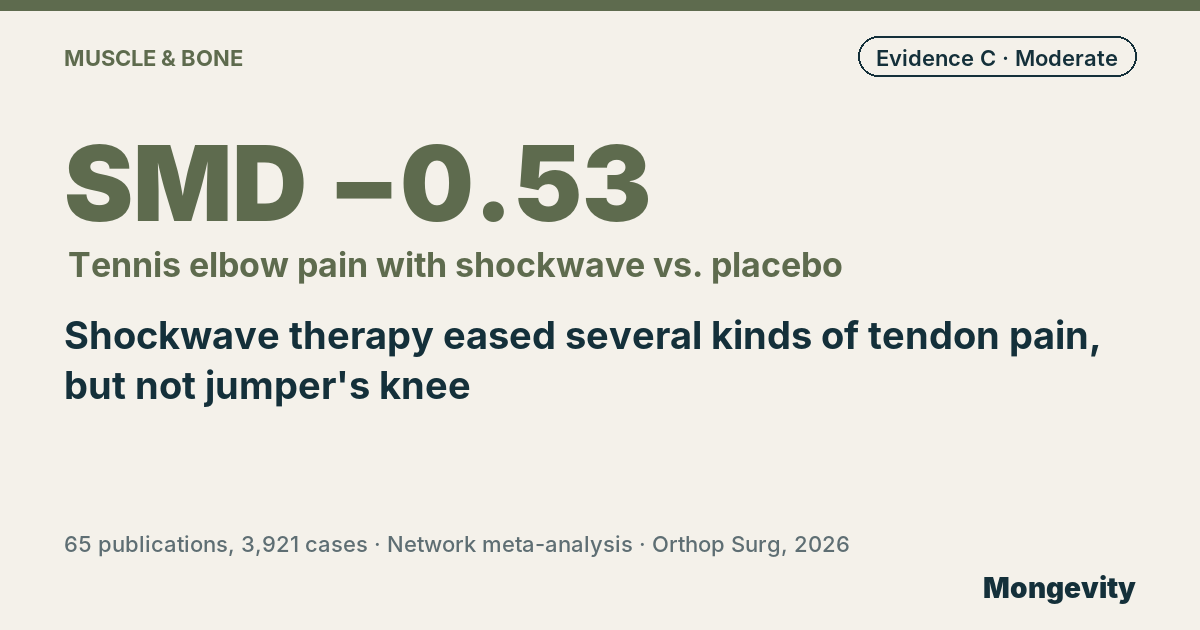
Extracorporeal shockwave therapy reduced pain in tennis elbow, Achilles and rotator cuff tendinopathy more than placebo, but not in patellar tendinopathy, in a network meta-analysis of 65 publications with 3,921 cases published Sept. 13, 2026, in Orthopaedic Surgery. It helps match the treatment to the type of tendon pain.
Tendinopathy is a painful, long-lasting problem of tendons, the cords that attach muscles to bones. It shows up as tennis elbow, Achilles pain, shoulder pain or jumper’s knee. Extracorporeal shockwave therapy (ESWT) sends sound pulses through the skin to stimulate healing.
What did the study look at?
Researchers searched several databases for randomized trials and found 65 publications from 2002 to 2024, with 3,921 cases in total. They covered five conditions: tennis elbow (lateral epicondylitis), rotator cuff tendinopathy in the shoulder, Achilles tendinopathy, greater trochanteric pain syndrome on the side of the hip, and patellar tendinopathy, also called jumper’s knee. They used a network meta-analysis to compare many treatments at once and rated certainty with GRADE.
What did the study find about tendon pain?
- Compared with placebo, ESWT reduced pain in tennis elbow (standardized mean difference −0.53), Achilles tendinopathy (−0.49) and rotator cuff tendinopathy (−1.25).
- In patellar tendinopathy, ESWT was not better than placebo (−0.15, not significant).
- For hip pain, ESWT did better than exercise alone (−0.41).
- Compared with other conservative treatments, ESWT ranked among the best options for tennis elbow, Achilles and shoulder tendinopathy, but was not always first.
Why does this matter?
Tendon pain can last months and limit work, sport and sleep. ESWT is non-invasive and widely available. This review helps match it to the conditions where it is more likely to help, and shows it isn’t a good choice for jumper’s knee.
How solid is this evidence?
It’s limited. Mongevity rates it C on our A-to-E scale: a network meta-analysis of randomized trials, but the authors describe the evidence as limited, some comparisons had high heterogeneity, and studies differed in protocols, doses and outcomes.
What are the open questions?
Larger, standardized trials are needed to define the best dose and number of sessions for each tendon, and how ESWT compares with progressive loading exercise, the cornerstone of tendon rehab.
What does this mean for you?
If you have long-lasting tendon pain, a progressive strengthening program guided by a physiotherapist is usually the first step. If you don’t improve, ask whether shockwave therapy is a reasonable add-on for your specific tendon. For jumper’s knee, focus on exercise-based rehab.
How do I explain this at dinner?
Shockwave therapy sends sound pulses into painful tendons. Pooling dozens of trials, it eased pain in tennis elbow, Achilles and shoulder tendons, but did nothing for jumper’s knee. A good question for the table: which joint gives you trouble after exercise?
In one sentence: extracorporeal shockwave therapy reduced pain in several tendinopathies, including tennis elbow, Achilles and rotator cuff, but not patellar tendinopathy, based on limited evidence.
Questions and answers
- What is shockwave therapy?
- A treatment that sends sound pulses through the skin to stimulate tendon healing.
- Which tendons did it help?
- Tennis elbow, Achilles and rotator cuff tendinopathy, compared with placebo.
- Which didn't it help?
- Patellar tendinopathy, or jumper's knee.
- Should it be the first treatment?
- Usually not; progressive strengthening exercise is the first step.