Severe vitamin D deficiency was linked to higher death risk; supplements to lower risk
Supplements: what the evidence saysPart of a story we are following · 3 articles · See every update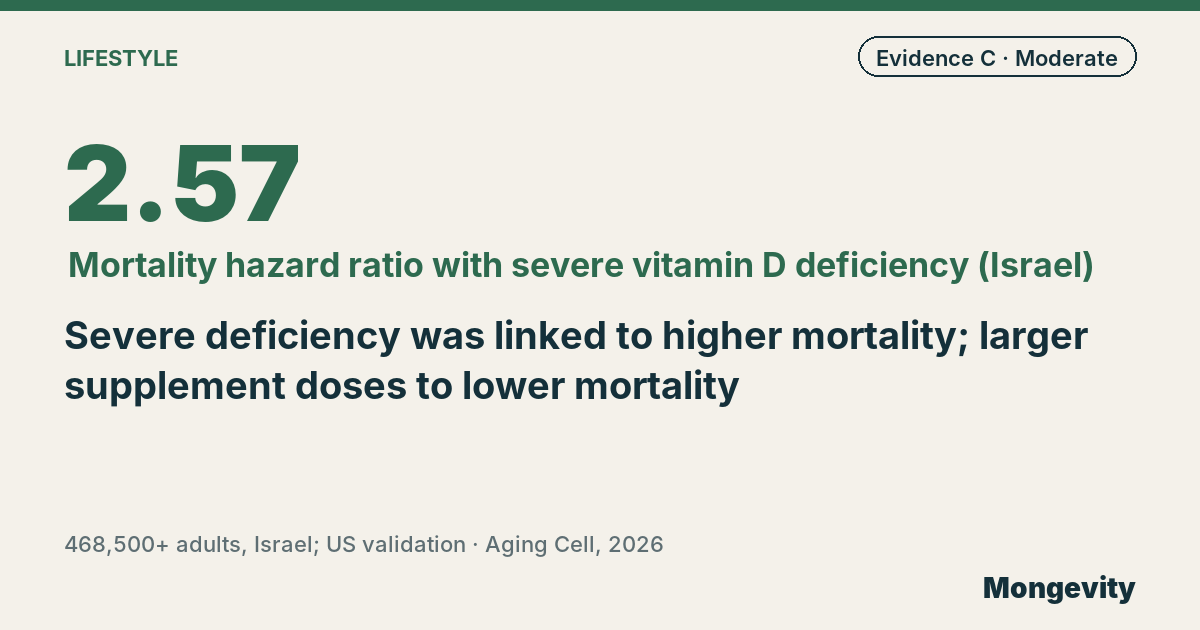
Severe vitamin D deficiency was linked to higher mortality (hazard ratios 2.57 and 1.59), and larger supplement doses to lower mortality (0.72), in health records from Israel and the US analyzed in a study published in October 2026 in Aging Cell. Supplements may matter most for people who are truly deficient.
Vitamin D supplements are among the most popular in the world, but large trials in people who aren’t deficient have mostly been disappointing.
What did the study look at?
Researchers analyzed more than 1.67 million vitamin D blood tests from over 468,500 adults in Leumit Health Services in Israel, from 2009 to 2020, and checked the results in 223,175 matched pairs from TriNetX, a US research network. They compared people with severe deficiency (under 10 ng/mL) with those with sufficient levels (over 30 ng/mL), followed for up to 10 years. They also modeled supplement use from pharmacy purchases.
What did the study find about supplements?
| Comparison | Mortality hazard ratio |
|---|---|
| Severe deficiency vs. sufficiency, Israel | 2.57 |
| Severe deficiency vs. sufficiency, US | 1.59 |
| Supplementation above a 10 ng/mL-equivalent dose | 0.72 |
Severe deficiency was also linked to higher risks across several aging-related conditions. Supplementation showed dose-dependent links to lower risks, but no link with skin cancers, which the authors used as a check. Additional statistical methods gave consistent results.
Why does this matter?
It suggests that severe vitamin D deficiency, rather than modestly low levels, may be the group where correcting vitamin D matters most. That fits with trials that found little benefit when people with normal levels took supplements.
How solid is this evidence?
It’s moderate. Mongevity rates it C on our A-to-E scale. The data are enormous and the results replicated in two countries, but this is observational: people with severe deficiency are often sicker, less active or spend less time outdoors. Supplement use was estimated from purchases, not confirmed intake. Only randomized trials in severely deficient people can prove a benefit.
What does this mean for you?
If you’re at risk of deficiency, for example if you get little sun, have darker skin, are older or have certain medical conditions, ask your doctor whether a vitamin D test makes sense. Very high doses without medical advice can cause harm.
How do I explain this at dinner?
Our body makes vitamin D with sunlight. Scientists looked at the records of hundreds of thousands of people and found that those with very little vitamin D were more likely to die, and that taking supplements was linked to lower risk. A good question for the table: how much time do you spend outside in daylight?
In one sentence: severe vitamin D deficiency was linked to higher mortality and larger supplement doses to lower mortality in two large databases, but the study can’t prove cause.
Questions and answers
- Is severe vitamin D deficiency dangerous?
- In this study it was linked to higher mortality: hazard ratio 2.57 in Israel and 1.59 in the US.
- Do vitamin D supplements help?
- Larger doses were linked to lower mortality (hazard ratio 0.72), but this is observational and doesn't prove benefit.
- Should everyone take vitamin D?
- No. The strongest signal was in severe deficiency; ask your doctor whether testing makes sense for you.