18.1 million people live with anorexia or bulimia, and cases keep rising
Eating disordersPart of a story we are following · 3 articles · See every update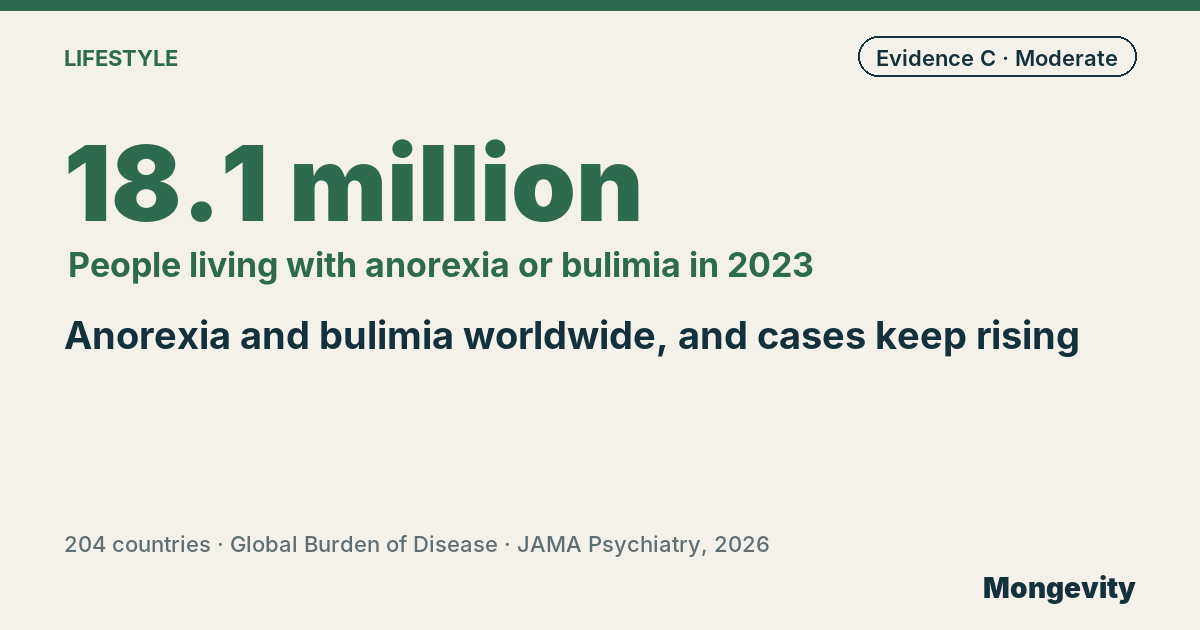
An estimated 18.1 million people lived with anorexia or bulimia nervosa in 2023, with cases up 71.0% since 1990, according to a Global Burden of Disease analysis across countries published Oct. 28, 2026, in JAMA Psychiatry. These eating disorders are expected to keep rising through 2050.
Anorexia nervosa and bulimia nervosa are serious eating disorders that affect body and mind, and anorexia has one of the highest death rates of any mental health condition. They are often thought of as rare or limited to certain countries.
What did the study do?
Using Global Burden of Disease 2023 methods, researchers combined data from systematic literature reviews, population surveys and death registries to produce estimates for 204 countries and territories from 1990 to 2023, with forecasts through 2050.
What did the study find about eating disorders?
| In 2023 | Estimate |
|---|---|
| People living with anorexia or bulimia | 18.1 million |
| Women and girls | 12.6 million (69.4%) |
| Men and boys | 5.5 million (30.6%) |
| Aged 10 to 24 years | 41.2% |
| Disability-adjusted life-years lost | 3.83 million |
Since 1990, the number of cases grew by 71.0%, and age-standardized prevalence and burden rose by about 21%. Rates were highest in high-income regions, especially Australasia and Western Europe, but the biggest relative increases were in East, South and Southeast Asia. Forecasts point to continued increases through 2050.
Why does this matter?
Eating disorders are a major cause of health loss that doesn’t show up in death statistics. The rise in Asia suggests they aren’t confined to wealthy Western countries, and the fact that 30.6% of cases are male challenges the idea that they only affect women. Health systems need to plan for them.
How solid is this evidence?
It’s moderate. Mongevity rates it C on our A-to-E scale: a large modeling study with standard, transparent methods, but estimates depend on the quality of data in each country, and in many places eating disorders are underdiagnosed. Uncertainty ranges are wide.
What does this mean for you?
Watch for warning signs in yourself or others, at any age or gender: extreme dieting, intense fear of gaining weight, bingeing followed by vomiting or laxatives, or a focus on body shape that takes over daily life. Early help works better. Talk to a doctor or contact an eating disorder support line.
How do I explain this at dinner?
Around the world, 18.1 million people live with anorexia or bulimia, and the number has grown a lot since 1990. It’s rising fastest in Asia, and 30.6% of people with these disorders are male. A good question for the table: why might these disorders be hidden so often?
In one sentence: 18.1 million people lived with anorexia or bulimia in 2023, cases have grown since 1990, and forecasts point to further increases.
Questions and answers
- How many people have anorexia or bulimia?
- An estimated 18.1 million people worldwide in 2023.
- Are men affected?
- Yes: about 5.5 million, or 30.6% of cases, were male.
- Is it increasing?
- Cases grew 71.0% since 1990, and forecasts point to further increases through 2050.