Eating disorders rarely come alone: about half also involve a personality disorder
Eating disordersPart of a story we are following · 3 articles · See every update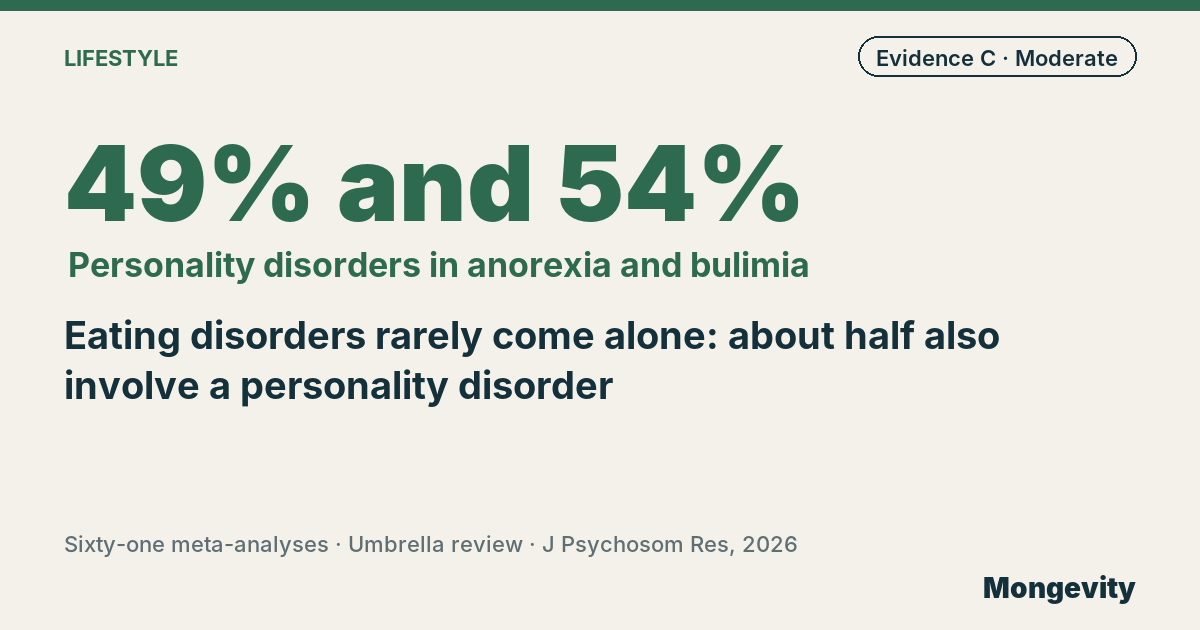
A personality disorder was found in 49% of people with anorexia and 54% with bulimia, and tobacco use disorder in 47.7% of people with binge-eating disorder, according to an umbrella review of 61 meta-analyses published in September 2026 in Journal of Psychosomatic Research. Eating disorders rarely come alone.
Anorexia nervosa, bulimia nervosa and binge-eating disorder are serious illnesses that affect both mind and body. People who have them often have other conditions too, which complicates treatment.
What did the study look at?
This was an umbrella review: researchers gathered systematic reviews with meta-analyses of observational studies about other psychiatric and medical conditions in people with anorexia, bulimia or binge-eating disorder, and the reverse. They searched seven databases up to June 2026, recalculated estimates when possible, and graded how credible each finding was.
What did the study find about eating disorders?
- Sixty-one meta-analyses provided 213 estimates.
- Of 134 estimates of how common other conditions are, 91 (67.9%) met moderate-to-strong credibility criteria.
- Any personality disorder was found in 49% of people with anorexia and 54% with bulimia.
- Non-suicidal self-injury was found in 37% of people with bulimia.
- Tobacco use disorder was found in 47.7% and bipolar disorder in 9.1% of people with binge-eating disorder.
- No finding about risk factors or outcomes reached the highest levels of credibility.
Why does this matter?
Treating an eating disorder alone may miss other problems that keep it going, such as self-harm, substance use or mood disorders. This review supports assessing the whole person with a multidisciplinary team, including mental health, medical and nutrition professionals.
How solid is this evidence?
It’s moderate for how common the overlaps are and weak for causes and outcomes. Mongevity rates it C on our A-to-E scale: a broad, careful umbrella review, but based on observational studies, with limited certainty about risk factors and outcomes. It covers only three eating disorders.
What are the open questions?
Long-term studies are needed to understand which conditions come first, how they influence each other and how best to treat them together.
What does this mean for you?
If you or someone close lives with an eating disorder, ask for an assessment that looks beyond eating and weight: mood, anxiety, self-harm, substance use and physical health. If there is any risk of self-harm, seek help right away from local emergency or crisis services.
How do I explain this at dinner?
Researchers pooled dozens of reviews and found that eating disorders rarely come alone. About half of people with anorexia or bulimia also have a personality disorder, and many with binge eating also have a tobacco problem. A good question for the table: why does treating one problem sometimes mean looking at several?
In one sentence: an umbrella review found credible evidence that anorexia, bulimia and binge-eating disorder frequently co-occur with other psychiatric conditions, while evidence on risk factors and outcomes was less certain.
Questions and answers
- What did the review cover?
- Anorexia nervosa, bulimia nervosa and binge-eating disorder, and other conditions that occur with them.
- How common are personality disorders?
- About 49% in anorexia and 54% in bulimia.
- What about binge-eating disorder?
- Tobacco use disorder in 47.7% and bipolar disorder in 9.1%.
- What should treatment include?
- A multidisciplinary assessment that looks beyond eating and weight.