A first targeted drug for Sjögren’s disease lowered activity slightly, but not symptoms
Autoimmune diseasesPart of a story we are following · 3 articles · See every update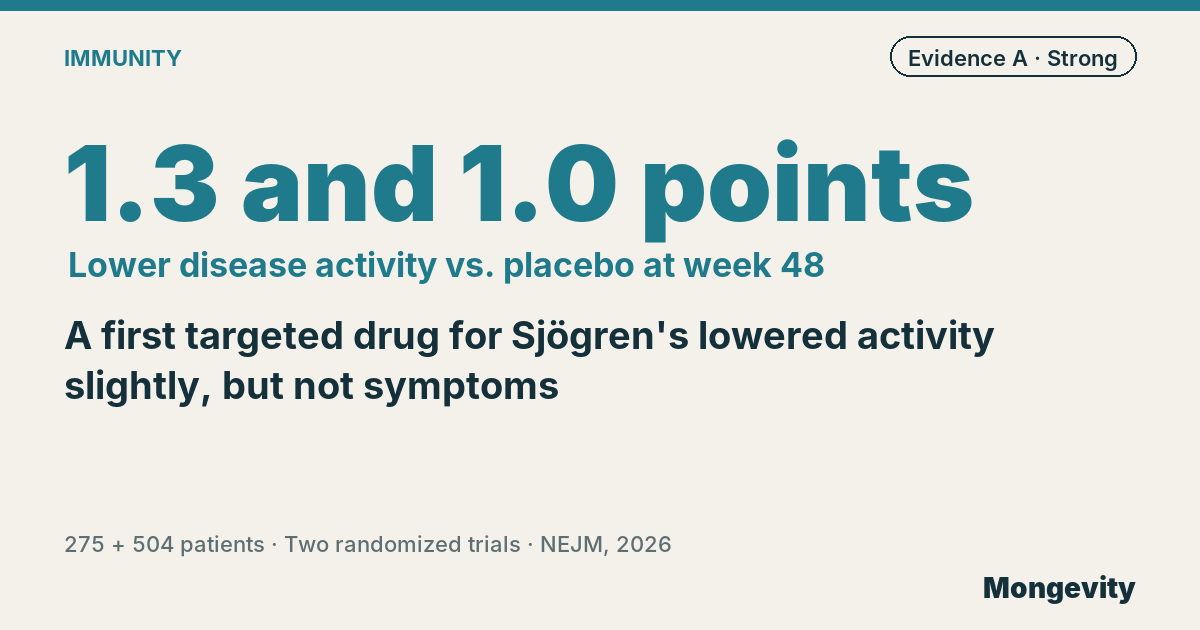
Monthly ianalumab lowered Sjögren’s disease activity at week 48 slightly more than placebo, but patient-reported symptoms didn’t improve more, in two trials published in October 2026 in New England Journal of Medicine. It is the first targeted drug tested for this autoimmune disease.
Sjögren’s disease is an autoimmune condition in which the immune system attacks the glands that make tears and saliva, and sometimes other organs. It causes dry eyes and mouth, fatigue and pain, and it has no approved targeted treatment.
What is ianalumab?
It’s a monoclonal antibody, given as an injection under the skin, that works on B cells, immune cells involved in Sjögren’s, in two ways: it removes them and blocks a signal they need to survive and become active.
What did the trials test?
Both trials lasted 52 weeks and were double-blind and placebo-controlled. In NEPTUNUS-1, 275 people with active Sjögren’s got 300 mg of ianalumab monthly or placebo. In NEPTUNUS-2, 504 people got ianalumab monthly, ianalumab every 3 months or placebo. The main goal was the change in a disease activity score called ESSDAI at week 48. That score ranges from 0 to 123, where higher means more active disease.
What did the study find about autoimmune disease?
| Difference vs. placebo in ESSDAI at week 48 | Ianalumab monthly |
|---|---|
| NEPTUNUS-1 | 1.3 points lower |
| NEPTUNUS-2 | 1.0 points lower |
Both differences were statistically significant, but small. There were no significant differences in the share of people with a meaningful drop in the score or in symptom questionnaires about dryness, fatigue and pain. Serious side effects were similar with ianalumab and placebo; injection reactions were more common with the drug.
Why does this matter?
These are the first large trials to show a targeted drug can lower Sjögren’s disease activity. But a small change in a doctor-measured score without changes in how patients feel leaves open how much difference it will make in daily life.
How solid is this evidence?
The design is strong. Mongevity rates it A on our A-to-E scale: two large double-blind randomized trials with the same result on the main goal. The limit is in the result itself: the benefit was small and didn’t reach symptoms. The trials were funded by the drugmaker.
What does this mean for you?
If you live with Sjögren’s, this drug isn’t a quick fix. Keep working with your rheumatologist on dryness and fatigue, with eye drops, saliva substitutes, hydration and regular dental care, and ask whether new trials or treatments might suit you.
How do I explain this at dinner?
In Sjögren’s disease, the immune system dries out the eyes and mouth. A new medicine that targets certain immune cells calmed the disease a little on doctors’ scores, but patients didn’t feel much better. A good question for the table: what counts more, a test score or how you feel?
In one sentence: monthly ianalumab lowered Sjögren’s disease activity slightly in two trials, without improving patient-reported symptoms more than placebo.
Questions and answers
- What is Sjögren's disease?
- An autoimmune disease that attacks tear and saliva glands and can affect other organs, causing dryness, fatigue and pain.
- Did ianalumab work?
- It lowered the disease activity score by 1.3 and 1.0 points more than placebo, a small difference.
- Did symptoms improve?
- Not more than with placebo: symptom questionnaires showed no significant differences.