A daily pill that blocks the IL-23 pathway helped people with ulcerative colitis
Autoimmune diseasesPart of a story we are following · 3 articles · See every update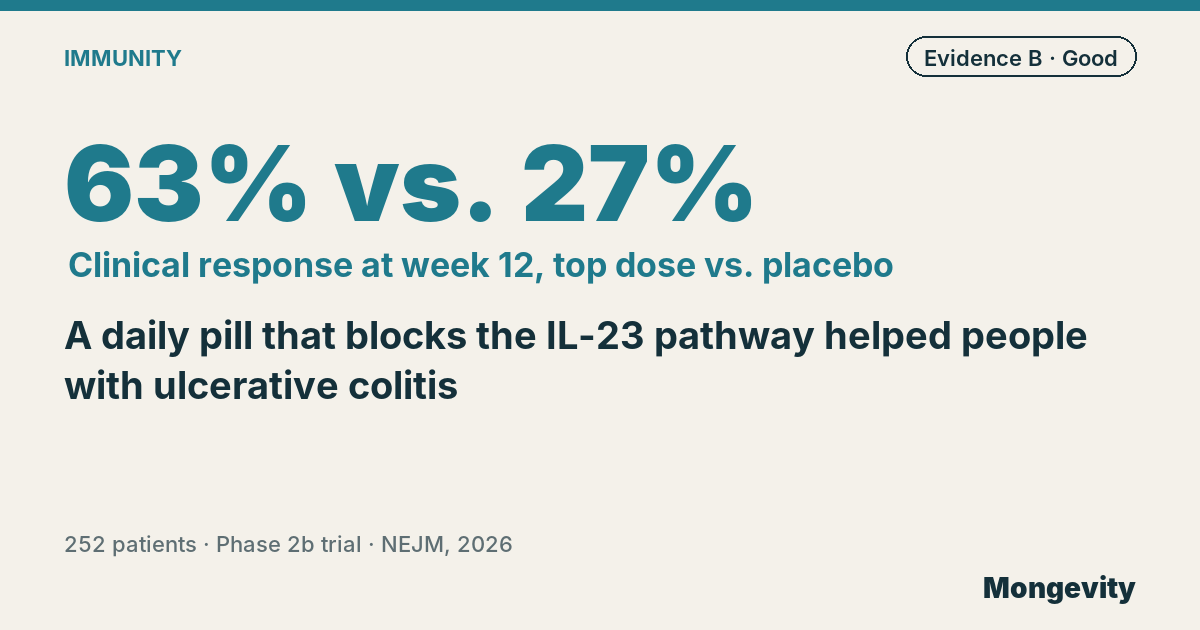
Oral icotrokinra led to a clinical response at week 12 in 63% of people with ulcerative colitis at the highest dose vs. 27% with placebo, in a phase 2b trial published in October 2026 in New England Journal of Medicine. A pill could join injections for this autoimmune disease.
Ulcerative colitis is an inflammatory bowel disease in which the immune system inflames the lining of the large intestine, causing diarrhea, bleeding and urgency. Antibodies that block the interleukin-23 pathway work well, but they must be given by IV or injection. Icotrokinra is a small peptide, taken as a daily pill, that blocks the receptor for interleukin-23.
What did the trial test?
252 adults with moderately to severely active ulcerative colitis were assigned by chance to icotrokinra once a day at 400 mg, 200 mg or 100 mg, or placebo. Neither patients nor doctors knew which. The main goal was a clinical response at week 12.
What did the study find about autoimmune disease?
| 400 mg | 63% |
|---|---|
| 200 mg | 58% |
| 100 mg | 55% |
| Placebo | 27% |
At 400 mg, compared with placebo:
- Clinical remission: 30% vs. 11%.
- Symptom remission: 46% vs. 19%.
- Improvement seen on endoscopy: 37% vs. 14%.
Through week 28, adverse events were 60%, 66%, 66% and 62% in the 400 mg, 200 mg, 100 mg and placebo groups. Serious adverse events were 2%, 5%, 0% and 10%.
Why does this matter?
Many people with ulcerative colitis would rather take a pill than get injections or infusions. If larger trials confirm these results, icotrokinra could bring the benefits of IL-23 blockers in a simpler form. A pill can also be easier to start, stop or adjust, and it avoids trips to an infusion center. All three doses beat placebo on the main goal, and serious side effects were not more frequent than with placebo, which is encouraging for this early stage.
How solid is this evidence?
It’s good. Mongevity rates it B on our A-to-E scale: a double-blind randomized trial with clear results on the main goal. Limits: it was a mid-stage trial of 12 weeks with a few hundred people, so long-term benefit and safety need phase 3 trials. It was funded by the drugmaker.
What does this mean for you?
If you live with ulcerative colitis, this pill isn’t available yet. Ask your gastroenterologist whether your current treatment keeps the disease in remission, and whether you might qualify for a trial. Don’t stop your medicines on your own.
How do I explain this at dinner?
In ulcerative colitis, the immune system inflames the gut. The best new treatments block one immune signal, but you need injections. A new daily pill blocks the same signal, and in a trial, many more people improved than with placebo at the top dose. A good question for the table: would you trade a shot for a pill?
In one sentence: a daily icotrokinra pill improved ulcerative colitis at week 12 compared with placebo, and now needs larger, longer trials.
Questions and answers
- What is icotrokinra?
- A peptide taken as a daily pill that blocks the interleukin-23 receptor, a key signal in bowel inflammation.
- How well did it work?
- At week 12, clinical response was 63% at 400 mg vs. 27% with placebo.
- Is it available?
- Not yet: it was a phase 2b trial, and larger, longer trials are needed.