A faster heart attack blood test didn’t shorten ER stays in five trials
Heart blood testsPart of a story we are following · 3 articles · See every update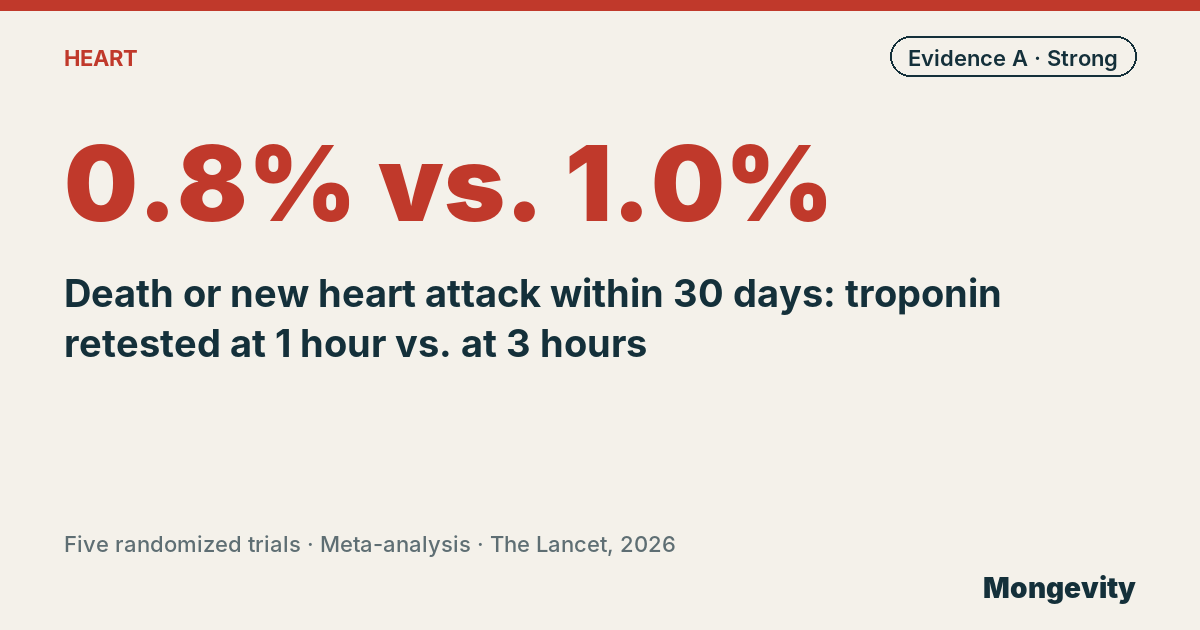
Retesting troponin after 1 hour instead of 3 hours didn’t shorten emergency stays on average, and short-term events were low with both, 0.8% vs. 1.0%, according to a meta-analysis of five randomized trials published Oct. 29, 2026, in The Lancet. Faster heart blood tests are safe, but time savings depend on the hospital.
When someone arrives at the emergency room with chest pain, doctors measure troponin, a protein released by damaged heart muscle. Guidelines recommend a quick approach: draw blood on arrival and again 1 hour later, instead of waiting 3 hours. The idea is to rule out a heart attack sooner and send people home faster.
Both were safe, but the faster test didn’t shorten emergency stays on average.
What is troponin?
Troponin is a protein inside heart muscle cells. When those cells are damaged, as in a heart attack, it leaks into the blood. Modern tests can detect very small amounts, which is why a second sample after a short wait can show whether levels are rising.
What did the study look at?
The researchers gathered the individual data from the five trials and used the same definitions for every outcome. Over a hundred thousand emergency visits were included, about half managed with the 1-hour pathway and half with the 3-hour pathway.
What did the study find about heart blood tests?
| 1-hour pathway | 3-hour pathway | |
|---|---|---|
| Death or new heart attack within 30 days | 0.8% | 1.0% |
| Median time in the emergency department | 314 min | 308 min |
| Sent home directly from the ER | 67.0% | 65.8% |
None of these differences was statistically clear. Results varied a lot between trials and hospitals, which suggests the effect depends on how each health system works.
Why does this matter?
Hospitals invest time and money to switch to faster pathways, expecting shorter waits. This study shows that faster blood tests alone don’t guarantee shorter stays: imaging, specialist reviews, beds and staffing also matter.
How solid is this evidence?
It’s strong. Mongevity rates it A on our A-to-E scale: an individual participant data meta-analysis of randomized trials is one of the most reliable designs. Limits: the safety estimate was imprecise, the main safety outcome was refined after the data arrived, and the trials differed a lot from one another.
What does this mean for you?
If you have chest pain, don’t wait: call emergency services. Both pathways were safe in these trials. If you’re sent home after blood tests, ask what symptoms should make you come back.
How do I explain this at dinner?
When someone has chest pain, doctors check a protein in the blood twice to see if the heart is hurt. Doing the second check sooner sounded like it would get people home faster, but the wait was about the same. A good question for the table: what else can make a line move slowly besides one step?
In one sentence: checking troponin after 1 hour instead of 3 was safe but didn’t shorten emergency room stays on average across five trials.
Questions and answers
- What is the 0/1 h troponin pathway?
- Blood is drawn on arrival and again 1 hour later to check whether troponin is rising, instead of waiting 3 hours.
- Does the 1-hour test get people home faster?
- Not on average. In this meta-analysis, median emergency stays were 314 min with the 1-hour pathway and 308 min with the 3-hour pathway.
- Is it safe?
- Short-term events were low with both: death or a new heart attack within 30 days occurred in 0.8% and 1.0% of visits.