In people with diabetes, high lipoprotein(a) was linked to a second heart attack
Heart blood testsPart of a story we are following · 3 articles · See every update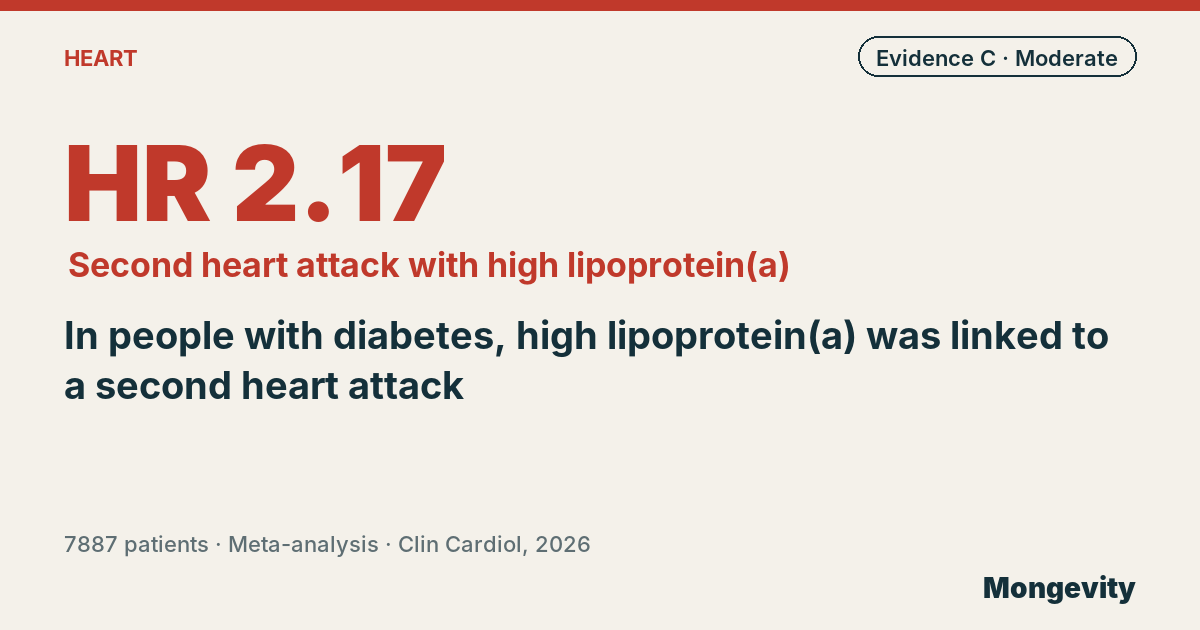
High lipoprotein(a) was linked to a higher risk of a second heart attack (hazard ratio 2.17) in 7887 people with type 2 diabetes after a heart attack or stent, in a meta-analysis of seven observational studies published in November 2026 in Clinical Cardiology. It supports this heart blood test after a heart attack.
People with type 2 diabetes who have had a heart attack or a stent stay at high risk of new events, even with good treatment. Lipoprotein(a), or Lp(a), a cholesterol particle mostly set by genes, is one suspected source of this leftover risk.
What did the study look at?
Researchers searched three databases for observational studies of patients with diabetes after an acute coronary syndrome, such as a heart attack, or after percutaneous coronary intervention, the procedure that places stents. They included studies reporting how Lp(a) related to a second heart attack or to repeat procedures to reopen arteries. Seven studies with 7887 patients qualified.
What did the study find about heart blood tests?
- High Lp(a) was linked to a higher risk of another heart attack (hazard ratio 2.17).
- It was not significantly linked to repeat procedures to reopen arteries (hazard ratio 1.68, not significant).
- Differences between studies were substantial (I² of 75% for heart attack).
Why does this matter?
Lp(a) is not part of most routine blood tests, and it doesn’t fall with diet or exercise. Knowing that it is linked to a second heart attack in people with diabetes supports measuring it to identify who needs closer follow-up and stricter control of other risk factors. Several drugs designed to lower Lp(a) are in late-stage trials.
How solid is this evidence?
It’s moderate. Mongevity rates it C on our A-to-E scale: a pre-registered meta-analysis of observational studies. Limits: few studies, substantial heterogeneity, differences in how high Lp(a) was defined, and limited evidence on repeat procedures. Observational data cannot show that Lp(a) causes the events.
What are the open questions?
Trials of Lp(a)-lowering drugs will show whether reducing it actually prevents heart attacks, and whether people with diabetes benefit especially.
What does this mean for you?
If you live with diabetes and have had a heart attack or stent, ask whether your Lp(a) has been measured. A single test is usually enough. If it’s high, focus on what you can control: LDL cholesterol, blood sugar, blood pressure, not smoking and staying active.
How do I explain this at dinner?
There’s an inherited cholesterol particle called lipoprotein(a). In people with diabetes who’d already had a heart problem, having a lot of it was linked to roughly twice the chance of another heart attack. A good question for the table: what’s in a standard blood test, and what’s left out?
In one sentence: in patients with diabetes after an acute coronary syndrome or PCI, high Lp(a) was linked to a higher risk of recurrent heart attack, though not of repeat revascularization.
Questions and answers
- What is lipoprotein(a)?
- A cholesterol-carrying particle whose level is mostly genetic.
- How much higher was the risk?
- A hazard ratio of 2.17 for a second heart attack.
- Was it linked to repeat stents?
- Not significantly (hazard ratio 1.68).
- Can I lower Lp(a)?
- Diet and exercise barely change it; new drugs are in trials. Control other risk factors.