Removing the clot helped even mild strokes caused by a large blocked artery
StrokePart of a story we are following · 3 articles · See every update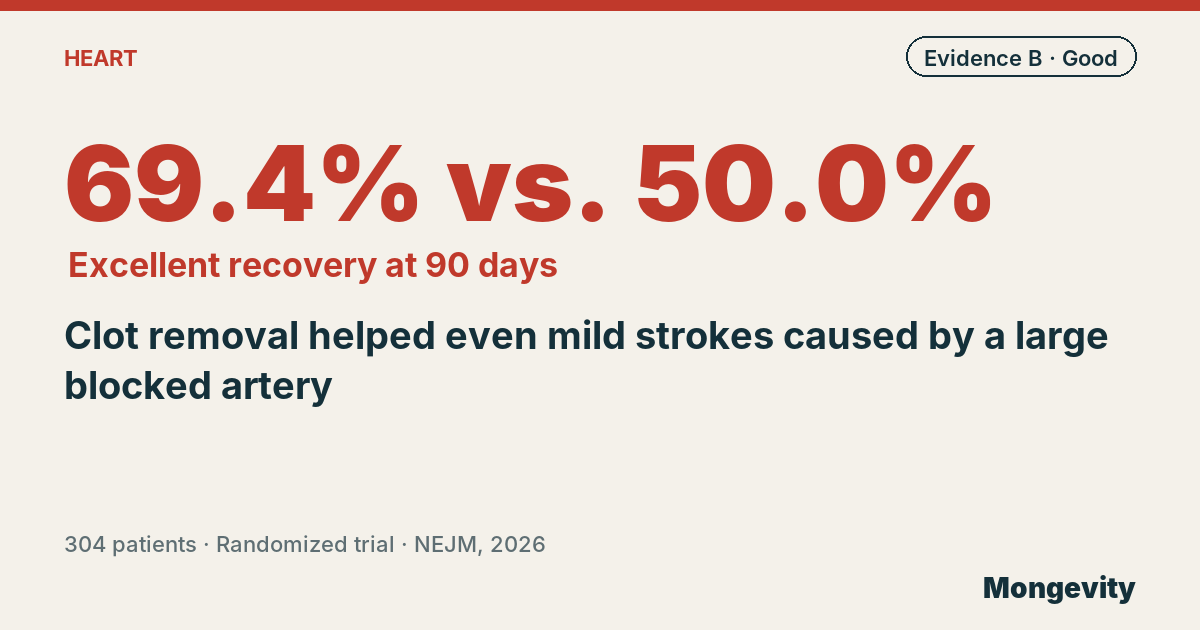
Clot removal gave 69.4% of people with a mild stroke from a large blocked artery an excellent recovery at 90 days vs. 50.0% with medicines alone, in the MILD-MT trial in China published Oct. 23, 2026, in New England Journal of Medicine. Procedure complications were frequent, so decisions about mild stroke need care.
When a large artery in the brain is blocked, doctors can thread a catheter up to the clot and pull it out. This is called endovascular therapy, or thrombectomy, and it’s standard for severe strokes. But what if the symptoms are mild? Many doctors hold back, because the procedure has its own risks.
What did the trial test?
At several hospitals in China, 304 patients with a mild stroke, a score of less than 6 on the NIH Stroke Scale, caused by a large blocked artery in the front of the brain were randomized. Scans showed a small area of brain already lost and a large area still at risk, within 24 hours of the first symptoms. Half got clot removal plus medicines; the rest got medicines alone. The main outcome was an excellent recovery, meaning no symptoms or no meaningful disability, at 90 days.
What did the study find about stroke?
| Clot removal + medicines | Medicines alone | |
|---|---|---|
| Excellent recovery at 90 days | 69.4% | 50.0% |
| Symptomatic brain bleeding within 48 hours | 3 patients | 3 patients |
The odds ratio was 2.32. Serious complications from the procedure occurred in 19 patients (13.2%) in the clot-removal group. One person died during the trial, in the clot-removal group.
Why does this matter?
A “mild” stroke from a large blocked artery can get worse over hours, and people with it often end up with lasting problems. This trial suggests that, when scans show a lot of brain still at risk, removing the clot can leave more people fully independent.
How solid is this evidence?
It’s good. Mongevity rates it B on our A-to-E scale: a randomized multicenter trial with a clear result. Limits: it was open-label, done only in China, selected patients with specific scan findings and had a high rate of procedure complications.
What does this mean for you?
Learn the signs of stroke: a drooping face, arm weakness and slurred speech. Call emergency services at once, even if symptoms seem mild or fade. Getting to a stroke center quickly is what makes treatments like this possible.
How do I explain this at dinner?
Some strokes look mild but are caused by a big blocked artery. Doctors in China tried pulling out the clot in these patients, and more of them recovered fully than with medicines alone, though the procedure had its own risks. A good question for the table: do you know the warning signs of a stroke?
In one sentence: for mild strokes from a large blocked artery with lots of brain still at risk, clot removal improved recovery at 90 days, with frequent procedure complications.
Questions and answers
- What is endovascular therapy?
- A procedure in which a catheter is threaded to a blocked brain artery to pull the clot out.
- Did it help in mild stroke?
- Excellent recovery at 90 days was 69.4% vs. 50.0% with medicines alone.
- Is it risky?
- Serious procedure complications occurred in 13.2% of patients who had it.