Lipoprotein(a) barely changed after a heart attack, so one test stays reliable
Heart blood testsPart of a story we are following · 3 articles · See every update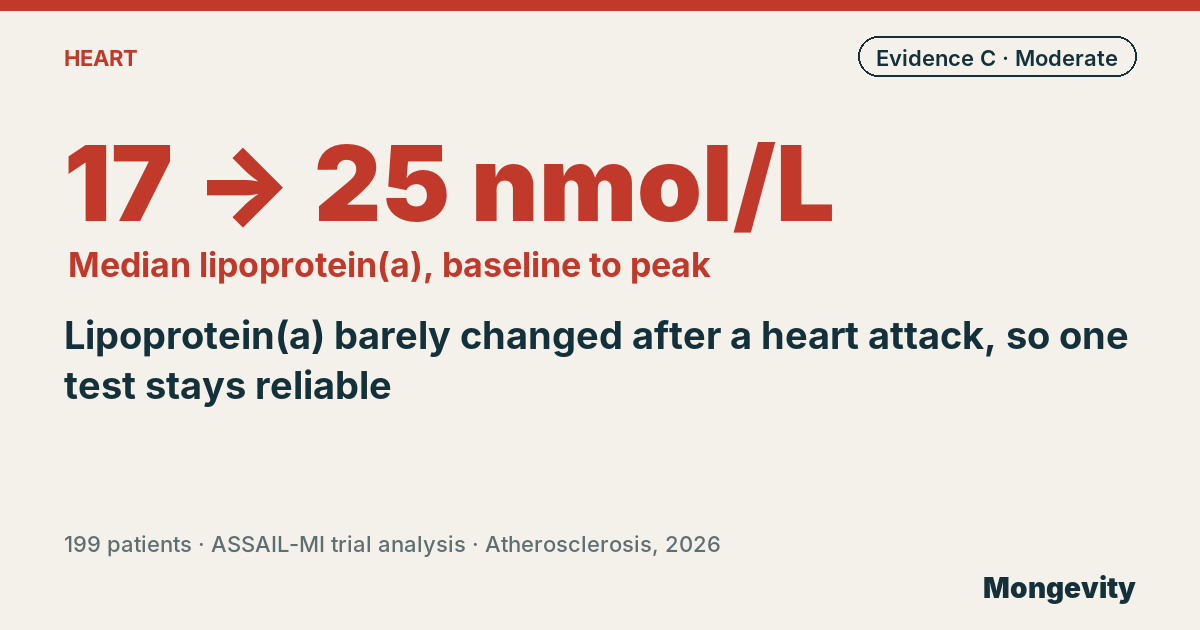
Lipoprotein(a) rose only slightly after a major heart attack, from a median of 17 to 25 nmol/L, in 199 patients from the ASSAIL-MI trial, published in September 2026 in Atherosclerosis. One heart blood test for Lp(a) stays reliable even soon after a heart attack.
Lipoprotein(a), or Lp(a), is a cholesterol-carrying particle whose level is mostly set by genes. High levels raise the risk of heart attacks and strokes, and experts recommend measuring it at least once in life. But many blood markers change sharply after a heart attack.
What did the study look at?
The data came from ASSAIL-MI, a trial in which 199 patients with a major heart attack (ST-elevation myocardial infarction) were assigned by chance to tocilizumab, a drug that blocks the inflammatory signal interleukin-6, or placebo within 6 hours of symptoms. Researchers measured Lp(a) at the start, at 24 hours, at 3 to 7 days, and at 3 and 6 months. They also measured heart damage with magnetic resonance imaging.
What did the study find about heart blood tests?
- The median Lp(a) at baseline was 17 nmol/L.
- It rose slightly to a peak of 25 nmol/L at 3 to 7 days, and was 22 nmol/L at 6 months.
- Few patients moved between low- and high-risk categories during follow-up.
- Tocilizumab did not affect Lp(a) levels.
- Baseline Lp(a) was not linked to how much heart muscle was saved, the final size of the damage or blockage of small vessels.
Why does this matter?
If Lp(a) changed a lot after a heart attack, a test taken in hospital could be misleading. This study shows the rise is statistically significant but not clinically relevant, so measuring Lp(a) during or soon after a heart attack still gives a useful picture of a person’s lifelong risk.
How solid is this evidence?
It’s moderate. Mongevity rates it C on our A-to-E scale: repeated measurements within a randomized trial, but the Lp(a) analysis itself is observational and the group is relatively small. Limits: most participants had low Lp(a), and the study was done in one country.
What are the open questions?
It’s unclear whether the same stability holds in people with very high Lp(a), and how new Lp(a)-lowering drugs will change practice after a heart attack.
What does this mean for you?
If you’ve had a heart attack or have a family history of early heart disease, ask your doctor whether your Lp(a) has been measured. One test is usually enough. If it’s high, controlling LDL cholesterol, blood pressure and other risk factors becomes even more important.
How do I explain this at dinner?
There’s an inherited cholesterol particle called lipoprotein(a) that raises heart risk. Doctors wondered if a heart attack scrambles its level. It barely moved, so a test in hospital is still reliable. A good question for the table: has anyone in our family had their Lp(a) checked?
In one sentence: after a major heart attack, Lp(a) rose slightly but not in a clinically relevant way, was not affected by blocking interleukin-6, and few patients changed risk category.
Questions and answers
- What is lipoprotein(a)?
- A cholesterol-carrying particle whose level is mostly genetic; high levels raise heart risk.
- Does it change after a heart attack?
- Only slightly: from a median of 17 to a peak of 25 nmol/L at 3 to 7 days.
- Can I trust a test taken in hospital?
- Yes; few patients changed risk category over six months.
- Did tocilizumab change Lp(a)?
- No.