Pressing a seed on the ear helped rosacea when added to standard treatment
Skin diseasesPart of a story we are following · 5 articles · See every update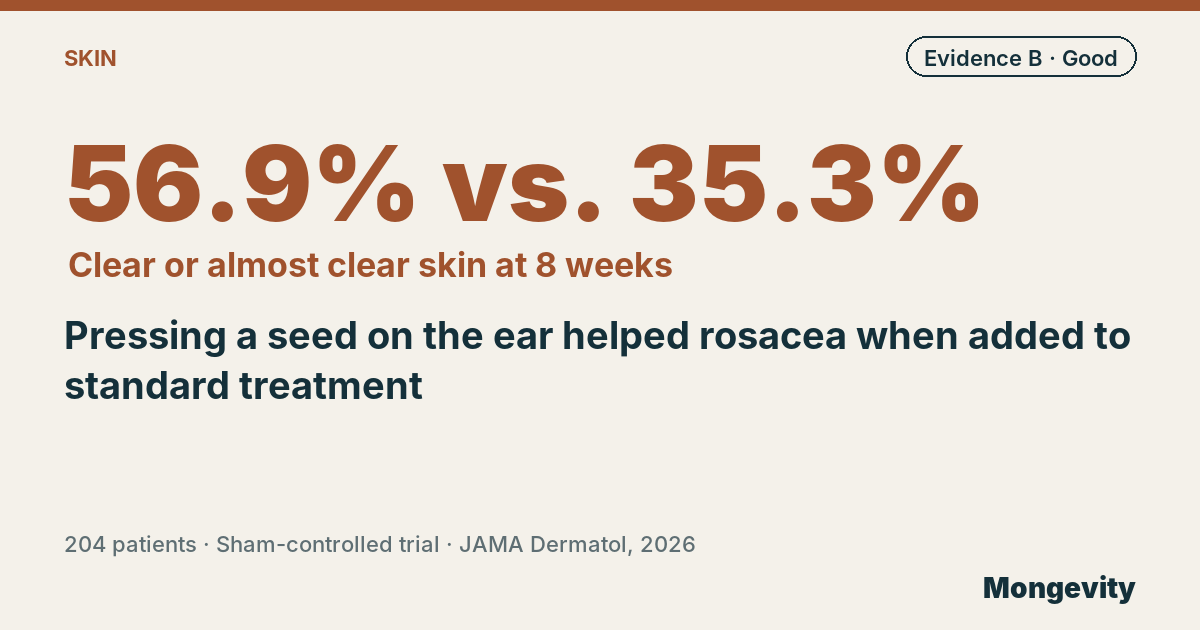
Pressing a seed taped on a specific ear spot helped 56.9% of people with rosacea reach clear or almost clear skin at 8 weeks vs. 35.3% with a sham spot, in a trial at a hospital in China published Oct. 14, 2026, in JAMA Dermatology. It adds a low-cost option for this skin disease.
Rosacea causes redness, flushing and bumps on the face, and it often keeps coming back despite treatment. One theory is that nerves and the immune system work together to drive flare-ups. Stimulating the vagus nerve branch in the ear with a device has shown benefit, but devices aren’t always easy to get.
What did the trial test?
At one hospital in Xi’an, China, from October 2025 to May 2026, 204 people with rosacea who were already on standard first-line treatment were split by chance into two groups of 102. One group had a small plant seed taped to the inner hollow of both ears, an area served by a branch of the vagus nerve. The other group had a seed on a different spot of the ear without that nerve supply. Both pressed the seed 3 times a day for 30 seconds, and extra during flare-ups, for 8 weeks. The doctors who judged the results didn’t know the group.
What did the study find about skin disease?
| Active point | 59.3% |
|---|---|
| Sham point | 7.4% |
The number needed to treat was 5. Blood markers of inflammation and nerve signaling, LL-37, CGRP, TNF-α and IL-6, fell more in the active group. At week 20, the active group still had lower severity and redness scores. There were no serious side effects. Most participants were women in their early 30s.
Why does this matter?
If confirmed, this is a cheap, device-free technique people could do at home, on demand, on top of their usual treatment. The blood marker findings also support the idea that the nerve-immune link matters in rosacea.
How solid is this evidence?
It’s good. Mongevity rates it B on our A-to-E scale: a randomized trial with a sham comparison and blinded assessors. Limits: it was done at a single center, participants could tell what they were doing, and most were young women, so results need confirmation in other groups.
What does this mean for you?
If you have rosacea, keep your usual treatment and protect your skin from the sun and known triggers. If you’re curious about ear acupressure, discuss it with your dermatologist; it seems low-risk, but it’s an add-on, not a replacement.
How do I explain this at dinner?
People with rosacea taped a tiny seed to a specific spot of their ear and pressed it a few times a day. More of them ended up with clear skin than people who pressed a spot elsewhere on the ear. A good question for the table: how could pressing the ear change the skin on the face?
In one sentence: pressing a seed on a vagus-nerve spot of the ear, added to standard care, helped clear rosacea more than a sham spot in a single-center trial.
Questions and answers
- What is auricular acupressure?
- Pressing specific spots of the ear; here, with a small seed taped over an area served by the vagus nerve.
- Did it help rosacea?
- At 8 weeks, 56.9% had clear or almost clear skin vs. 35.3% with a sham spot, on top of standard treatment.
- Can it replace my treatment?
- No: in this trial it was added to standard first-line therapy.