New US guidelines for hidradenitis suppurativa back four biologics and routine pain checks
Skin diseasesPart of a story we are following · 5 articles · See every update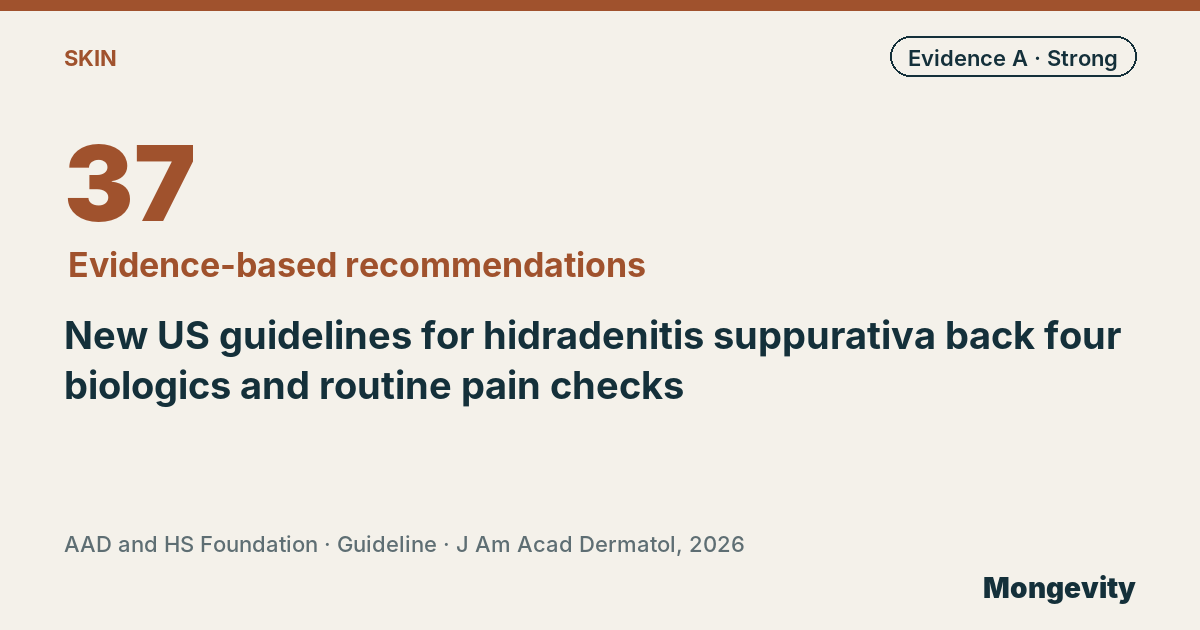
Joint US guidelines from the American Academy of Dermatology and the Hidradenitis Suppurativa Foundation, published Oct. 20, 2026, in Journal of the American Academy of Dermatology, make 37 recommendations, with strong support for four biologic drugs and for checking pain at every visit. It is a roadmap for a painful skin disease.
Hidradenitis suppurativa, or HS, is a long-lasting skin disease that causes painful lumps, abscesses and tunnels under the skin, usually in the armpits, groin and under the breasts. It affects 0.7% to 1.5% of people worldwide, often takes years to be diagnosed and can deeply affect daily life.
How were the guidelines made?
A workgroup systematically reviewed the research and used a standard method, called GRADE, to rate how certain the evidence was. From that, they wrote 37 recommendations. A “strong” recommendation means the benefits clearly outweigh the downsides for most people; a “conditional” one means it may suit some people, depending on the situation.
What do they strongly recommend?
- Four biologic drugs: adalimumab, bimekizumab, infliximab and secukinumab.
- Assessing pain routinely, as part of care.
What do they conditionally recommend?
| Type | Options |
|---|---|
| Creams and gels | Clindamycin, resorcinol, ruxolitinib |
| Antibiotic pills | Doxycycline, tetracycline, clindamycin with rifampin |
| Other medicines | IV ertapenem, spironolactone, short courses of steroids, upadacitinib |
| Procedures | Specific procedures, depending on the case |
| Lifestyle and support | Quitting tobacco, pain management, zinc, vitamin D if low |
Why does this matter for skin disease?
HS is often missed or treated as a simple infection. Clear guidelines help doctors offer effective options earlier, and the strong focus on pain recognizes how much it affects people’s lives.
How solid is this evidence?
The guideline itself is strong. Mongevity rates it A on our A-to-E scale, because it’s a systematic review with formal grading by a major professional society. The authors note that it can only be as good as the research available, and many conditional recommendations rest on limited studies.
What does this mean for you?
If you have painful lumps that keep coming back in the same areas, see a dermatologist and mention HS. If you already have it, ask whether a biologic could be an option for you, and say clearly how much pain you have. If you smoke, quitting is part of the recommended care.
How do I explain this at dinner?
There’s a painful skin disease called hidradenitis suppurativa that many people have without knowing its name. New US guidelines say four biologic drugs clearly help, and that doctors should ask about pain every time. A good question for the table: why do some diseases take so long to diagnose?
In one sentence: new US guidelines for hidradenitis suppurativa make 37 recommendations, strongly backing four biologics and routine pain checks.
Questions and answers
- What is hidradenitis suppurativa?
- A long-lasting skin disease that causes painful lumps, abscesses and tunnels under the skin in folds such as the armpits and groin.
- Which treatments are strongly recommended?
- Adalimumab, bimekizumab, infliximab and secukinumab, plus routine pain assessment.
- Can lifestyle changes help?
- The guidelines conditionally recommend quitting tobacco, and zinc and vitamin D repletion in some cases.