In a scarring blistering disease, fewer than half reached remission at every site
Skin diseasesPart of a story we are following · 5 articles · See every update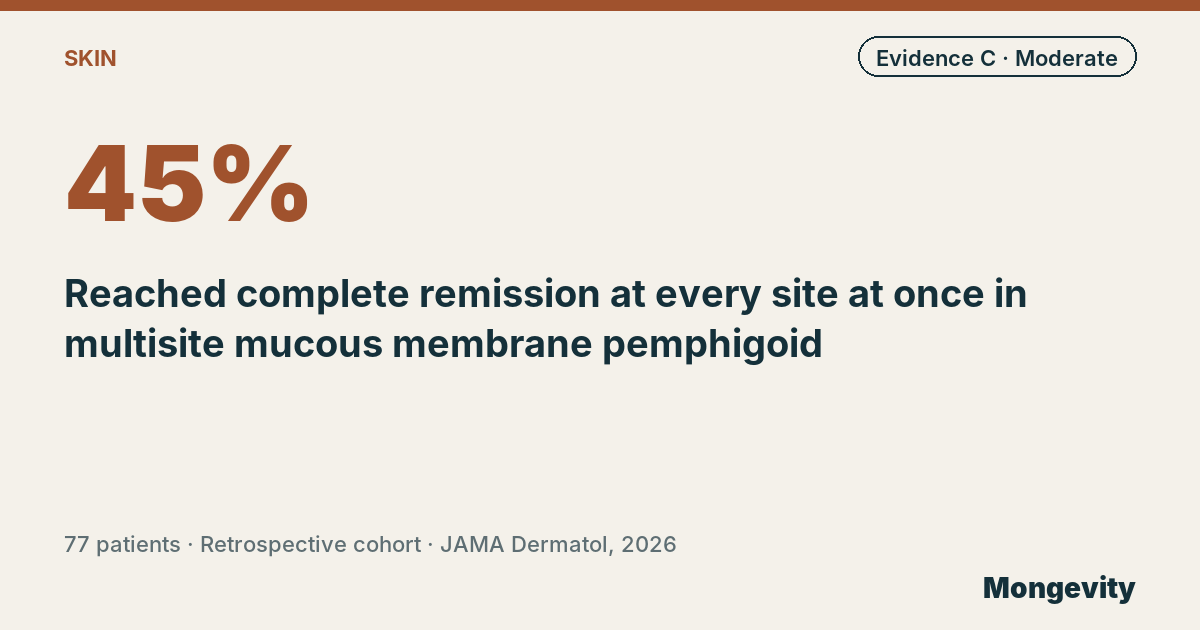
Only 45% of 77 people with mucous membrane pemphigoid affecting several body sites reached complete remission at every site at once, after a median of 32.0 months, in a study at a university center published Oct. 28, 2026, in JAMA Dermatology. Mouth and eye disease were the hardest to control in this skin disease.
Mucous membrane pemphigoid is a rare autoimmune disease in which the immune system attacks the linings of the mouth, eyes, nose, throat and genitals, causing blisters and scarring. Scarring in the eyes or throat can be serious.
What did the study look at?
Researchers reviewed the records of 77 people treated at a dermatology and eye referral center in Texas between 2013 and 2025. Each had the disease confirmed by lab tests, involvement of at least 2 body sites, and at least 12 months of follow-up after treatment.
What did the study find about skin disease?
| Outcome | Result |
|---|---|
| High-risk disease (eyes, throat, esophagus or genitals) | 88% |
| Mouth involvement | 95% |
| Eye involvement | 66% |
| Complete remission at every site at once | 45% |
| Median time to that remission | 32.0 months |
| Remission at 1 or more sites | 83% |
Among the 64 people who reached remission at some site, 44% later relapsed, most often in the mouth and eyes. Regimens based on rituximab and JAK inhibitors were linked to high rates of improvement. Serious side effects were most frequent with cyclophosphamide alone and with JAK inhibitors.
Why does this matter?
Patients and doctors often measure success site by site. This study shows that persistent mouth and eye disease frequently keeps people from full control, and that future studies should measure remission across every site.
How solid is this evidence?
It’s moderate. Mongevity rates it C on our A-to-E scale. For a rare disease, 77 patients is a meaningful group, but it’s a retrospective study from one specialized center, without comparison groups, so it can’t show which treatment is best.
What does this mean for you?
If you have mouth sores or eye irritation that don’t heal, see a doctor; early diagnosis helps prevent scarring. People with this disease benefit from care that coordinates dermatology, eye and other specialists. Regular eye checks matter even when the eyes feel fine, because scarring can progress quietly.
How do I explain this at dinner?
In a rare disease, the body’s defenses attack the soft linings of the mouth and eyes. Doctors found that even when treatment helped, it often took years to calm every spot. A good question for the table: why is it harder to fix a problem that shows up in many places?
In one sentence: in multisite mucous membrane pemphigoid, fewer than half of patients reached remission at every site, with mouth and eye disease the hardest to control.
Questions and answers
- What is mucous membrane pemphigoid?
- A rare autoimmune disease that causes blisters and scarring on the linings of the mouth, eyes, nose, throat and genitals.
- How often do people reach full remission?
- In this study, 45% reached complete remission at every site, after a median of 32.0 months.
- Which treatments helped most?
- Rituximab-based regimens and JAK inhibitors were linked to high rates of improvement, but the study can't compare treatments fairly.