With eczema under control, tapering a biologic may keep it calm in some people
EczemaPart of a story we are following · 3 articles · See every update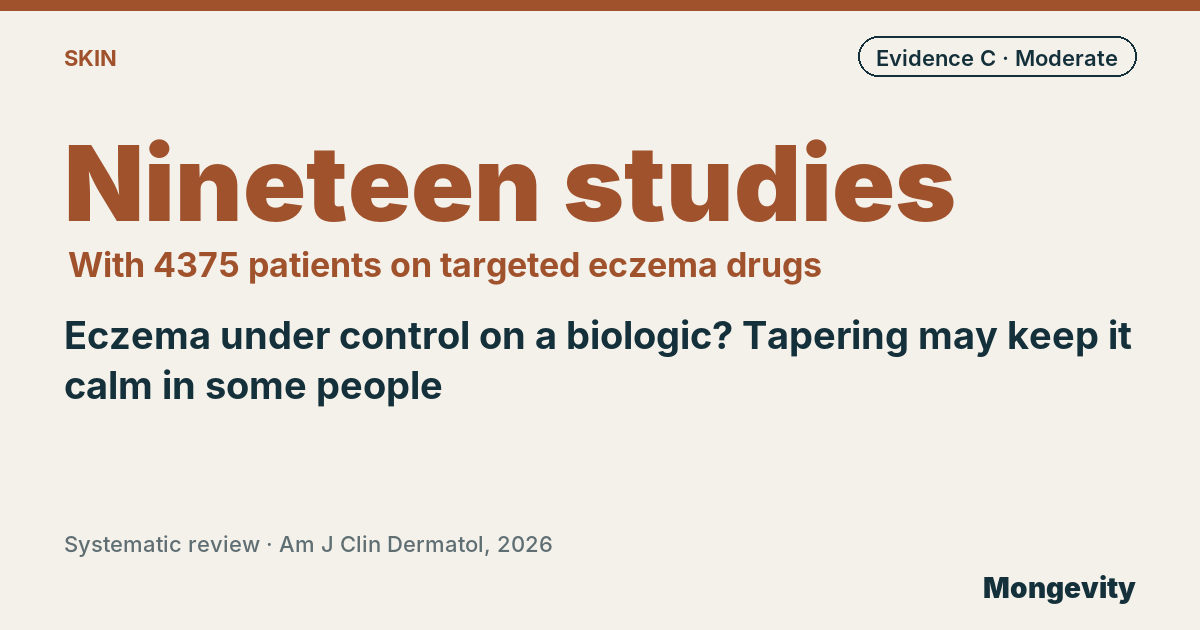
Tapering targeted eczema drugs often kept disease controlled better than stopping abruptly, with results varying by drug, according to a systematic review of nineteen studies with 4375 patients published Oct. 14, 2026, in American Journal of Clinical Dermatology. People with well-controlled eczema may not need full doses indefinitely.
Moderate to severe atopic dermatitis, the most common form of eczema, often needs long-term treatment with biologic drugs or JAK inhibitor pills. Once the skin is under control, many patients and doctors ask: can the dose be lowered, or the drug spaced out?
What did the study do?
Researchers searched three databases from 2010 onward for studies that lowered the dose or stopped dupilumab, tralokinumab, lebrikizumab, abrocitinib, baricitinib or upadacitinib. They included nineteen studies with 4375 patients.
What did the study find about eczema?
The share of patients who stayed in control after tapering varied widely:
| Drug | Sustained response after tapering |
|---|---|
| Dupilumab | 30-100% |
| Lebrikizumab | 67-82% |
| Baricitinib | 45-61% |
| Upadacitinib | 47-61% |
| Tralokinumab | 25-50% |
| Abrocitinib | 0-60% |
Lower disease activity at the start and early improvement often predicted lasting control. For dupilumab, older age, lower body mass index and a type of eczema with itchy nodules were linked to sustained response in some groups. Upadacitinib had higher relapse rates after stopping.
Why does this matter?
Lowering the dose of a long-term medicine can reduce cost, injections and side effects. This review suggests that, for well-controlled patients, gradual tapering is often a better strategy than stopping all at once.
How solid is this evidence?
It’s moderate. Mongevity rates it C on our A-to-E scale: a systematic review, but the included studies differed a lot in design, tapering methods, follow-up and how they defined success, so the ranges are wide and drugs can’t be compared directly.
What are the open questions?
Longer prospective studies are needed to find the best way to taper each drug and to identify who can safely step down.
What does this mean for you?
If your eczema has been well controlled for a while on a biologic or JAK inhibitor, ask your dermatologist whether tapering could be an option for you, and agree on a plan for what to do if it flares. Don’t stop or space out doses on your own.
How do I explain this at dinner?
People with severe eczema often need medicine for a long time. A review found that, once the skin is calm, slowly lowering the dose kept many people under control, though it depended on the drug and the person. A good question for the table: how do you know when you can ease off a treatment?
In one sentence: in well-controlled atopic dermatitis, gradually tapering targeted drugs often preserved control better than stopping, but results varied by drug and patient.
Questions and answers
- Can eczema drugs be tapered?
- In selected well-controlled patients, tapering often kept disease controlled, with results varying by drug.
- Which drug had the highest sustained response?
- Ranges were widest for dupilumab (30-100%); lebrikizumab ranged 67-82%.
- Should I stop my medicine?
- Not on your own: talk to your dermatologist about a tapering plan.