Mohs surgery for melanoma was linked to survival as good as or better than standard
Melanoma treatmentPart of a story we are following · 3 articles · See every update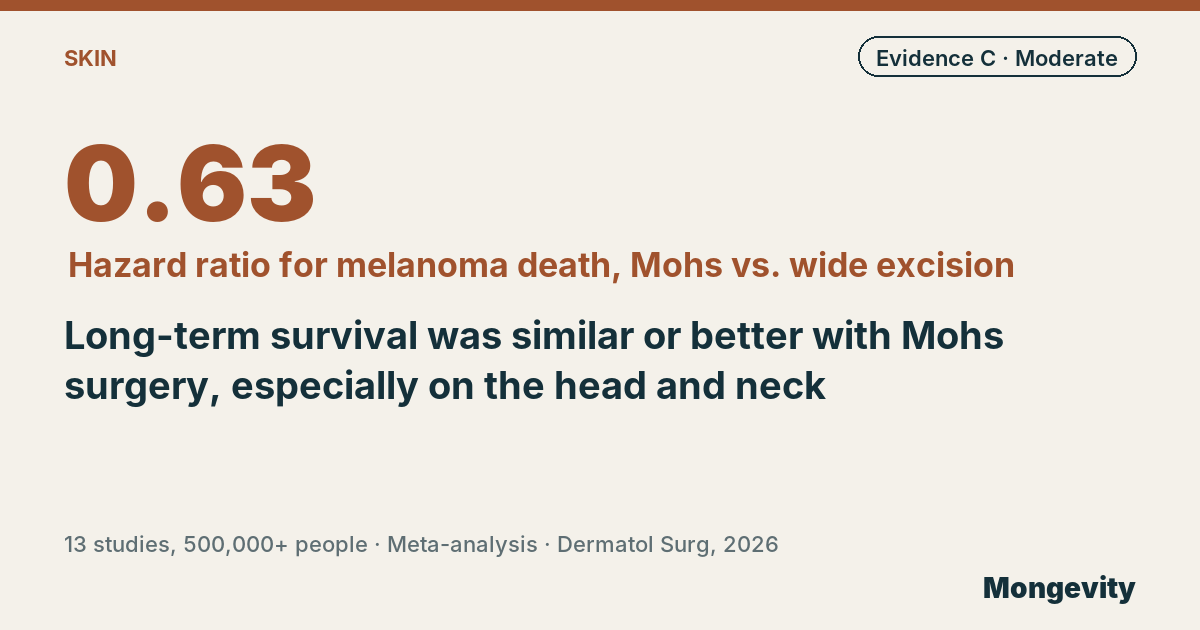
Mohs surgery for melanoma was linked to similar or better long-term survival than wide local excision, especially for head and neck melanomas, in a meta-analysis of thirteen studies with more than 500,000 people published Oct. 28, 2026, in Dermatologic Surgery. It supports a tissue-sparing option for melanoma.
The standard surgery for melanoma, the most dangerous common skin cancer, is wide local excision: removing the tumor with a set margin of healthy skin. Mohs surgery is different: the surgeon removes thin layers and checks each under the microscope during the operation, removing only what’s needed. It’s tissue-sparing, which matters on the face. But there are no randomized trials comparing long-term survival.
What did the review include?
Thirteen studies with more than 500,000 individuals, comparing overall or melanoma-specific survival after Mohs surgery or wide local excision, using adjusted hazard ratios.
What did the study find about melanoma?
| Outcome, Mohs vs. wide excision | Hazard ratio |
|---|---|
| Long-term overall survival | 0.93 |
| Long-term melanoma-specific survival | 0.63 |
| Head and neck melanoma, overall survival | 0.92 |
| Lentigo maligna subtype, overall survival | 0.89 |
A hazard ratio below 1 favors Mohs. At 5 years, there was no significant difference in overall or melanoma-specific survival. The authors conclude Mohs was consistently linked to survival similar to or better than wide excision.
Why does this matter?
For melanomas on the face, ears or scalp, saving healthy tissue can make a big difference in appearance and function. Evidence that it doesn’t compromise survival supports offering Mohs in selected cases.
How solid is this evidence?
It’s moderate. Mongevity rates it C on our A-to-E scale. The studies were observational, so patients chosen for Mohs may have differed from those who had wide excision, for example in tumor type or access to care. There are no randomized trials, and reading frozen sections for melanoma is technically demanding.
What does this mean for you?
If you’re diagnosed with melanoma, especially on the head or neck, ask your dermatologist or surgeon which surgery is recommended for your case and why. Experience with Mohs for melanoma varies between centers. Check your skin regularly and see a doctor for any changing mole. Survival after melanoma depends most on catching it early, whatever surgery is used.
How do I explain this at dinner?
To remove a skin cancer, surgeons can cut a wide circle or peel thin layers and check each one under a microscope. The careful layer method seemed to work at least as well for survival. A good question for the table: when is it worth going slow and careful?
In one sentence: Mohs surgery for melanoma was linked to survival similar to or better than standard wide excision in a large meta-analysis of observational studies.
Questions and answers
- What is Mohs surgery?
- A technique that removes skin cancer in thin layers and checks each under the microscope during surgery, sparing healthy tissue.
- Is Mohs safe for melanoma?
- In this meta-analysis it was linked to long-term survival similar to or better than wide local excision, but the studies weren't randomized.
- Which melanomas benefit most?
- The overall survival benefit was mainly seen in head and neck melanomas and the lentigo maligna subtype.