Surgery for hidradenitis suppurativa sharply cut pain at 6 months
Skin diseasesPart of a story we are following · 5 articles · See every update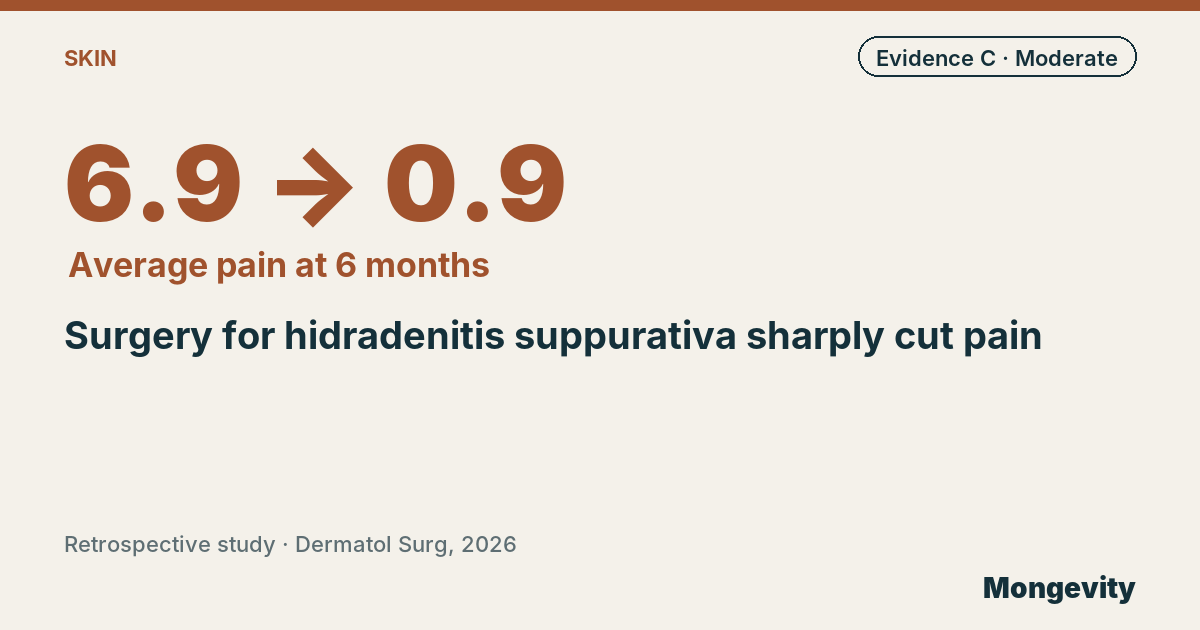
Local surgical removal of hidradenitis suppurativa lesions lowered average pain from 6.9 to 0.9 on a visual scale at 6 months in a study of eighty-three patients at one center, published Oct. 26, 2026, in Dermatologic Surgery. Surgery can bring big relief in this skin disease.
Hidradenitis suppurativa, or HS, is a chronic skin disease that causes painful lumps, abscesses and tunnels under the skin, usually in the armpits, groin and other skin folds. Pain is one of its hardest parts. Medicines help, but tunnels often need surgery.
What did the study do?
Researchers reviewed consecutive patients who had local excision of HS lesions at a specialized dermatologic surgery unit between May 2024 and May 2025. They measured pain on a visual analog scale before surgery and 6 months after. They also measured how far the tunnels extended, both by touch and by high-frequency ultrasound.
What did the study find about skin disease?
- Eighty-three patients with 194 lesions were included.
- Average pain fell from 6.9 before surgery to 0.9 at 6 months, a mean drop of 6.0 points.
- The drop was larger in people with more advanced disease.
- When ultrasound showed the tunnels were longer than they felt by touch, residual pain was slightly higher, but the link was weak.
- Tunnel length on ultrasound by itself wasn’t linked to pain outcomes.
Why does this matter?
Pain shapes daily life for people with HS, from sleep to work to relationships. These results suggest that local surgery can bring substantial relief across disease severity levels, and that it deserves a place alongside medical treatment.
How solid is this evidence?
It’s moderate. Mongevity rates it C on our A-to-E scale: a study of consecutive patients with a clear before-and-after measurement, but retrospective, at a single specialized center and without a comparison group. Surgical skill and patient selection may differ elsewhere.
What are the open questions?
Studies still need to show how long the relief lasts beyond 6 months, how often lesions come back, and how surgery is best combined with biologic drugs.
What does this mean for you?
If you have HS with painful lumps that keep returning in the same place, ask your dermatologist whether surgery could be an option, alongside medicines. Tell your doctor how much pain you have; pain assessment is part of good HS care.
How do I explain this at dinner?
Hidradenitis suppurativa causes painful lumps and tunnels under the skin. In a study of eighty-three people, surgery to remove the affected skin brought average pain down from 6.9 to 0.9 on a pain scale six months later. A good question for the table: why do some diseases need both medicine and surgery?
In one sentence: local surgery for hidradenitis suppurativa sharply reduced pain at 6 months across severity levels, though the study had no comparison group.
Questions and answers
- What is hidradenitis suppurativa?
- A chronic skin disease with painful lumps, abscesses and tunnels under the skin in folds such as the armpits and groin.
- How much did surgery reduce pain?
- Average pain fell from 6.9 to 0.9 on a visual pain scale at 6 months.
- Does ultrasound help predict pain?
- Only weakly: a gap between ultrasound and touch findings was slightly linked to residual pain.