About a quarter of dogs had subtle balance deficits their owners hadn’t noticed
Senior dogsPart of a story we are following · 6 articles · See every update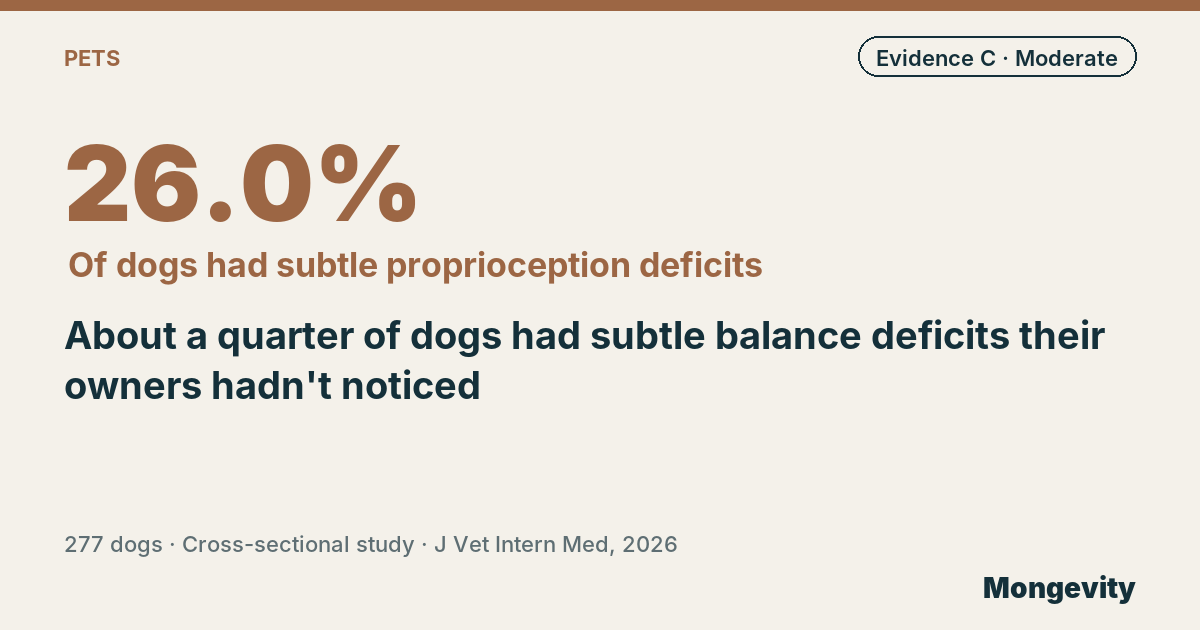
Subtle proprioception deficits that owners hadn’t noticed appeared in 26.0% of 277 dogs seen for non-neurologic reasons at a university hospital, becoming more common with age, in a study published in September 2026 in Journal of Veterinary Internal Medicine. Senior dogs may benefit from balance checks.
Proprioception is a dog’s built-in sense of where its legs and body are in space, without needing to look. It keeps the gait steady and coordinated. Vets usually test it only when a dog shows signs of nervous system disease. But how common are subtle deficits in dogs that seem healthy?
What did the study do?
At the Cornell University veterinary hospital, trained examiners tested 277 dogs that had come in for non-neurologic reasons, such as eye, skin or dental problems, and whose owners reported no neurologic or gait problems. They checked hopping and how quickly each paw returned to its normal position after being flipped. Dogs were grouped by how far along they were in their expected lifespan.
What did the study find about senior dogs?
- Seventy-two dogs, 26.0%, had a subtle proprioception deficit their owners hadn’t noticed.
- Deficits became more common with age: each year of age was linked to higher odds (odds ratio 1.22), as was being further along in life expectancy (1.31).
- They weren’t linked to sex or to chondrodystrophic breeds, short-legged dogs such as Dachshunds or Corgis that are prone to disc disease.
Why does this matter?
The findings suggest that mild proprioceptive changes can be part of normal aging in dogs, rather than always signaling active disease. For vets, an isolated, mild deficit in an older dog without other worrying signs may not need an extensive workup right away, while still staying alert to signs of a progressive problem.
How solid is this evidence?
It’s moderate. Mongevity rates it C on our A-to-E scale: a careful prospective exam of a decent number of dogs, but at a single teaching hospital, at one point in time, and without follow-up to see which deficits progressed.
What are the open questions?
Following dogs over time would show which mild deficits stay stable and which mark the start of a neurologic disease.
What does this mean for you?
Watch how your older dog walks: scuffing nails, knuckling over, wobbling or trouble on stairs or slippery floors are worth mentioning to your vet. Non-slip rugs, ramps and keeping your dog at a healthy weight help senior dogs move safely.
How do I explain this at dinner?
Vets tested dogs that came in for things like skin or teeth, and about one in four had a small, hidden problem sensing where their paws were. It got more common with age, like balance in older people. A good question for the table: how does your dog handle slippery floors?
In one sentence: subtle proprioception deficits were found in 26.0% of dogs without known neurologic disease, more often in older dogs, suggesting they can be part of normal aging.
Questions and answers
- What is proprioception?
- A dog's sense of where its legs and body are in space, without needing to look.
- How common were deficits?
- 26.0% of dogs seen for non-neurologic reasons had a subtle deficit.
- Is it always a disease?
- Not necessarily: it became more common with age and may be part of normal aging.