Most healthy cats accepted a kidney diet in a home trial
Cats and kidney diseasePart of a story we are following · 3 articles · See every update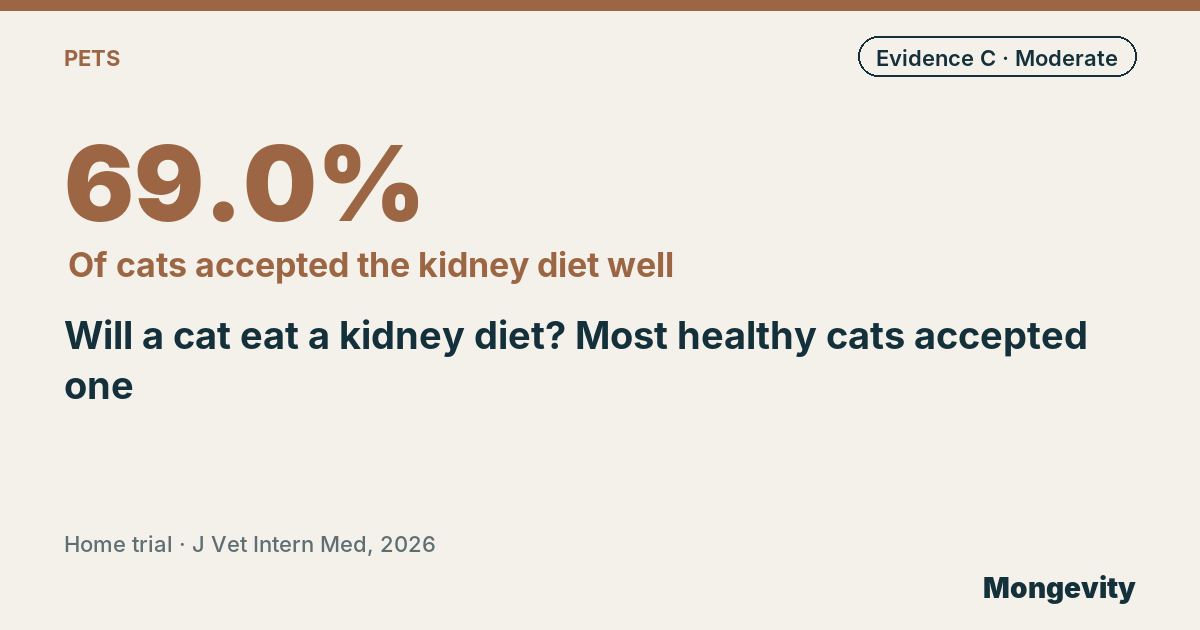
Owners rated acceptance of a wet kidney diet as positive in 69.0% of healthy cats and would offer it to 78.6% if prescribed, in an in-home trial published in September 2026 in Journal of Veterinary Internal Medicine. For kidney disease in cats, a diet only helps if the cat eats it.
Chronic kidney disease is common in older cats, and a special renal diet, with less phosphorus among other changes, is one of the most effective treatments. But cats are famously picky, and owners often worry their cat won’t eat it.
What did the study do?
Forty-two healthy cats living with 31 owners took part at home, in three 6-day phases: first only the renal diet, then only their usual wet food, then both offered side by side. Owners recorded how quickly cats started eating, how much they ate and their behavior around food.
What did the study find about kidney disease in cats?
- Owners rated acceptance of the renal diet as positive for 69.0% of cats, negative for 23.8% and neutral for 7.1%.
- Cats tended to eat more of their usual food than the renal diet, but how quickly they started eating didn’t differ significantly.
- When both foods were offered together, neither was significantly preferred; owners thought 47.6% preferred their usual food and 45.2% the renal diet.
- If prescribed, owners said they would offer the renal diet to 78.6% of the cats.
Why does this matter?
Fear that a cat will refuse a kidney diet can delay a treatment that helps. These results suggest most cats will accept a well-designed wet renal diet, which may encourage owners and vets to start it earlier.
How solid is this evidence?
It’s moderate. Mongevity rates it C on our A-to-E scale: a structured home trial, but small, open-label, short and done in healthy cats, not cats with kidney disease, whose appetite is often poorer. It tested one commercial product.
What are the open questions?
It would help to repeat this in cats with kidney disease and over longer periods, since long-term acceptance is what matters for treatment.
What does this mean for you?
If your cat is diagnosed with kidney disease, ask your vet about a renal diet early. Switch gradually over several days, mixing it with the old food, and offer it warm. If your cat refuses, ask about other renal brands or textures rather than giving up.
How do I explain this at dinner?
Kidney diets help cats with kidney disease, but owners worry their cats won’t eat them. In a home test, most healthy cats accepted a wet kidney diet, and when given a choice, they didn’t clearly prefer their usual food. A good question for the table: how picky is your pet?
In one sentence: most healthy cats accepted a wet renal diet in a short home trial, a reassuring sign for owners of cats who may need one.
Questions and answers
- Why do cats with kidney disease need a special diet?
- Renal diets, with less phosphorus among other changes, are among the most effective treatments.
- Did cats accept the renal diet?
- Owners rated acceptance as positive for 69.0% of healthy cats.
- Did cats prefer their usual food?
- When both were offered, neither was significantly preferred.