For older dogs, behavior and mobility mattered more to quality of life than illness count
Senior dogsPart of a story we are following · 6 articles · See every update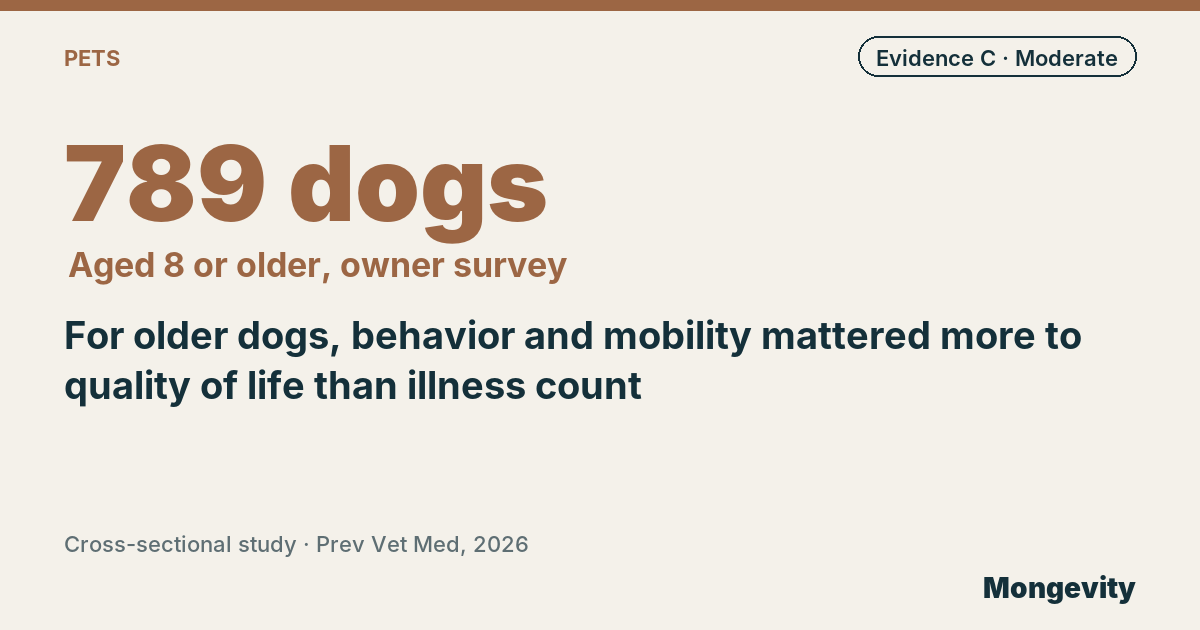
Sensitivity to touch and unexplained vocalizing were linked to poorer quality of life, while better mobility was linked to better quality of life, in a survey of owners of 789 dogs aged 8 or older published Sept. 18, 2026, in Preventive Veterinary Medicine. For senior dogs, behavior and movement mattered more than the number of illnesses.
Older dogs often have several health problems at once, such as arthritis, dental disease or heart issues. But how much each one affects a dog’s quality of life isn’t always obvious.
What did the study do?
Researchers analyzed anonymous online questionnaires from owners of 789 dogs aged 8 or older. Owners reported chronic health conditions, behavioral changes, how well their dog moved and how they rated its quality of life, using parts of a standard canine quality-of-life framework.
What did the study find about senior dogs?
After accounting for age, overall health burden and other factors:
| Linked to poorer quality of life | Odds ratio |
|---|---|
| Increased response to being touched | 2.65 |
| Vocalizing without an obvious reason | 2.04 |
Better mobility was linked to lower odds of poorer quality of life (odds ratio 0.56). Surprisingly, the total number of health conditions was not independently linked to quality of life.
Why does this matter?
Signs such as flinching when touched, whining for no clear reason or moving stiffly may reflect pain, anxiety or cognitive changes. These everyday observations can tell vets and owners more about a dog’s well-being than a list of diagnoses, and many are treatable.
How solid is this evidence?
It’s moderate. Mongevity rates it C on our A-to-E scale: a large owner survey with careful statistics, but cross-sectional and based on owner reports, so the links can’t be read as causes. Owners who chose to answer may differ from others.
What are the open questions?
It would help to follow dogs over time and test whether treating pain, improving mobility or reducing anxiety raises quality of life.
What does this mean for you?
Pay attention to small changes in your older dog: sensitivity to touch, unexplained crying, stiffness or reluctance to walk. Mention them to your vet, since pain relief, physiotherapy, weight control and environmental changes can help a lot.
How do I explain this at dinner?
In a survey of owners of older dogs, what mattered most for the dog’s quality of life wasn’t how many illnesses it had, but whether it moved well and didn’t cry or flinch for no reason. A good question for the table: how do you know if a pet is happy?
In one sentence: in older dogs, behavior and mobility, more than the number of illnesses, were linked to owner-rated quality of life.
Questions and answers
- What was linked to poorer quality of life?
- Increased sensitivity to touch (odds ratio 2.65) and vocalizing without an apparent reason (2.04).
- Did mobility matter?
- Yes: better mobility was linked to lower odds of poorer quality of life (odds ratio 0.56).
- What about the number of illnesses?
- It wasn't independently linked to quality of life.