In older dogs, accidents indoors may signal cognitive decline, not just bladder trouble
Senior dogsPart of a story we are following · 6 articles · See every update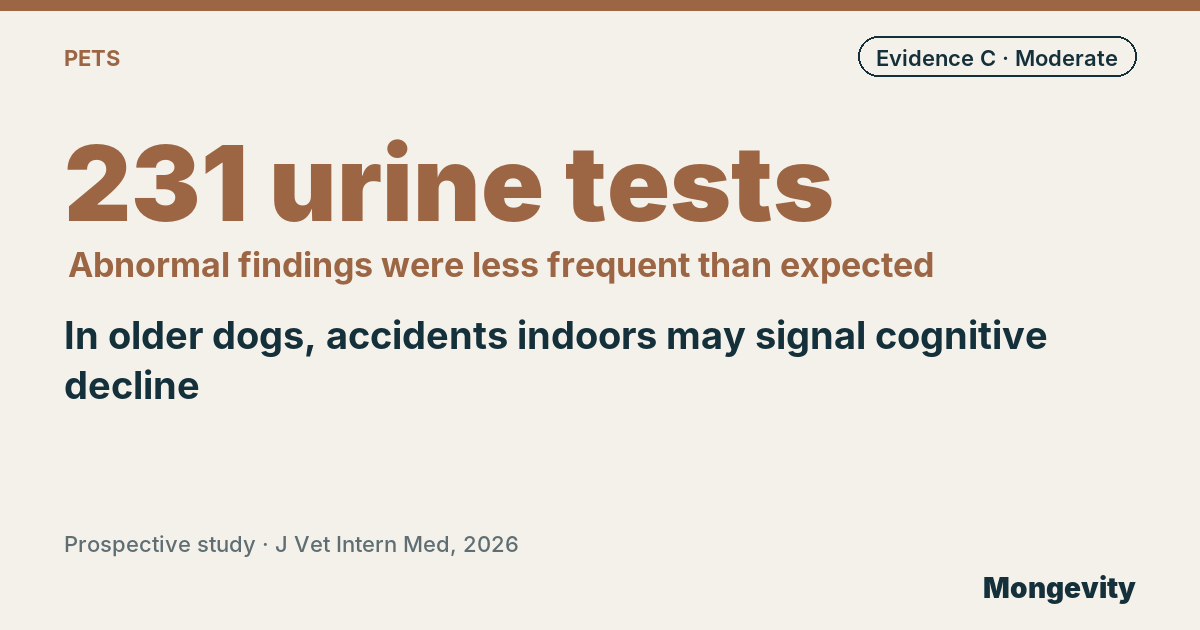
House soiling in eighty-four aging dogs was linked to more dilute urine and poorer performance on thinking tests, while urinary abnormalities were less frequent than expected, in a study published in September 2026 in Journal of Veterinary Internal Medicine. For senior dogs, accidents indoors may signal cognitive decline.
When an older dog starts having accidents in the house, owners and vets usually think first of bladder infections or kidney disease. In older people, dementia and urinary problems often feed each other.
What did the study do?
Researchers followed eighty-four client-owned dogs enrolled in a long-term aging study. The dogs’ mean age was 12.77 years. Twice a year, the dogs had a urine test, owners completed a canine dementia scale that included questions about soiling, and the dogs did a battery of thinking tests.
What did the study find about senior dogs?
- Of 231 urine tests, abnormalities such as white blood cells, blood or bacteria were less common than expected: 19 showed pyuria, 14 blood and 11 bacteria. Protein was common, in 194.
- Urine concentration fell with age.
- Soiling scores rose with age and with more dilute urine, and both remained significant in combined models.
- Dogs with higher soiling scores did worse on tests of self-control and problem solving.
Why does this matter?
The results suggest that accidents in an older dog aren’t always a sign of urinary or systemic disease. They could also be a sign of cognitive decline, which deserves attention in its own right.
How solid is this evidence?
It’s moderate. Mongevity rates it C on our A-to-E scale: a prospective study with repeated urine and cognitive tests, but small, observational and based partly on owner reports. It can’t show that cognitive decline causes soiling.
What are the open questions?
Larger studies are needed to confirm the link and to test whether managing cognitive decline, for example with enrichment or diet, reduces soiling.
What does this mean for you?
If your older dog starts having accidents, see your vet first to rule out infections, kidney disease or diabetes. If tests are normal, ask about cognitive dysfunction. More frequent outings, a consistent routine and mental enrichment can help.
How do I explain this at dinner?
When old dogs start peeing in the house, we usually blame the bladder. But in a study, accidents were more linked to dilute urine and to doing worse on thinking tests than to urinary infections. A good question for the table: how would you notice that a pet’s mind is changing?
In one sentence: in aging dogs, house soiling was linked to dilute urine and poorer thinking-test performance, suggesting it may also signal cognitive decline.
Questions and answers
- Are accidents in old dogs always a bladder problem?
- Not necessarily: in this study they were linked to cognitive test performance.
- Were urinary infections common?
- Less than expected: 19 of 231 urine tests showed pyuria and 11 showed bacteria.
- What should I do?
- See your vet to rule out medical causes, then ask about cognitive dysfunction.