Platelet-rich plasma didn’t clearly rebuild knee cartilage, a review of 12 trials finds
Knee osteoarthritisPart of a story we are following · 3 articles · See every update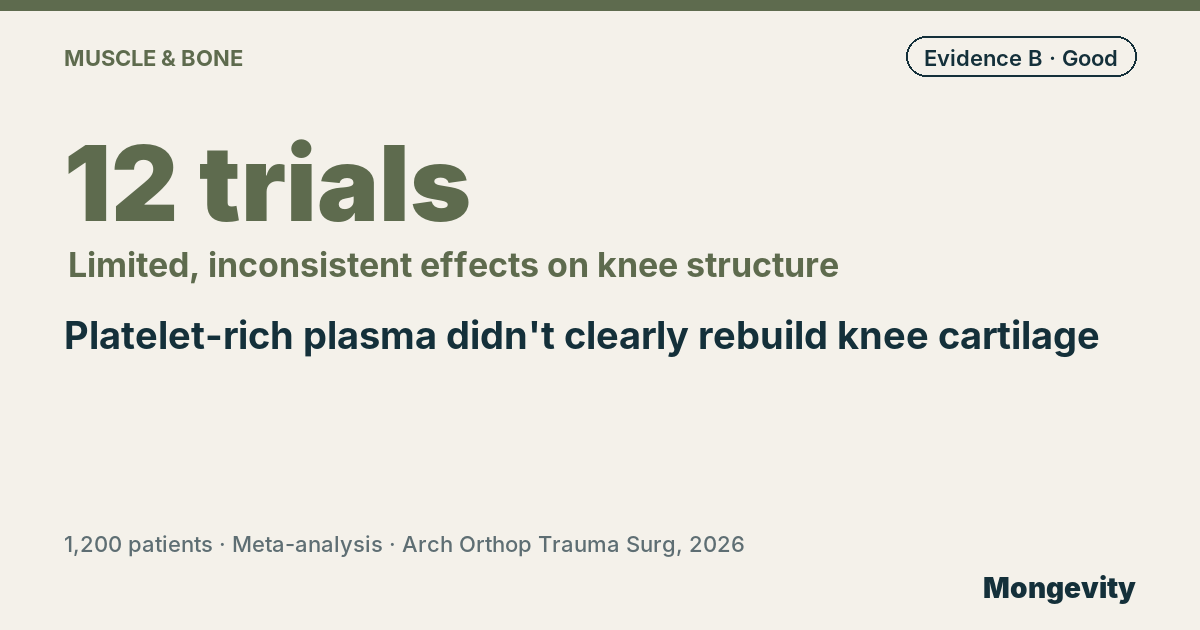
Platelet-rich plasma injections had limited and inconsistent effects on knee structure on imaging in osteoarthritis, according to a meta-analysis of 12 randomized trials published Oct. 22, 2026, in Archives of Orthopaedic and Trauma Surgery. PRP is not a proven way to rebuild cartilage in knee osteoarthritis.
Platelet-rich plasma, or PRP, is made by concentrating platelets from a person’s own blood and injecting them into a joint. It’s widely offered for knee osteoarthritis, sometimes with claims that it can repair cartilage.
What did the study do?
Researchers searched three databases up to May 2026 for randomized controlled trials that measured the structural effects of PRP in knee osteoarthritis using imaging such as MRI. They included 12 trials with 1,200 patients.
What did the study find about knee osteoarthritis?
| Structural outcome | PRP vs. control |
|---|---|
| Cartilage behind the kneecap | Greater improvement (SMD 0.94) |
| Cartilage on the inner shinbone | No significant difference |
| Progression of cartilage defects | No significant difference |
| Bone marrow swelling on MRI | Reduced (SMD -0.40) |
| Synovitis, inflammation of the joint lining | No overall difference |
| Bone spurs and cysts | No difference |
The authors conclude that PRP showed limited and inconsistent effects on knee structure and that the few favorable findings should be interpreted with caution.
Why does this matter?
PRP can be costly and is often paid out of pocket. Claims that it “regrows cartilage” go beyond the evidence. Some patients report less pain, but this review shows no clear proof that PRP slows or reverses structural damage.
How solid is this evidence?
It’s good. Mongevity rates it B on our A-to-E scale: a systematic review and meta-analysis of randomized trials. Limits: the trials were relatively small, used different PRP preparations and imaging methods, and a few positive results may reflect chance.
What are the open questions?
High-quality trials with standardized PRP preparations and imaging endpoints are needed to settle whether any type of PRP protects the knee’s structure.
What does this mean for you?
If you have knee osteoarthritis, the treatments with the strongest evidence are exercise, especially strengthening, and weight management if needed, with pain relief as appropriate. If you’re considering PRP, ask what benefit to realistically expect, how much it costs and what evidence supports it.
How do I explain this at dinner?
Platelet-rich plasma injections are often sold as a way to rebuild knee cartilage. Pooling 12 trials, researchers found little consistent change in the knee’s structure on scans. A good question for the table: how can we tell a promising treatment from a proven one?
In one sentence: platelet-rich plasma had limited and inconsistent effects on knee structure in osteoarthritis, giving no clear evidence that it rebuilds cartilage.
Questions and answers
- What is PRP?
- Platelet-rich plasma: a concentrate of platelets from the person's own blood injected into a joint.
- Does PRP rebuild knee cartilage?
- Not clearly: effects on structure were limited and inconsistent across 12 trials.
- What helps knee osteoarthritis?
- Exercise, especially strengthening, weight management if needed and appropriate pain relief.