Fatty liver: some blood test panels came close to replacing a liver biopsy
Fatty liverPart of a story we are following · 3 articles · See every update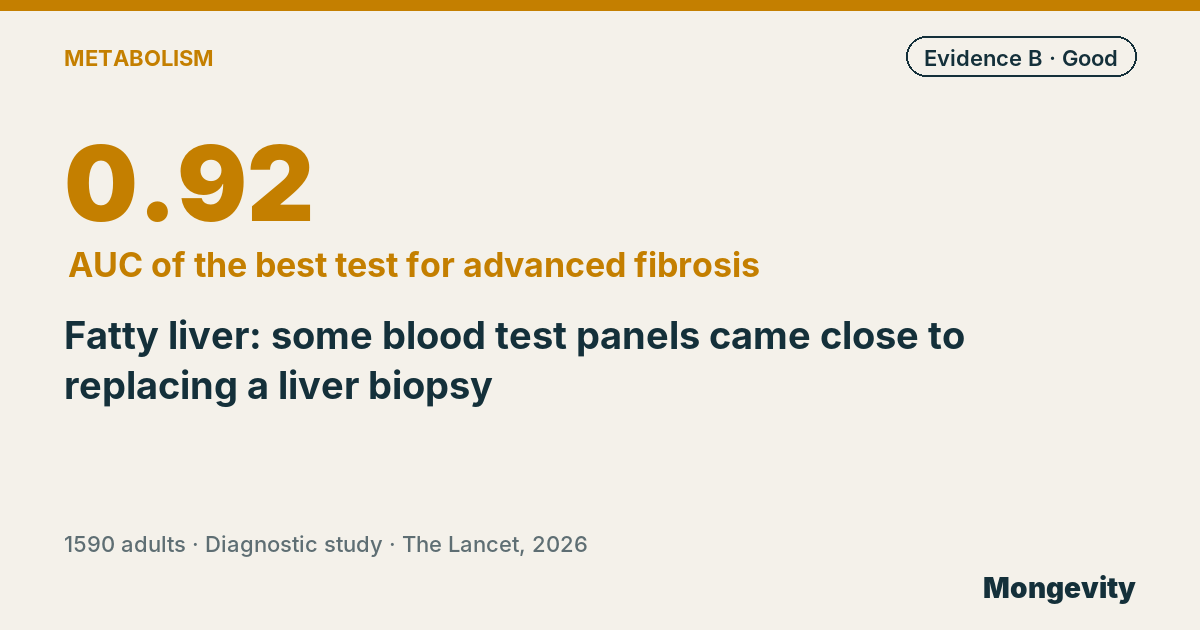
Multimarker blood panels came closest to a liver biopsy among 30 non-invasive tests in 1590 adults with fatty liver disease, in the LITMUS study across Europe published Oct. 31, 2026, in The Lancet. A protein panel led for at-risk disease and advanced scarring.
Metabolic dysfunction-associated steatotic liver disease, or MASLD, is the new name for fatty liver disease linked to excess weight, diabetes and high cholesterol. It’s very common. In some people it progresses to inflammation, called MASH, and then to scarring, fibrosis and cirrhosis. Now that approved drugs exist, doctors need to find the people at risk without a liver biopsy.
What did the study do?
Across 13 countries in Europe and the USA, researchers enrolled 1590 adults with biopsy-confirmed MASLD between 2018 and 2023. They compared 12 single markers and 18 multimarker panels, blood tests and imaging, with expert-scored biopsies. The yardstick was the AUC, a measure where higher is better and a perfect test scores one; a value above 0.80 was set as good enough to potentially replace a biopsy.
What did the study find about fatty liver?
| What the test tried to detect | Best performers (AUC) |
|---|---|
| At-risk MASH | SomaSignal, 0.83 |
| Advanced fibrosis | SomaSignal 0.92, FibroMeter-VCTE 0.87, Agile 3+ and TSP2 0.84, NIS4 0.82 |
| Cirrhosis | FibroMeter-VCTE 0.94, SomaSignal 0.92, Agile 3+ 0.88, Agile 4 0.87 |
Single markers performed variably and were often too weak. No test other than SomaSignal reached the threshold for at-risk MASH. A two-step approach, starting with a common liver enzyme blood test, gamma-glutamyl transferase, met the threshold for both advanced fibrosis and at-risk MASH.
Why does this matter?
Biopsies are invasive, costly and not practical for the many people with fatty liver. Knowing which tests work best helps doctors choose who needs treatment and helps regulators and guideline writers.
How solid is this evidence?
It’s good. Mongevity rates it B on our A-to-E scale: a large, prospective, multicenter study using biopsy as the reference. Limits: participants were people already referred for biopsy, so results may differ in primary care, and some tests are not widely available or are costly.
What does this mean for you?
If you have excess weight, type 2 diabetes or abnormal liver tests, ask your doctor whether you should be checked for fatty liver and fibrosis, often starting with a simple blood score or a liver stiffness scan. Weight loss, physical activity and limiting alcohol all help the liver.
How do I explain this at dinner?
Fatty liver is common, and a few people develop scarring that can become serious. Researchers compared 30 tests against biopsy, and some combined blood tests came close to replacing the needle. A good question for the table: when was your liver last checked?
In one sentence: in people with fatty liver disease, multimarker blood and imaging panels detected advanced scarring and at-risk disease well enough to potentially avoid many biopsies.
Questions and answers
- What is MASLD?
- The new name for fatty liver disease linked to metabolic problems such as excess weight and diabetes.
- Which tests worked best?
- Multimarker panels; SomaSignal reached an AUC of 0.92 for advanced fibrosis, and FibroMeter-VCTE 0.94 for cirrhosis.
- Can these replace a biopsy?
- Several panels met the study's threshold for potentially replacing biopsy in some situations.