Blocking fructose processing cut liver fat and improved insulin response in a small trial
Fatty liverPart of a story we are following · 3 articles · See every update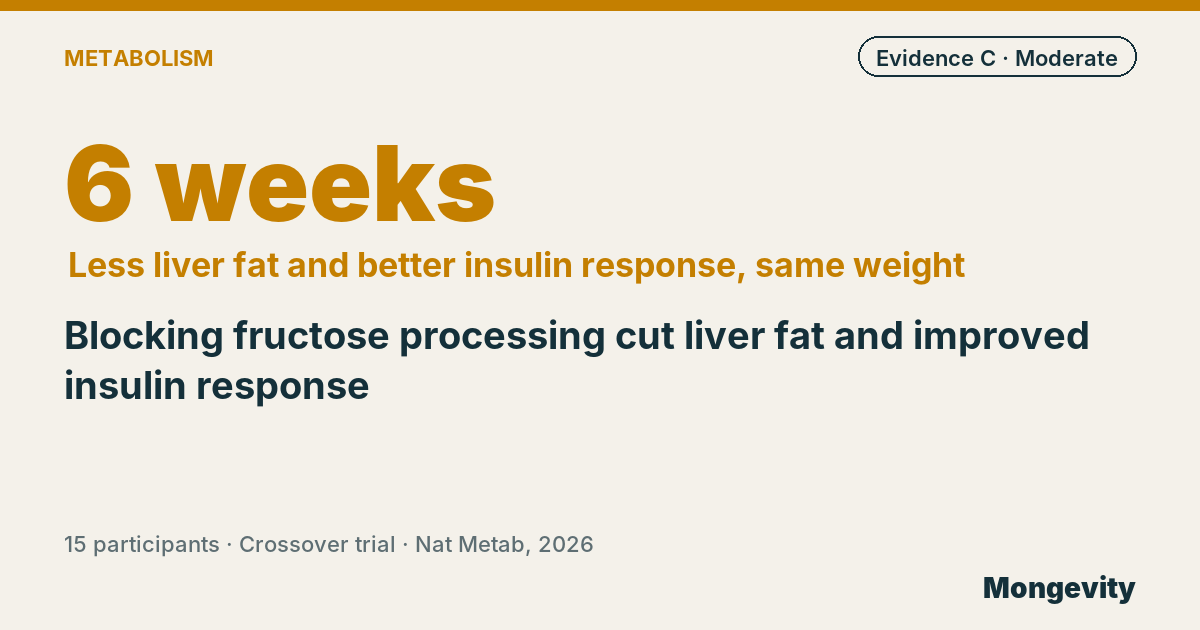
Six weeks of a drug that blocks the first step of fructose metabolism improved the liver’s response to insulin and reduced liver fat, without changing body weight, in a placebo-controlled crossover trial of 15 people with fatty liver disease published Oct. 7, 2026, in Nature Metabolism. It points to fructose as a driver of fatty liver.
Fructose, the sugar in fruit and, in much larger amounts, in table sugar and sweetened drinks, is processed mainly by the liver. Too much is thought to fuel fat buildup in the liver and insulin resistance. Ketohexokinase is the enzyme that starts fructose processing.
What did the trial test?
15 people with metabolic dysfunction-associated steatotic liver disease (MASLD), the new name for fatty liver linked to metabolism, took an experimental ketohexokinase blocker, PF-06835919, and a placebo, each for 6 weeks, in random order. The main outcome was the liver’s sensitivity to insulin, measured by how well insulin suppresses the liver’s own glucose production. Researchers also measured fat distribution and fat burning.
What did the study find about fatty liver?
- Body weight did not change.
- The liver became more sensitive to insulin.
- Fat inside the liver, and its saturated fat content, decreased.
- Insulin worked better in muscles and fat tissue too, and fat distribution improved.
- Fat burning at night increased.
- There were changes in blood fat particles and in hormones released by the liver.
Why does this matter?
Fatty liver affects a large share of adults and can progress to inflammation, scarring and cirrhosis. This study supports the idea that fructose metabolism is a driver of the disease, and that blocking it has benefits beyond the liver. It also reinforces why reducing sugary drinks matters.
How solid is this evidence?
It’s early. Mongevity rates it C on our A-to-E scale: a randomized, placebo-controlled crossover trial with detailed measurements, but with only 15 participants and 6 weeks of treatment. The abstract doesn’t give the size of the changes, and the drug is experimental and not available.
What are the open questions?
Larger, longer trials are needed to know whether this approach reduces liver inflammation and scarring, and whether it’s safe over time.
What does this mean for you?
There’s no fructose-blocking pill to take. But you can reduce the fructose load on your liver today: cut down on sugary drinks, juices and sweets. Whole fruit is fine, because its fiber slows absorption. Weight loss, activity and less alcohol also help fatty liver.
How do I explain this at dinner?
Researchers gave people with fatty liver a pill that stops the liver from processing fructose, the sugar abundant in soda. In six weeks, their liver fat fell and insulin worked better, even though they didn’t lose weight. A good question for the table: how many sweet drinks do we have in a week?
In one sentence: in people with MASLD, 6 weeks of ketohexokinase inhibition improved hepatic insulin sensitivity and reduced liver fat without changing body weight.
Questions and answers
- What is MASLD?
- Metabolic dysfunction-associated steatotic liver disease, the new name for fatty liver linked to metabolism.
- What does the drug do?
- It blocks ketohexokinase, the enzyme that starts fructose processing in the liver.
- What changed?
- Liver insulin sensitivity improved and liver fat decreased, without weight change.
- Can I take it?
- No; it is experimental. Reducing sugary drinks is a practical step.