A cholesterol injection on top of a statin narrowed brain artery blockages after a stroke
CholesterolPart of a story we are following · 3 articles · See every update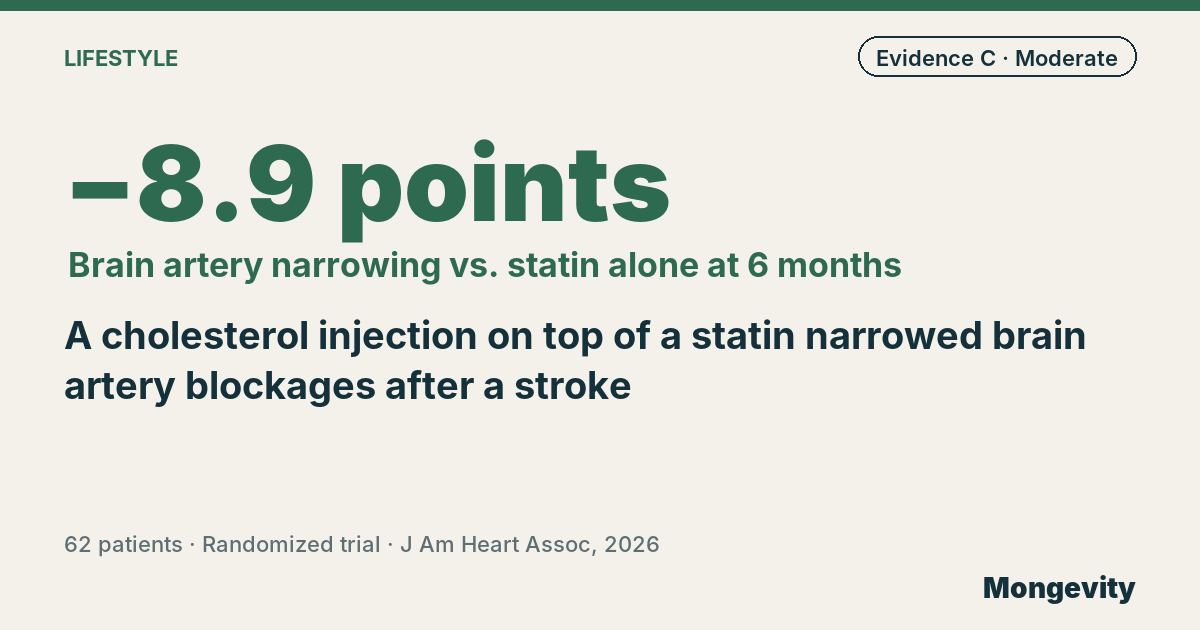
Adding the PCSK9 inhibitor alirocumab to a high-intensity statin for 6 months reduced brain artery narrowing by 8.9 percentage points more than the statin alone in a small randomized trial of 62 stroke patients, published Sept. 9, 2026, in Journal of the American Heart Association. Very low cholesterol may help shrink these plaques.
Some strokes happen because fatty plaque narrows the arteries inside the skull, a condition called intracranial atherosclerosis. It is especially common in Asia, and strokes tend to recur despite treatment. PCSK9 inhibitors are injections that lower LDL cholesterol much further than statins alone.
What did the trial test?
62 patients with a stroke caused by intracranial atherosclerosis, with a median age of 66 years and 77% men, were assigned by chance, 1 to 2, to alirocumab (75 mg every 2 weeks) plus a high-intensity statin, or the statin alone, for 6 months. Patients knew their treatment, but those reading the scans did not. The main outcome was the change in artery narrowing, measured with high-resolution magnetic resonance imaging of the vessel wall.
What did the study find about cholesterol?
- The narrowing shrank by a median of 7.1% with alirocumab, while it changed by −1.2% (slightly worse) with the statin alone.
- After adjusting for baseline, the difference was 8.9 percentage points.
- LDL cholesterol below 55 mg/dL was reached by 85% with alirocumab vs. 13% with the statin alone.
- A new stroke occurred in 5% vs. 13%, a difference that was not statistically significant.
- No serious adverse events were reported.
Why does this matter?
Brain artery narrowing is hard to treat; stents in these arteries have had disappointing results. If very low LDL can actually shrink plaques, PCSK9 inhibitors could become an important part of preventing repeat strokes.
How solid is this evidence?
It’s moderate. Mongevity rates it C on our A-to-E scale: a randomized trial with blinded assessment of scans, but small, open-label and with an imaging result as the main outcome. The difference in repeat strokes was not significant.
What are the open questions?
Larger trials are needed to see whether narrowing the arteries translates into fewer strokes and better recovery over the long term.
What does this mean for you?
If you’ve had a stroke caused by narrowed brain arteries, ask your neurologist what your LDL target is and whether you’re reaching it. If a statin alone isn’t enough, other medicines, including PCSK9 inhibitors, may be an option. Blood pressure control and not smoking are also key.
How do I explain this at dinner?
People who had a stroke from clogged arteries in the brain got an extra cholesterol-lowering injection on top of their statin. Six months later, the narrowing in their brain arteries had shrunk, and most had reached a very low cholesterol level. A good question for the table: do you know your LDL target?
In one sentence: in patients with stroke due to intracranial atherosclerosis, adding alirocumab to a high-intensity statin for 6 months reduced arterial narrowing and improved LDL control, without a significant difference in recurrent stroke.
Questions and answers
- What is intracranial atherosclerosis?
- Fatty plaque that narrows the arteries inside the skull and can cause strokes.
- What is alirocumab?
- A PCSK9 inhibitor injection that lowers LDL cholesterol beyond what statins achieve.
- How much did the narrowing improve?
- 8.9 percentage points more than with the statin alone after 6 months.
- Did it prevent strokes?
- New strokes were 5% vs. 13%, not a statistically significant difference.