A face-name test spotted early decline, a dementia warning sign, as well as the MoCA
Alzheimer's and dementiaPart of a story we are following · 6 articles · See every update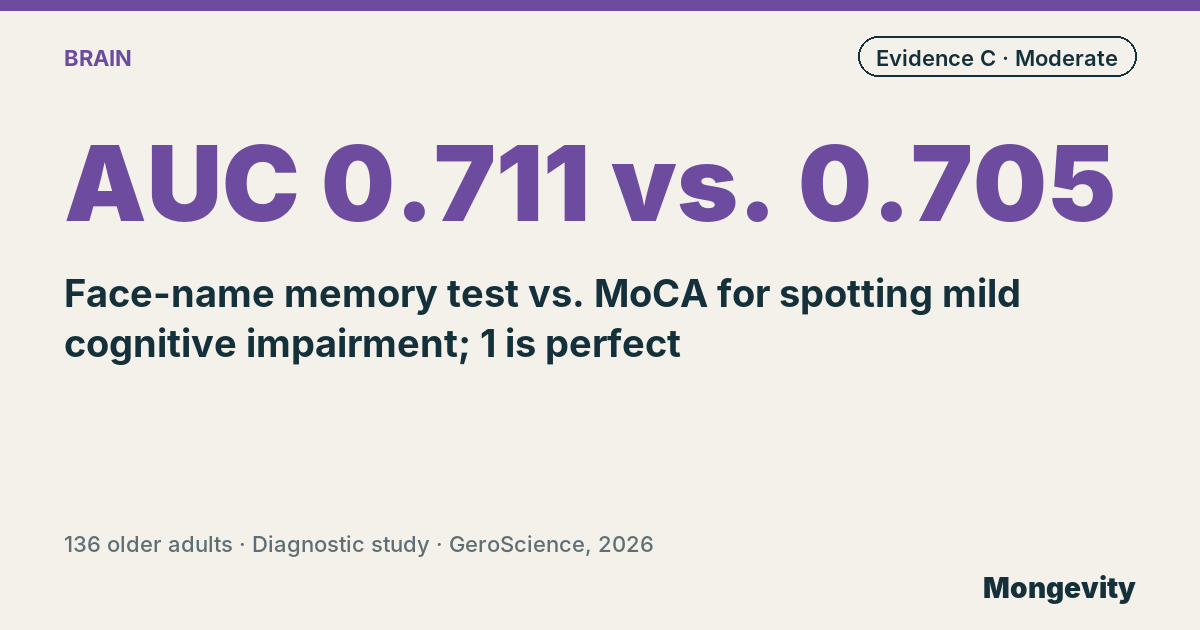
Delayed recall on a face-name memory test told apart people with mild cognitive impairment about as well as the MoCA (AUC 0.711 vs. 0.705), with higher specificity, in a study of 136 older adults in Italy published Oct. 30, 2026, in GeroScience. A quick test could help spot early decline before dementia.
Forgetting a name right after meeting someone is common. But difficulty linking faces and names after a delay may be one of the earliest signs of brain diseases like Alzheimer’s.
The delayed part of the test identified mild cognitive impairment about as well as the Montreal Cognitive Assessment (MoCA), one of the most widely used screening tests.
What is the face-name test?
The Italian Face-Name Association Test shows people faces paired with names. It measures how many they remember right away, how many they can recall freely after a delay, and the types of errors they make.
What did the study test?
136 older adults had a full neuropsychological assessment and were classified as cognitively healthy (72) or with mild cognitive impairment (64). Researchers compared their scores on the face-name test with the MoCA, adjusting for age and education.
What did the study find about dementia?
- Healthy participants did better on immediate and delayed free recall.
- Delayed free recall was the strongest single predictor of mild cognitive impairment.
- Accuracy was similar for delayed free recall (AUC 0.711) and the MoCA (AUC 0.705), with no significant difference.
- The MoCA was more sensitive, catching more cases, while the face-name test was more specific, with fewer false alarms.
Why does this matter?
Combining tests that measure different things can make early detection more reliable. A face-name test captures a type of memory that standard screening may not fully cover.
How solid is this evidence?
It’s moderate. Mongevity rates it C on our A-to-E scale. The study was small and done in Italy with an Italian version of the test. Accuracy was moderate for both tests, and results need confirmation in other groups and languages.
What does this mean for you?
Occasionally forgetting names is normal. If memory problems are new, getting worse or affecting daily life, talk to a doctor. A full evaluation uses several tests, not just one.
How do I explain this at dinner?
Doctors showed older people faces with names and later asked them to remember. People with early memory problems had more trouble, and the test worked about as well as a common screening quiz. A good question for the table: what tricks do you use to remember someone’s name?
In one sentence: a face-name memory test helped spot early cognitive decline about as well as a standard screening test, with fewer false alarms.
Questions and answers
- What is mild cognitive impairment?
- A decline in memory or thinking greater than expected for age, but not enough to interfere much with daily life.
- Is the face-name test better than the MoCA?
- In this study, accuracy was similar (AUC 0.711 vs. 0.705); the MoCA was more sensitive and the face-name test more specific.
- Is forgetting names a sign of dementia?
- Not on its own. See a doctor if memory problems are new, worsening or affect daily life.