No questionnaire predicted dementia very well; the best score was fair
Alzheimer's and dementiaPart of a story we are following · 6 articles · See every update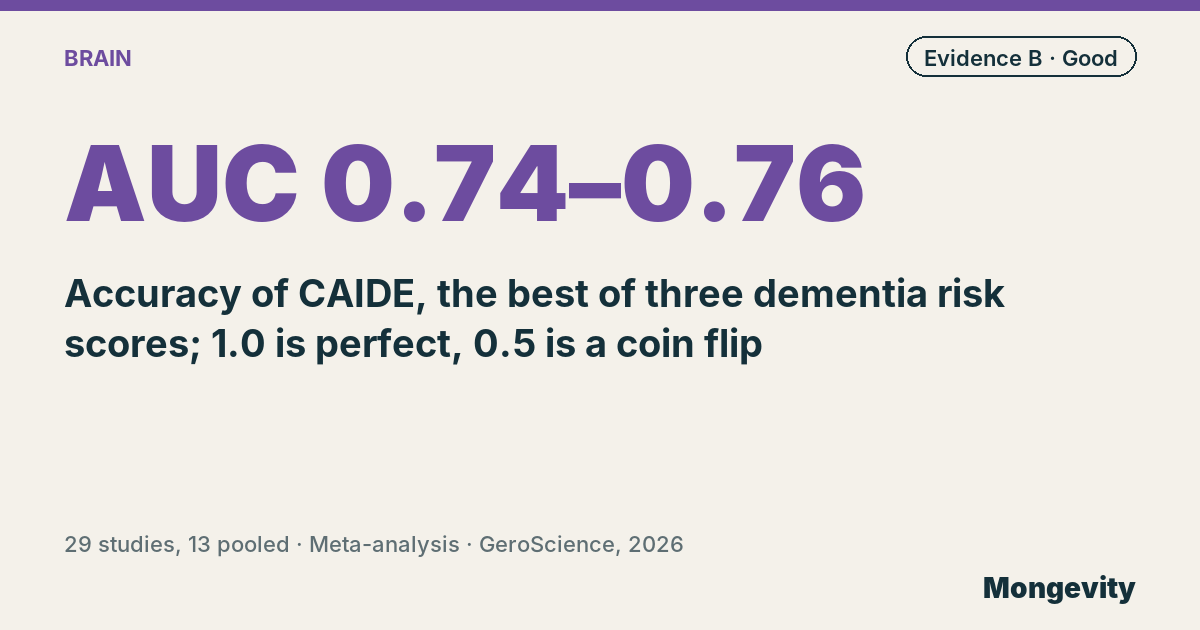
CAIDE predicted dementia best among risk questionnaires, with an accuracy (AUC) of 0.74 to 0.76, while the original LIBRA did worst, at 0.51 to 0.60, in a meta-analysis published Oct. 26, 2026, in GeroScience. Dementia risk scores are fair, not great.
Several questionnaires promise to estimate your risk of developing dementia from things like age, education, blood pressure, cholesterol and physical activity. Many are free online. But how good are they at predicting who will actually get dementia?
Only three had enough comparable data to combine: CAIDE, LIBRA and ANU-ADRI. CAIDE did best, but none was close to perfect.
How is accuracy measured?
The researchers used the AUC, a number that runs from coin-flip level, where the score is no better than chance at telling who will develop dementia, up to 1, where it’s always right. The closer to 1, the better.
What did the review include?
29 studies met the criteria, and 13 went into the pooled analyses. They followed middle-aged and older people who started without dementia, for short, medium and long periods.
What did the study find about dementia?
| Score | Accuracy (AUC) |
|---|---|
| CAIDE | 0.74 to 0.76 |
| ANU-ADRI | about 0.65 to 0.71 |
| LIBRA, modified | 0.65 to 0.67, and 0.70 at medium follow-up |
| LIBRA, original | 0.51 to 0.60 |
CAIDE worked best in people who were middle-aged when first assessed and who were followed for longer. The original LIBRA was close to chance; the modified version did better.
Why does this matter?
A large share of dementia risk is linked to factors that can change, such as blood pressure, physical activity, smoking and hearing. A good risk score can help doctors spot who would benefit most from acting early. But a fair score can also wrongly worry some people and falsely reassure others.
How solid is this evidence?
It’s good. Mongevity rates it B on our A-to-E scale. A meta-analysis of cohort studies is a solid way to judge a prediction tool. But only three of ten scores could be pooled, results varied by age and follow-up, and the authors call for more testing in different populations.
What does this mean for you?
Online dementia risk calculators can be a starting point for a conversation, not a diagnosis. Whatever your score, the factors behind it, like blood pressure, activity and hearing, are worth working on. If you’re worried about your memory, see a doctor rather than relying on a questionnaire.
How do I explain this at dinner?
Some quizzes try to guess who might have memory problems many years from now. Scientists checked how well they work: the best one is decent, but far from a crystal ball. A good question for the table: what’s the difference between a guess and a sure thing?
In one sentence: dementia risk scores can help sort people by risk, and CAIDE did best, but none predicts the future with high accuracy.
Questions and answers
- Which dementia risk score works best?
- In this meta-analysis, CAIDE, with an AUC of 0.74 to 0.76, especially in middle-aged people followed for longer.
- Can an online quiz tell me if I'll get dementia?
- No. Even the best score is only fair at predicting it. It can help start a conversation with a doctor about modifiable risk factors.
- What is an AUC?
- A measure of how well a test separates people who will and won't develop a condition: the closer to 1, the better.