Even after correcting for donor bias, most former NFL players likely had CTE
Head impacts and sportPart of a story we are following · 3 articles · See every update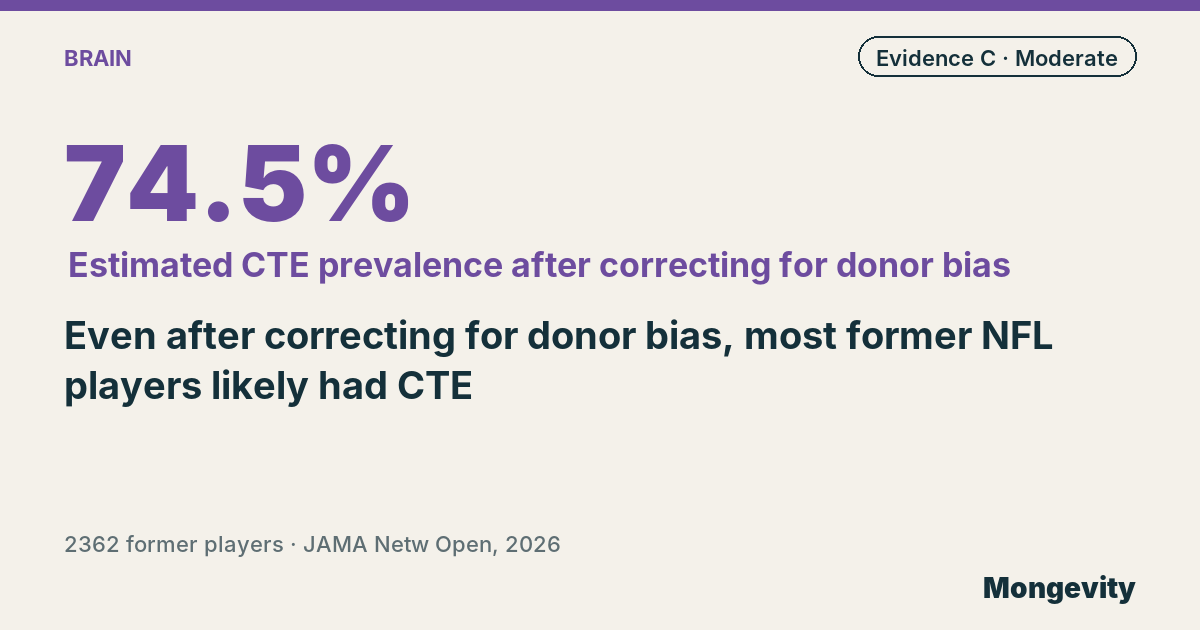
An estimated 74.5% of former NFL players who died between 2008 and 2023 had chronic traumatic encephalopathy, after correcting for the bias of studying only donated brains, in a US study published Oct. 1, 2026, in JAMA Network Open. Repeated head injuries in football leave a lasting mark.
Chronic traumatic encephalopathy, or CTE, is a brain disease linked to repeated head impacts, diagnosed only by examining the brain after death. Most of what we know about CTE in American football players comes from brains donated by families, often because the player had symptoms. That makes donated brains more likely to show disease.
What did the study do?
Researchers combined data from a large brain bank with national death records for 2362 former NFL players who died between 2008 and 2023: 396 brain donors and 1966 nondonors. They estimated how much more likely players with CTE were to have their brains donated, and used that to adjust the prevalence found in donors.
What did the study find about head injuries?
- Among donors, 362 of 387 (93.5%) had CTE.
- Players with CTE were estimated to be more likely to be donated, with a selection ratio of 4.97.
- After correcting for this bias, an estimated 74.5% of all deceased former NFL players had CTE.
- A conservative lower estimate was 63.7%.
- An estimated 27.2% had dementia during life.
Why does this matter?
The study confirms that donor-based studies overestimate CTE, but shows that the bias doesn’t explain away the problem: the disease appears very common among former professional players. That’s relevant for players, families, leagues and the design of safer sport.
How solid is this evidence?
It’s moderate. Mongevity rates it C on our A-to-E scale: a careful method to correct a well-known bias, using national data. But the correction relies on assumptions about why families donate, CTE diagnosis on autopsy doesn’t always match symptoms in life, and the results apply to professional players, not to people who played football casually or at youth levels.
What are the open questions?
It remains unclear how CTE findings translate into symptoms, how much risk comes from the number and type of head impacts, and what reduces it.
What does this mean for you?
If you play or coach contact sports, take head impacts seriously: report symptoms after a hit, follow return-to-play rules and support rule changes that reduce head contact. If a former player you know has memory, mood or behavior changes, encourage a medical evaluation.
How do I explain this at dinner?
Studies of donated brains suggested almost all former NFL players had a brain disease from head hits, but those brains were often donated because something seemed wrong. Correcting for that, researchers still estimated that most of them had it. A good question for the table: how should sports protect players’ brains?
In one sentence: after correcting for donor bias, an estimated 74.5% of former NFL players who died between 2008 and 2023 had CTE, confirming a high burden of the disease.
Questions and answers
- What is CTE?
- A brain disease linked to repeated head impacts, diagnosed only by examining the brain after death.
- How common was it after correcting for bias?
- An estimated 74.5% of deceased former NFL players, with a conservative lower bound of 63.7%.
- Does this apply to all football players?
- No: it applies to former professional NFL players.