A head injury rule caught nearly all patients who would get worse, sparing some others
Head impacts and sportPart of a story we are following · 3 articles · See every update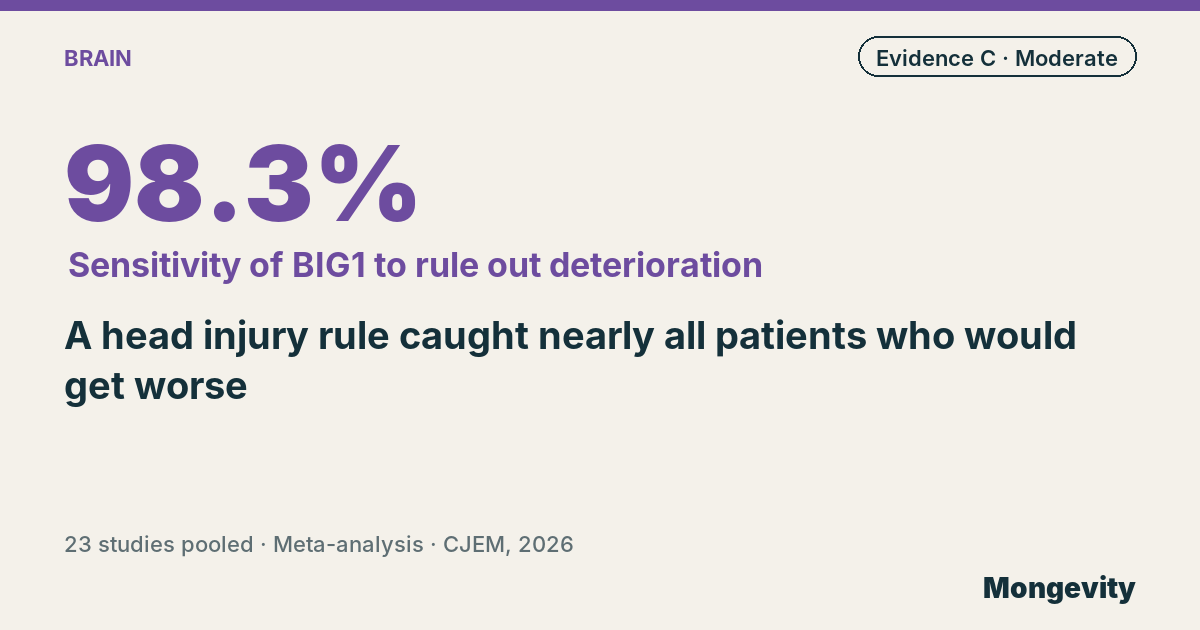
The Brain Injury Guidelines ruled out deterioration, surgery and death in mild head injuries with a sensitivity of 98.2% to 98.7%, but low specificity, according to a meta-analysis published in October 2026 in CJEM. The rule helps sort which head injuries need a specialist.
When someone hits their head and a scan shows a small bleed or fracture, hospitals often call a neurosurgeon, repeat the scan and sometimes transfer the patient to a bigger center. Many of these patients do fine. The Brain Injury Guidelines (BIG) sort them into categories to decide who needs that and who can safely go home.
What did the study look at?
Researchers searched seven databases up to October 2025 and screened thousands of studies. They identified 47 articles, of which 23 studied the original BIG and could be combined. They looked at the mildest category, BIG1, and how well it ruled out three outcomes: neurological deterioration, need for neurosurgery and death.
What did the study find about head injuries?
- For neurological deterioration, BIG1 had a sensitivity of 98.3% and a specificity of 12.7%.
- For neurosurgical intervention, sensitivity was 98.7% and specificity 14.4%.
- For death, sensitivity was 98.2% and specificity 12.8%.
- High sensitivity means BIG1 rarely misses a patient who will get worse; low specificity means many patients flagged are not at risk.
Why does this matter?
Head injuries in older adults, often from falls, are rising. A reliable rule can avoid unnecessary transfers, repeat scans and consultations, saving time and resources and sparing patients long hospital stays, without putting them at risk.
How solid is this evidence?
It’s moderate. Mongevity rates it C on our A-to-E scale: a meta-analysis of studies that were mostly observational, with risk of bias assessed. Limits: the studies differed in design and populations, specificity estimates were very imprecise, and there were too few data on newer versions of the rule.
What are the open questions?
Newer versions of BIG might improve specificity, and studies in different hospitals and in older adults on blood thinners are needed.
What does this mean for you?
After a hit to the head, seek care if there is loss of consciousness, vomiting, a worsening headache, confusion, or if the person takes blood thinners. If doctors send you home after a scan, follow the warning signs they give you and return if anything changes.
How do I explain this at dinner?
Doctors have a checklist to decide which patients with a small brain bleed after a knock on the head can go home. Pooling studies, it caught almost every patient who would get worse, though it also flagged many who were fine. A good question for the table: do you know the warning signs after a head bump?
In one sentence: the Brain Injury Guidelines are highly sensitive for ruling out deterioration, surgery and death in mild traumatic brain injury, but their specificity is low.
Questions and answers
- What are the Brain Injury Guidelines?
- A tool that sorts patients with head injuries and scan findings into categories to guide care.
- How sensitive is BIG1?
- Very: 98.3% for deterioration, 98.7% for neurosurgery and 98.2% for death.
- What is its weakness?
- Low specificity, about 12.7% to 14.4%, so many flagged patients are not at risk.
- Does it apply to me after a fall?
- It's a hospital tool; seek care if warning signs appear.