Exercise and fitness before colon cancer surgery didn’t cut complications overall
Exercise as medicinePart of a story we are following · 4 articles · See every update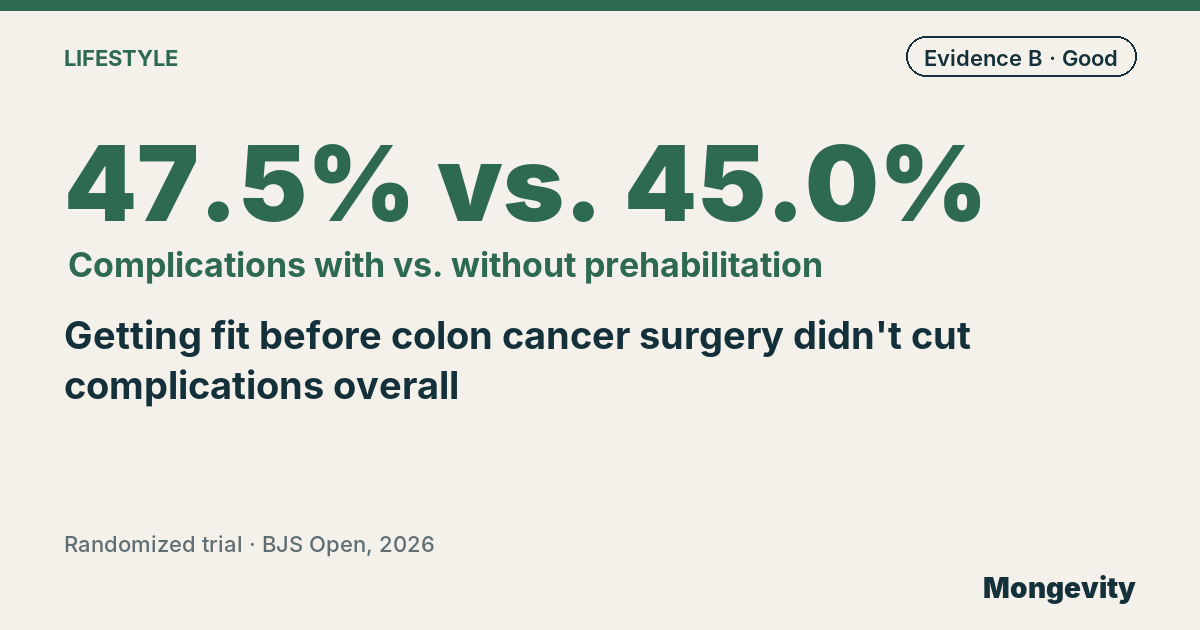
A multidisciplinary prehabilitation program, which includes exercise, before colorectal cancer surgery didn’t reduce complications, 47.5% vs. 45.0%, in a Swedish trial published in September 2026 in BJS Open. People with more disability seemed to benefit.
Surgery for colorectal cancer is a major operation, and complications are common even with modern recovery programs. Prehabilitation means preparing the body before surgery, with exercise, nutrition and other steps, so patients go into the operation stronger.
What did the trial test?
At a hospital in Stockholm, Sweden, between 2021 and 2025, 328 adults scheduled for colorectal cancer surgery were randomized to a multidisciplinary prehabilitation program or standard care, which already included enhanced recovery after surgery. Prehabilitation included a medicine review, nutrition counseling, supervised exercise and targeted risk optimization, starting within 3 days of enrollment. In total, 242 patients who had surgery were analyzed: 122 with prehabilitation and 120 with standard care.
What did the study find about exercise?
- Complications occurred in 47.5% with prehabilitation and 45.0% with standard care, not a significant difference.
- Severe complications occurred in 19.0% of patients overall and were numerically less frequent with prehabilitation, but the difference wasn’t significant.
- Hospital stay and reoperations were similar.
- The prehabilitation group lost less weight after surgery and had modest improvements in physical performance and reported physical function at 30 days.
- In exploratory analyses, patients with more disability before surgery had a greater reduction in severe complications with prehabilitation.
Why does this matter?
Prehabilitation is increasingly recommended, but this trial suggests it may not help everyone. Targeting it at patients who start out weaker might give the best value.
How solid is this evidence?
It’s good. Mongevity rates it B on our A-to-E scale: a randomized trial with a clear main result. Limits: it was at a single center, many randomized patients didn’t have surgery and weren’t analyzed, and the finding about patients with more disability is exploratory.
What are the open questions?
Trials focused on frailer patients are needed to confirm whether targeted prehabilitation reduces serious complications.
What does this mean for you?
If you or someone close to you is facing colorectal cancer surgery, staying as active as possible, eating well with enough protein, stopping smoking and limiting alcohol before the operation are sensible steps. If mobility is limited, ask whether a prehabilitation program is available.
How do I explain this at dinner?
Doctors tried getting people fitter before colon cancer surgery. Overall, it didn’t reduce complications, but people who started out weaker seemed to gain the most. A good question for the table: how would you prepare for a big operation?
In one sentence: prehabilitation before colorectal cancer surgery didn’t reduce complications overall, but people with more disability may benefit, which needs confirmation.
Questions and answers
- What is prehabilitation?
- Preparing the body before surgery with exercise, nutrition and other steps.
- Did it reduce complications?
- No: complications were 47.5% with prehabilitation vs. 45.0% with standard care.
- Who might benefit?
- In exploratory analyses, patients with more disability before surgery.