Older adults who exercised or became active were more emotionally resilient
Exercise as medicinePart of a story we are following · 4 articles · See every update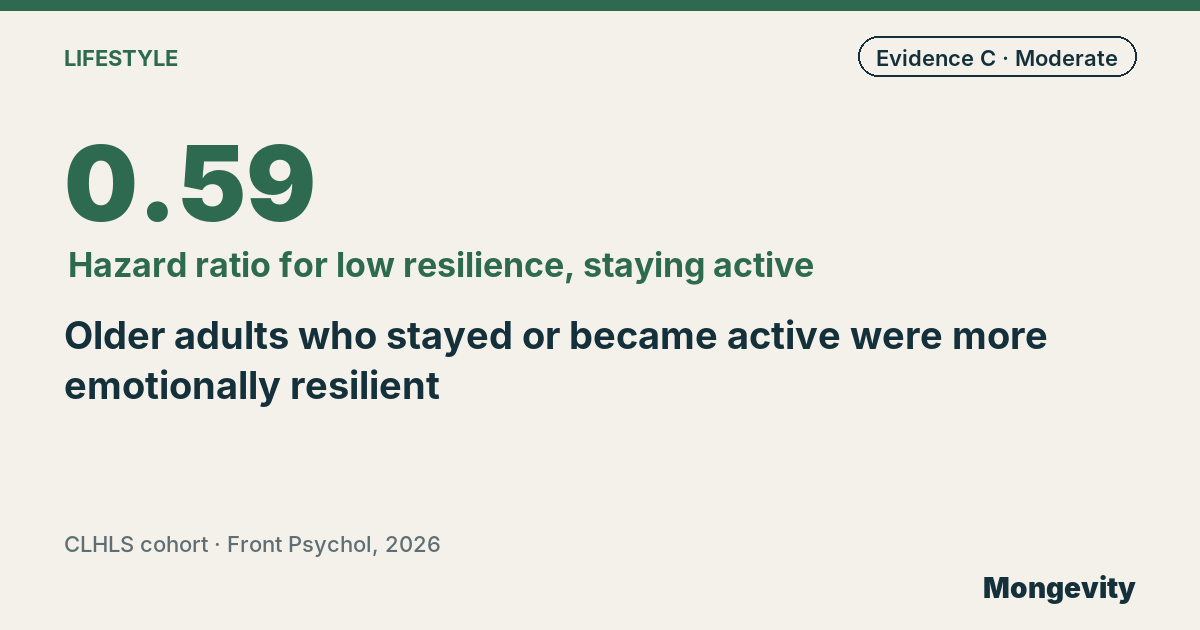
Older adults in China who became active or stayed active had a lower risk of low psychological resilience (hazard ratios 0.59 and 0.61), in an analysis of the Chinese Longitudinal Healthy Longevity Survey published Oct. 9, 2026, in Frontiers in Psychology. Exercise at any point in later life seemed to help.
Psychological resilience is the ability to cope with stress and bounce back from difficulties. It’s especially important in later life, when losses and health problems become more common. Exercise is known to help mood, but does it build resilience over time?
What did the study do?
Researchers used two waves, 2011 and 2014, of the Chinese Longitudinal Healthy Longevity Survey. They grouped older adults by how their physical activity changed: consistently inactive, active to inactive, inactive to active, and consistently active. Resilience was measured with a five-item scale and classified as high or low. They adjusted for social, lifestyle and health factors.
What did the study find about exercise?
At one point in time, compared with people who stayed inactive:
| Group | Odds of low resilience |
|---|---|
| Became active | 0.59 |
| Stayed active | 0.61 |
| Became inactive | 0.94 (not significant) |
Over time, compared with staying inactive, the risk of developing low resilience was lower for those who became inactive (hazard ratio 0.73), those who became active (0.72) and those who stayed active (0.59).
Why does this matter?
The key message is that current activity seemed to matter, regardless of past habits. It’s never too late: older adults who started moving had similar benefits to those who had always been active.
How solid is this evidence?
It’s moderate. Mongevity rates it C on our A-to-E scale: a large national survey with a longitudinal analysis, but observational. Activity and resilience were self-reported, and people who are more resilient may also find it easier to stay active.
What are the open questions?
Trials are needed to test whether starting exercise programs in later life builds resilience, and what types and amounts help most.
What does this mean for you?
If you or an older relative have been inactive, starting now still counts. Choose something enjoyable and sustainable, such as walking with a friend, tai chi, dancing, gardening or a gentle exercise class. Social activities that involve movement may give a double benefit.
How do I explain this at dinner?
In a large study of older Chinese adults, those who were physically active coped better with life’s challenges, and people who only started being active later got a similar boost. A good question for the table: what activity helps you shake off a bad day?
In one sentence: in older adults, current physical activity, whether long-standing or new, was linked to greater psychological resilience over time.
Questions and answers
- What is psychological resilience?
- The ability to cope with stress and bounce back from difficulties.
- Is exercise linked to resilience?
- Yes: staying active was linked to lower risk of low resilience (hazard ratio 0.59).
- Is it too late to start?
- No: becoming active was linked to similar benefits (hazard ratio 0.72).