Magnesium pills showed small, uncertain effects on blood vessels and blood pressure
Supplements: what the evidence saysPart of a story we are following · 3 articles · See every update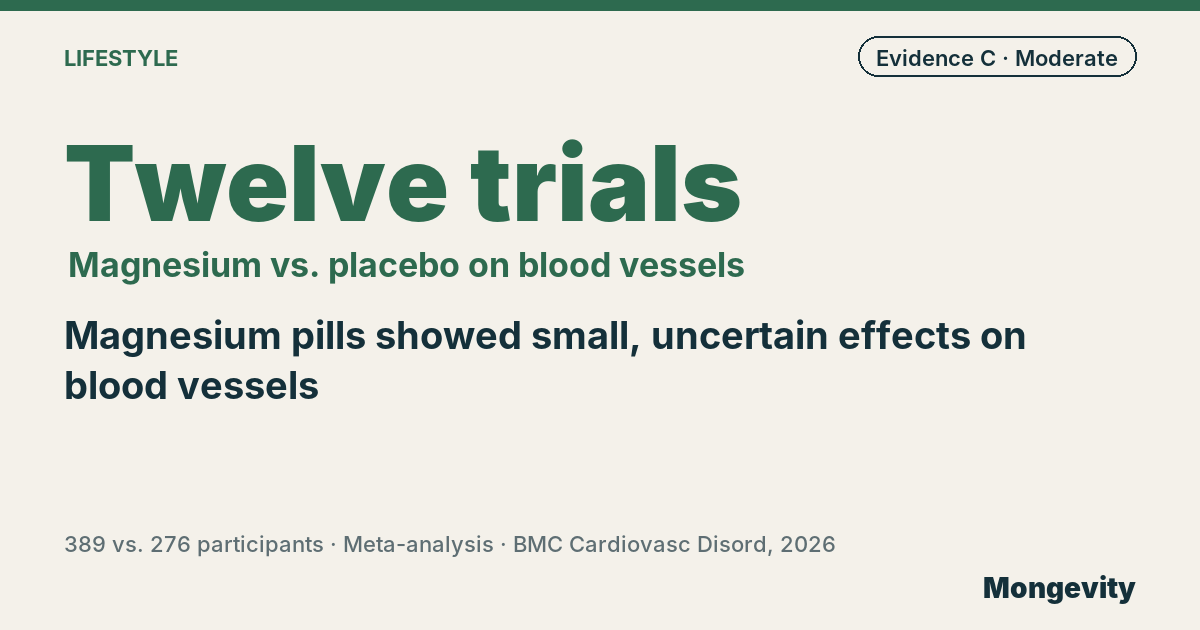
Magnesium supplements didn’t significantly improve blood vessel function overall or lower blood pressure in a meta-analysis of twelve placebo-controlled trials published Sept. 15, 2026, in BMC Cardiovascular Disorders, though doses above 400 mg a day showed a possible effect in 2 studies. Food remains a better source than supplements.
Magnesium is involved in hundreds of processes in the body, including how blood vessels relax. Magnesium supplements are popular for heart health, sleep and cramps.
What did the study look at?
Researchers searched five databases up to April 2026 for randomized, placebo-controlled trials of oral magnesium in adults. The main outcomes were flow-mediated dilation (how well an artery widens when blood flow increases, a marker of the inner lining’s health), pulse wave velocity (a measure of arterial stiffness) and carotid intima-media thickness (the thickness of the neck artery wall). Twelve trials qualified, with 389 people taking magnesium and 276 placebo.
What did the study find about supplements?
- Overall, magnesium did not significantly improve flow-mediated dilation (mean difference 2.86, not significant).
- Doses above 400 mg per day did improve it (mean difference 8.32), but this came from only 2 studies.
- Carotid wall thickness decreased slightly (−0.08).
- Arterial stiffness did not change.
- Blood magnesium rose, but blood pressure reductions were not significant.
Why does this matter?
Supplements are often marketed as heart protectors. This review shows that, for magnesium, the evidence on arteries is limited and inconsistent. A possible effect at high doses deserves study, but it isn’t enough to recommend magnesium pills to protect the heart.
How solid is this evidence?
It’s limited. Mongevity rates it C on our A-to-E scale: a meta-analysis of placebo-controlled trials, but with few, small trials, inconsistent results and a high-dose finding based on just 2 studies. The authors themselves call for caution.
What are the open questions?
Large trials are needed to define whether magnesium helps arteries, at what dose and in whom, for example people with low magnesium levels.
What does this mean for you?
Get magnesium from food: leafy greens, legumes, nuts, seeds and whole grains. If you’re thinking about supplements, talk with your doctor first, especially if you have kidney disease or take other medicines, as high doses can cause side effects. Mongevity does not recommend specific brands or products.
How do I explain this at dinner?
Researchers pooled twelve trials of magnesium pills to see if they help blood vessels. Overall, they didn’t clearly improve how arteries work or lower blood pressure; a hint of benefit at high doses came from only two small studies. A good question for the table: which foods on our plate are rich in magnesium?
In one sentence: oral magnesium supplements did not significantly improve overall vascular function or blood pressure in twelve trials, with possible effects at higher doses that need confirmation.
Questions and answers
- Does magnesium improve blood vessel function?
- Not significantly overall in twelve trials.
- What about high doses?
- Doses above 400 mg per day improved it in 2 studies; this needs confirmation.
- Does it lower blood pressure?
- The reductions were not statistically significant.
- Should I take magnesium?
- Prefer food sources; talk with your doctor before supplements.