High-dose fish oil with a heart-healthy diet lowered a ceramide-based risk score
Supplements: what the evidence saysPart of a story we are following · 3 articles · See every update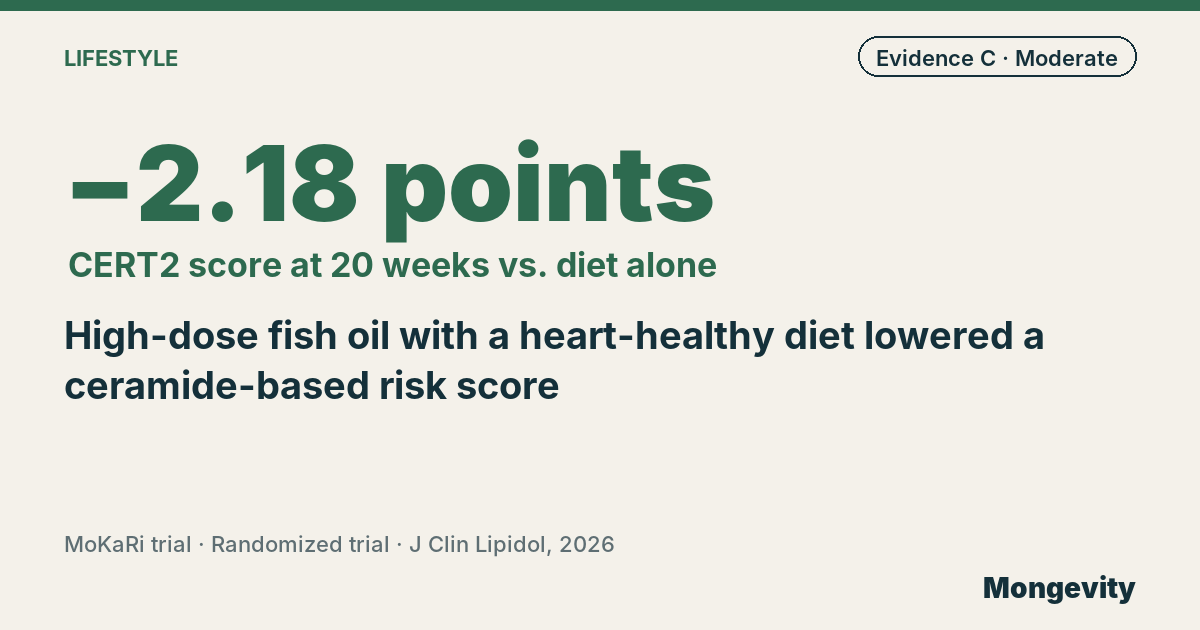
Adding 3 g per day of omega-3 fish oil to a heart-healthy menu plan lowered the CERT2 risk score by 2.18 points more than the diet alone at 20 weeks, in the MoKaRi trial of adults with high LDL cholesterol published in September 2026 in Journal of Clinical Lipidology. Whether that means fewer heart attacks is unknown, a caveat for fish oil supplements.
Ceramides are fat molecules in the blood that, together with phosphatidylcholines, form a risk score called CERT2. It predicts heart attacks and strokes beyond LDL cholesterol.
What did the trial test?
In the MoKaRi trial, adults aged 20 to 80 with LDL cholesterol of 3.0 mmol/L or higher and no cholesterol-lowering medicine were assigned by chance to personalized heart-healthy menu plans, or the same menus plus 3 g per day of EPA and DHA, the omega-3 fats in fish oil. The intervention lasted 20 weeks, followed by 20 weeks of follow-up. The change in CERT2 was an exploratory outcome.
What did the study find about supplements?
- The fish oil group lowered CERT2 more than the diet-only group: by 2.44 points at week 10 and 2.18 points at week 20.
- At 40 weeks, after the intervention ended, the difference was smaller but still significant (1.63 points).
- Only the fish oil group showed favorable changes in ceramide-phosphatidylcholine ratios.
Why does this matter?
It suggests that CERT2, a newer marker of heart risk, can be changed by nutrition, which could make it useful to track the effect of prevention strategies beyond LDL cholesterol.
How solid is this evidence?
It’s limited. Mongevity rates it C on our A-to-E scale: a randomized trial, but CERT2 was an exploratory outcome and a biomarker, not heart attacks or strokes. Limits: the abstract doesn’t give the number of participants, the dose was high, and participants knew whether they took fish oil.
What are the open questions?
It remains unknown whether lowering CERT2 with fish oil prevents heart events. Large trials of omega-3 supplements on heart outcomes have given mixed results, and high doses have been linked to atrial fibrillation in some trials.
What does this mean for you?
Eating fatty fish such as salmon, sardines or mackerel twice a week is a well-supported part of a heart-healthy diet. High-dose fish oil supplements should only be taken with medical advice. Mongevity does not recommend specific brands or products.
How do I explain this at dinner?
People with high cholesterol followed a heart-healthy menu, and some also took fish oil. Those with fish oil saw a bigger drop in a new blood test that predicts heart risk from fat molecules called ceramides. Whether that means fewer heart attacks is still unknown. A good question for the table: how often do we eat oily fish?
In one sentence: in adults at increased cardiometabolic risk, high-dose EPA plus DHA within a heart-healthy diet lowered the CERT2 ceramide risk score more than the diet alone.
Questions and answers
- What is CERT2?
- A risk score based on ceramides and phosphatidylcholines in blood that predicts heart events beyond LDL.
- Did fish oil lower it?
- Yes: 2.18 points more than diet alone at 20 weeks.
- Does it prevent heart attacks?
- Not shown; the trial measured a biomarker.
- Should I take fish oil?
- Prefer oily fish in your diet; take high-dose supplements only with medical advice.