Age times LDL: a simple cholesterol ‘dose’ score flagged higher risk after a heart attack
CholesterolPart of a story we are following · 3 articles · See every update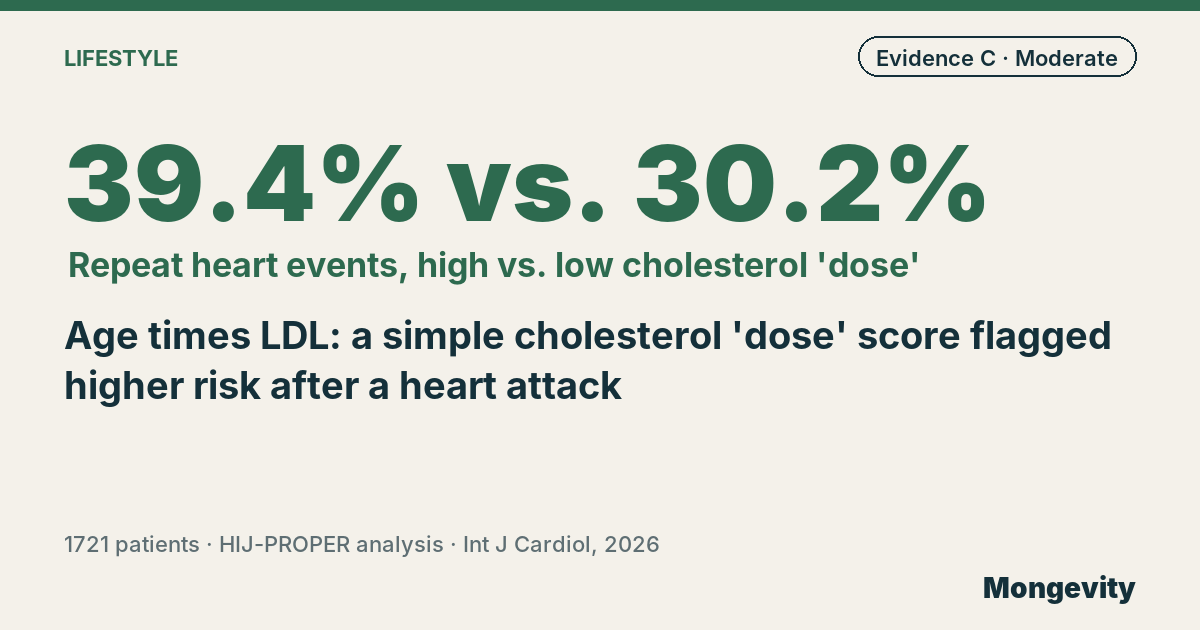
Patients in Japan whose age times LDL cholesterol was above the median had more repeat heart events after an acute coronary syndrome, 39.4% vs. 30.2%, in an analysis of 1721 patients published in September 2026 in International Journal of Cardiology. The simple score reflects lifetime exposure to cholesterol.
The damage cholesterol does to arteries builds up over time: what matters is not only how high LDL is today, but for how many years it has been high. Measuring that history is hard, because few people have decades of blood tests. A simple shortcut is to multiply age by a single LDL value.
What did the study look at?
The data came from the HIJ-PROPER trial in Japan, which enrolled 1734 patients with acute coronary syndrome. Researchers calculated the estimated cumulative LDL exposure for 1721 of them using their age and the LDL measured at the time of the event. They split patients at the median, 8643 mg/dL-years, and followed them for death, heart attack, stroke, unstable angina and procedures to reopen arteries.
What did the study find about cholesterol?
- The combined outcome occurred in 39.4% of patients with high exposure and 30.2% with low exposure.
- High exposure was linked to higher risk (hazard ratio 1.37), even after adjusting for other factors.
- Risk rose step by step across quarters of exposure.
- The strongest threshold was around 8000 mg/dL-years.
- The score did not predict better than using age and LDL separately.
Why does this matter?
The idea of cholesterol “dose” over a lifetime explains why lowering LDL early and keeping it low matters. A simple score that anyone can calculate could help communicate risk to patients and support stronger cholesterol treatment after a heart event.
How solid is this evidence?
It’s moderate. Mongevity rates it C on our A-to-E scale: an observational analysis within a randomized trial. Limits: the estimate assumes LDL was the same all life, which is rarely true; it didn’t improve prediction beyond age and LDL; and patients were Japanese, so thresholds may differ elsewhere.
What are the open questions?
It’s unclear whether using this score to guide treatment improves outcomes, and how to account for years of treated or untreated cholesterol.
What does this mean for you?
Know your LDL cholesterol and discuss your target with your doctor. The earlier in life LDL is kept low, the less damage builds up. After a heart attack, intensive cholesterol lowering is one of the most effective ways to prevent another.
How do I explain this at dinner?
Doctors multiplied people’s age by their bad cholesterol to estimate how much cholesterol their arteries had faced over the years. After a heart attack, those with a higher “dose” had more new heart problems. A good question for the table: when did you first check your cholesterol?
In one sentence: after acute coronary syndrome, a high estimated cumulative LDL exposure (age times LDL) was linked to more recurrent cardiovascular events, though it didn’t improve prediction beyond its parts.
Questions and answers
- What is cumulative LDL exposure?
- An estimate of how much LDL cholesterol the arteries have faced over time; here, age times one LDL value.
- Did it predict new heart events?
- Yes: 39.4% vs. 30.2% above vs. below the median (hazard ratio 1.37).
- Is it better than age and LDL alone?
- No; it didn't improve prediction beyond them.
- What should I do?
- Know your LDL, discuss your target and keep it low over time.