A map of 3.5 million immune cells shows how small DNA differences shape disease risk
How the immune system worksPart of a story we are following · 3 articles · See every update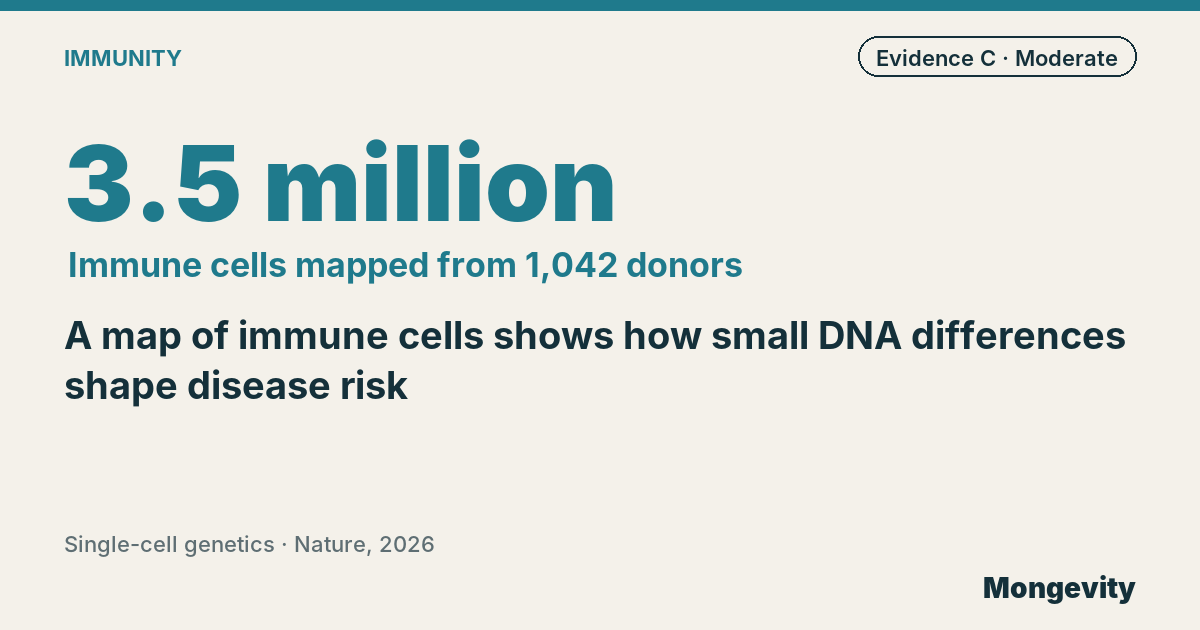
Mapping 3.5 million blood immune cells from 1,042 people showed how DNA variants change which genes can be switched on in each cell type, in a study published Oct. 28, 2026, in Nature. It helps explain how the immune system shapes genetic risk for many diseases.
Large genetic studies have found thousands of small DNA differences linked to diseases such as inflammatory bowel disease or rheumatoid arthritis. But most sit outside genes, in regions that act like switches, and it’s often unclear which switch they affect and in which cell.
What did the study do?
Researchers studied 3.5 million immune cells from the blood of 1,042 donors whose full genomes had been sequenced. With a technique that measures chromatin accessibility, how open each stretch of DNA is and therefore how ready it is to be used, they looked at 28 immune cell types one cell at a time. Then they linked DNA variants to changes in that openness.
What did the study find about the immune system?
- Many variants changed how open DNA was, and 60% of these effects were specific to one cell type.
- Across genetic studies of 16 diseases and 44 blood traits, these chromatin effects explained 4.5-22.6% more disease signals than gene activity data alone.
- Taking cell type, tissue and other factors into account raised the match between disease genetics and gene activity from ≈16% to ≈65%.
- The state of a cell also mattered: some variant effects appeared only when cells were activated.
- At ADCY7, a risk gene for inflammatory bowel disease, the effect of the variant changed with the activity of a signaling pathway in CD4+ T cells.
Why does this matter?
To turn genetic findings into treatments, scientists need to know which gene, in which cell and in which situation, a risk variant acts on. This map narrows that search for many immune-related diseases and blood traits, and it’s a resource other researchers can use.
How solid is this evidence?
It’s moderate for patients. Mongevity rates it C on our A-to-E scale: a very large, high-quality human genetics resource, but it’s basic science. It explains mechanisms and doesn’t test any treatment or prediction tool.
What does this mean for you?
Nothing changes in daily care. Genetic risk is only part of the picture for most immune diseases, and lifestyle, infections and environment matter too. If several relatives have the same autoimmune disease, mention it to your doctor; family history is still one of the most useful tools.
How do I explain this at dinner?
Our DNA has millions of tiny differences, and some raise the risk of diseases. Scientists mapped millions of immune cells to see which switches those differences flip, and in which cells. It’s like finding which light switch in a big building controls which room. A good question for the table: what runs in your family?
In one sentence: a map of 3.5 million immune cells showed that DNA variants act on gene switches in specific cell types and states, helping explain genetic risk for immune diseases.
Questions and answers
- What is chromatin accessibility?
- How open a stretch of DNA is, which shows whether nearby genes are ready to be switched on.
- What did the map show?
- Many DNA variants change these switches, and 60% of the effects were specific to one immune cell type.
- Can I get tested for this?
- No: it's a research resource, not a clinical test.